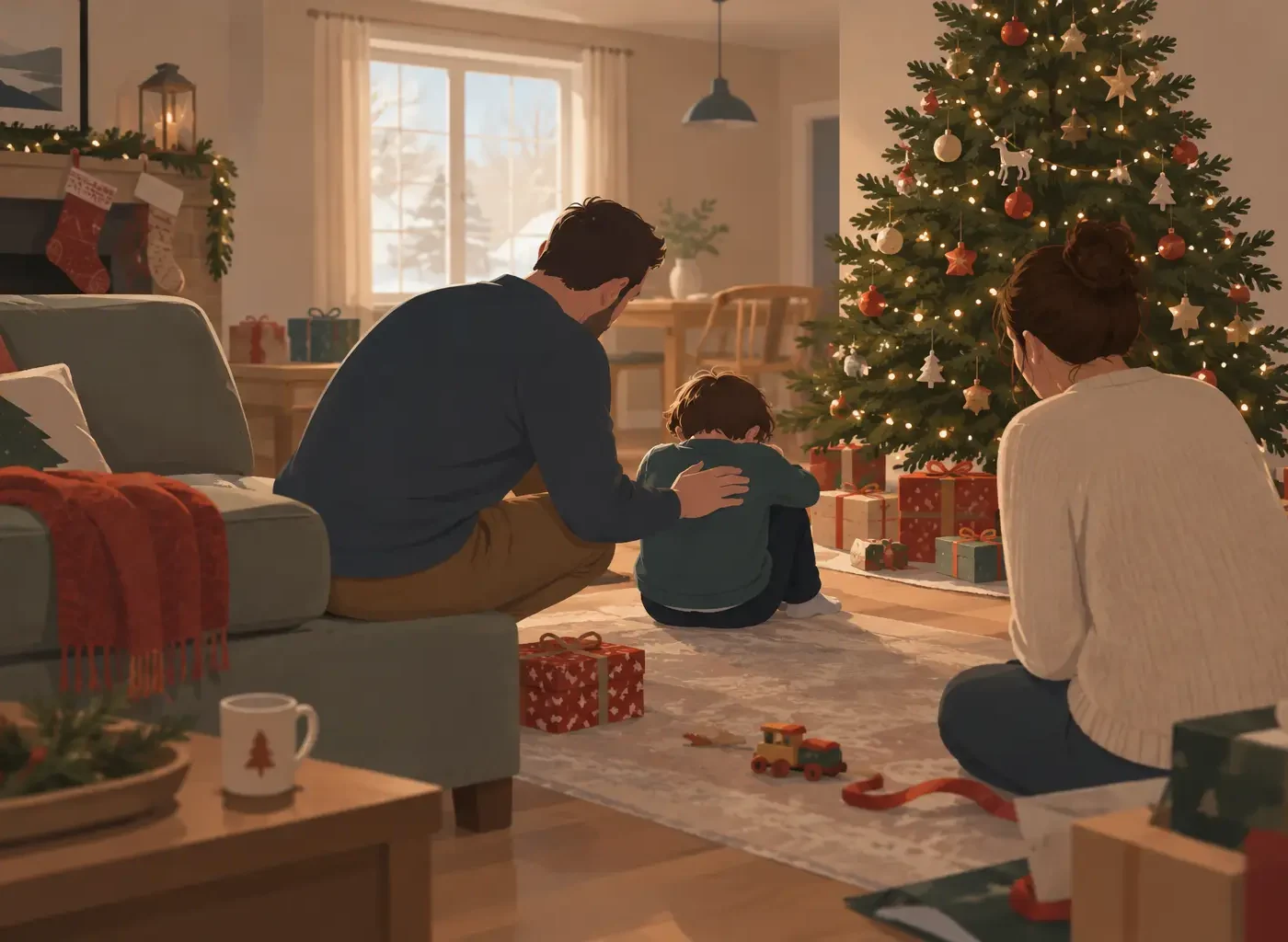
By 10:30 on Christmas morning, the living room can look like a toy store after a tornado, breakfast is barely touched, a relative wants a photo, and your child is crying because the wrapping paper tore the wrong way. If you are searching for why kids melt down at Christmas and what to do, you are not looking for a perfect holiday. You are trying to get through a very big day with the people you love.
A Christmas meltdown is not proof that your child is ungrateful or that you got the day wrong. It is often what happens when excitement, noise, waiting, unfamiliar plans, sugar, company, and missed rest all land on a child at once. The most useful response starts before the hard moment, then gets very simple when it arrives.
Table of Contents
Lower the load before you lower your expectations
Your child does not need a more magical Christmas. They may need a less demanding one.
Adults can feel excited and tired at the same time, then push through because we understand the plan and can see the finish line. Kids have less room for that. The buildup begins well before December 25: school events, decorations, disrupted evenings, visitors, shopping trips, and adults who are busy in ways children can feel even if nobody says it aloud.
Choose one or two parts of the day to protect rather than trying to protect everything. Maybe presents happen after breakfast, not at dawn. Maybe you open fewer gifts at a time. Maybe you leave the big family gathering earlier than usual, even if someone is disappointed. These choices can feel small, but they reduce the number of transitions your child has to handle. Psychologists at the Child Mind Institute recommend the same kind of planning ahead to prevent holiday meltdowns, from keeping bedtimes close to normal to deciding in advance when you will leave a gathering.
Make the plan visible and plain
Tell your child what will happen in the order it will happen, especially if relatives are coming over or you are traveling. Keep it short: “We will open these gifts, eat breakfast, get dressed, then go to Grandma’s. We will stay until after lunch.”
For younger children, repeat the plan when the next part is close. For older kids, give them a little useful information ahead of time, such as where they can take a break or how long the visit is likely to last. Knowing the plan does not remove every hard feeling, but surprises are easier when the rest of the day feels predictable.
It also helps to build in a quiet pocket that is not framed as a punishment. A child can play in a bedroom, sit with you in a quieter room, read, draw, or simply step away from the crowd. The goal is not to make them perform cheerfulness. It is to give their system less to manage.
When the meltdown starts, make the moment smaller
In the middle of a meltdown, connection and safety matter more than teaching a lesson.
Your child may be yelling because a gift is not what they hoped for, refusing to put on shoes, or sobbing over something that seems tiny. The trigger may be real, but it is rarely the whole story. This is not the moment to explain gratitude, insist they use a polite voice, or ask them to tell you exactly what is wrong.
Move closer if your child accepts that. Lower your own voice. Use fewer words than you think you need: “This is a lot. I am here. We are going somewhere quieter.” If they do not want touch, stay nearby without crowding them. If you are at someone else’s house, it is okay to take your child to the car, a porch, or an empty room for a few minutes.
Let the audience go without you
Christmas meltdowns get harder when adults feel watched. You may worry that your parents, siblings, in-laws, or friends think your child is spoiled. That pressure can make you talk too much or become sharper than you mean to be.
Give yourself a simple line and repeat it if needed: “He is overwhelmed. We are taking a break.” You do not owe a longer explanation. A supportive partner can be especially helpful here by handling the plates, the conversation, or the other children while you step away. That is not leaving one person with the problem. It is dividing the moment according to who can do what right then.
If your child is throwing objects or hurting someone, calmly block the behavior and create space. You can say, “I will not let you throw that at people. We are moving away from the gifts for now.” Be steady without making the moment bigger. The conversation about repair can wait until everyone has more room inside themselves.
Why kids melt down at Christmas
A hard reaction is often a sign of overload, not a verdict on your child or your holiday.
Christmas asks children to manage several opposing feelings at once. They are thrilled, but they have to wait. They enjoy attention, but too much attention can feel intense. They want the special food and gifts, but they may also miss their usual rhythms and familiar space.
There is also the gap between the Christmas a child pictured and the real one. A preschooler may have imagined opening every present immediately. A 10-year-old may be disappointed by one gift but embarrassed to show it. A teenager may feel pulled between family plans and friends. None of those feelings make them selfish. They make them human, and Christmas gives them very little ordinary time to work through them.
Adults carry their own hopes too. You may have spent hours choosing gifts, cleaning, cooking, organizing travel, or making sure everyone has what they need. When a child falls apart, it can hit that tender place: “After all this, why can’t they just enjoy it?” That thought is understandable. It just tends to make the next response harder.
One thing that worked for us was treating the hours after gift opening as deliberately boring. We put away the extra packaging, chose one toy to set up, and stopped asking the kids to move on to the next exciting thing. The day did not look like a holiday commercial. It felt calmer.
Plan for the pressure points, not the perfect schedule
A flexible plan is not giving up on Christmas. It is making room for your actual family.
Look ahead at the parts of the day most likely to stretch your child: waiting to open gifts, sharing new toys, getting dressed for photos, a long drive, a crowded meal, or saying goodbye when they are already tired. Pick a response before you are standing in the middle of it.
For presents, consider opening them in small groups instead of all at once. This gives your child time to see what they have and reduces the frantic rush to the next package. If siblings are involved, you can put aside a couple of gifts for later, not as leverage, but because more is not always better in one morning.
For travel or visiting, bring a familiar activity and give your child a job that is genuinely optional. They might help carry napkins, choose a song in the car, or show a grandparent a new game. Some children want to join in. Others need permission to observe first.
You can also agree with your partner on a quiet exit signal before the day begins. It might mean, “I need you to take over with the relatives,” or, “We should leave in ten minutes.” This matters because the parent who has been tracking gift bags, food, spare clothes, and everyone’s mood may be running on fumes by midday. A quick check-in can prevent resentment from becoming part of the holiday.
Come back to the relationship after the storm
The repair after a rough moment teaches more than a perfectly behaved Christmas ever could.
Later, when your child is settled, you can name what happened without turning it into a lecture. Try: “You really wanted to keep opening gifts, and it was hard when we stopped. You cried and threw the box. Next time, I will help you take a break before it gets that big. We still cannot throw things.”
Keep your part honest too. If you raised your voice, say so plainly: “I was stressed, and I spoke too loudly. I am sorry.” You are not handing your child the job of making you feel better. You are showing them that people can make mistakes, repair, and stay connected.
For the hardest moments of the season, these go deeper: how to help your child calm down without shame and staying calm when your child says I hate you.
If you want the whole framework, from toddlers to teens, read positive parenting: the complete guide by age.
Frequently Asked Questions About Why Kids Melt Down at Christmas
Why do kids melt down on Christmas Day specifically?
Christmas stacks a lot onto one day: early waking, sugar, waiting, noise, new people, and a big gap between what a child imagined and what actually happens. Any one of those might be manageable. Together they overload a young nervous system, so a tiny trigger like torn wrapping paper can tip everything over.
Is it normal for kids to be ungrateful after opening presents?
What looks like ingratitude is usually overwhelm or disappointment a child cannot hide yet. A five-year-old who sulks after opening gifts is rarely spoiled. They are tired and full of feelings. Gratitude is better taught on a calm day in January than in the middle of a Christmas morning crash.
How do I stop a Christmas meltdown at a relative’s house?
You often cannot stop it, but you can shrink it. Move your child somewhere quieter, like a bedroom, porch, or the car, and use very few words. Tell relatives simply, “She is overwhelmed, we are taking a break.” Most meltdowns pass faster with fewer people watching and less talking.
Should I take away presents if my child has a meltdown?
Usually not. Taking gifts away in the moment tends to make an overloaded child more upset and turns the day into a power struggle. If a toy is being thrown or used to hurt someone, set it aside calmly for now. Save any bigger conversation for later, once your child is regulated again.
How can I make Christmas calmer for a sensitive child?
Plan a smaller version of the day. Open gifts in a few rounds, keep meals and naps close to normal, choose one gathering instead of three, and give your child a known quiet spot. Tell them the plan in order beforehand. Sensitive kids cope far better when the day has shape and exits.
Final Thoughts
Understanding why kids melt down at Christmas takes some of the sting out of it. It is rarely about the gift or the wrapping paper. It is about a small person carrying a very big day.
Let Christmas be imperfect. The photos may show one cheerful minute, not the crying that happened before it. The real win is not getting a flawless day. It is helping your child feel held through a hard one, and helping yourself believe that a hard moment did not ruin everything.
If you are the parent who usually stays with the relatives while someone else carries the crying child to the car, this might be the year you swap. Kids remember who came to find them.
How to Be a Better Dad is a practical guide to being the calm one in the hard moments, from Christmas morning to an ordinary Tuesday, written by a mom of two who has done her share of porch breaks on holidays.