If you’ve ever stood in your kitchen while your child screamed over the wrong color cup, or watched a birthday party dissolve into a full meltdown on the drive home, you already know how hard it is to help your child calm down in those moments. It’s loud. It’s draining. And when you’re running on four hours of sleep and a cold cup of coffee, staying calm yourself can feel genuinely impossible.
The good news is that you don’t have to have it all figured out. Most of us are doing this in real time, improvising, learning what works for our specific kid with their specific wiring. There’s no single script that works for every child every time. But there are some approaches that consistently make things easier, and none of them involve shame or punishment.
In this post we’re going to look at why kids struggle to calm down in the first place, what actually helps in the middle of a meltdown, and how you can build habits that make the hard moments a little less frequent over time.
Table of Contents: Help Your Child Calm Down
Why Kids Struggle With Big Emotions
Before we get into what to do, it helps to understand what’s actually happening. Big emotions in kids aren’t defiance, manipulation, or attention-seeking, even when they feel that way. A child in meltdown mode has genuinely lost access to the part of their brain that can reason, listen, or respond to logic.
Think of it like a smoke alarm going off in a kitchen. You don’t stand in front of the alarm and explain why it should stop beeping. You deal with whatever triggered it first. Kids’ brains work the same way. When the emotional part of the brain is flooded, the thinking part goes offline. That’s biology, not bad behavior.
This is especially true for kids who are tired, hungry, overstimulated, or going through something hard at school or socially. Their threshold for what sets off that alarm is just lower. Knowing this doesn’t make it less exhausting, but it does change how we respond. And that shift in response is where everything starts to move.
What Co-Regulation Strategies Actually Look Like
The term “co-regulation” sounds clinical, but it just means that kids borrow our calm when they can’t find their own. Co-regulation strategies are the things we do, consciously or not, that help a child’s nervous system come down from a state of overwhelm.
The most powerful one? Your own body. When you slow your breathing, lower your voice, and soften your face, you’re sending a signal to your child’s nervous system that the danger has passed. It doesn’t always work immediately, especially with kids who are further into a meltdown. But it works more often than anything else.
Some practical co-regulation strategies that tend to help:
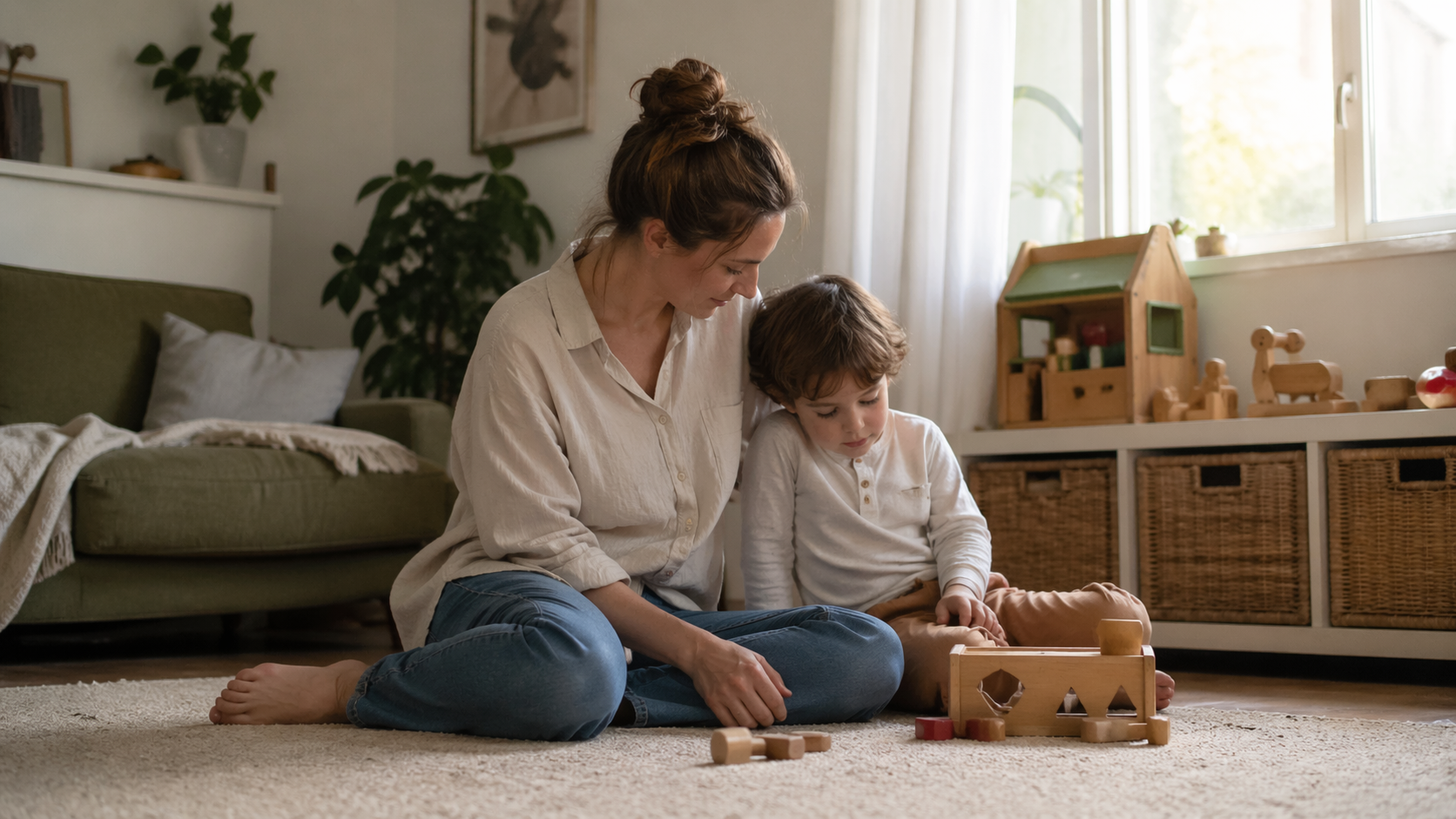
Sitting near them without demanding eye contact or explanation. Just being physically present at their level, on the floor, crouched down, close but not crowding.
Matching their breathing. Breathe slowly and audibly. Some kids will start to mirror you without realizing it.
Offering touch if they want it. A hand on the back, a quiet hug, sitting shoulder to shoulder. Some kids need space instead, so following their lead matters here.
Narrating without judgment. Something like “you’re really upset right now” rather than “you need to calm down.” One describes what you see. The other puts pressure on a child who literally cannot comply yet.
None of these require you to be serene or pretend the moment isn’t hard. You can be stressed and still choose to slow down. That’s not performing calm. That’s practicing it.
Gentle Discipline Techniques That Keep Connection Intact
Here’s what gentle discipline techniques are not: giving in to everything, ignoring behavior, or pretending limits don’t exist. Gentle discipline is about holding the limit and staying connected. Those two things can live in the same moment.
When a child hits, throws something, or says something unkind, the behavior still needs addressing. But the timing matters. In the middle of a meltdown is not the time for a lesson. That conversation can happen later, when the storm has passed and the thinking brain is back online.
During the moment, what tends to help is:
Naming the limit simply. “I won’t let you hit. I’m going to hold your arms so we’re both safe.” Not a lecture, just a fact.
Staying close. Sending a child away to calm down alone, especially younger kids, can feel like abandonment rather than support. Some older kids do want and need space, and that’s worth knowing about your own child.
Skipping the why for now. “Why did you do that?” is an impossible question mid-meltdown. Save it.
After things have settled, that’s when gentle discipline techniques come into their own. A calm, curious conversation. “That got really big earlier. What do you think happened?” You’ll often be surprised what kids can tell you when they feel safe and not cornered.
Building a Calm-Down Toolkit Together
One of the things that genuinely shifted things for us was doing this work before the hard moment, not in the middle of it. Emotional regulation for children improves when they have tools they’ve already practiced, not ones they’re being handed mid-meltdown.
Sit down together on a good day and talk about what helps. With younger kids you can make it concrete and visual, a small box or corner with a few things they chose. With older kids a simple conversation can work: “When things get really big, what actually helps you feel better?”
Some things kids often choose: a soft blanket or comfort object, a slow breathing exercise they’ve practiced (blowing up a pretend balloon, smelling a flower and blowing out a candle), something to squeeze or fidget with, a few favorite books or a drawing pad, a playlist of songs that feel calming.
The key is that they chose it. Ownership matters. A “calm-down kit” that a parent assembled and handed over is less powerful than one a child helped build. And when you can reference it in the moment, “do you want to grab your box?”, you’re offering a bridge rather than a demand.
This is also where emotional regulation for children starts to grow longer legs. The more times a child experiences finding their way back to calm, with support, the more that pathway gets strengthened. They’re building something real.
Help Your Child Calm Down: When You’re Losing It Too
This part doesn’t get talked about enough. Helping your child calm down is genuinely hard when you’re also dysregulated. And that happens to every parent. Not occasionally. Regularly.
It is not failing. It’s being a person who is also carrying things.
If you feel yourself escalating, there are a few things that can interrupt the spiral. Dropping your voice instead of raising it, even if it feels strange. Taking one long exhale before you speak. Physically moving to a slightly different spot in the room. Even just buying yourself three seconds before you respond.
And sometimes, when kids are old enough to be safe, it’s okay to say “I need a minute too. I’m going to stand in the hallway and take some breaths and then I’ll come back.” You’re modeling exactly what you want them to learn. That strong feelings don’t have to run the show. That we can pause.
If you find yourself reacting in ways you regret regularly, that’s worth being curious about. Not self-punishing, just curious. What’s driving that? Sleep, stress, your own history? There’s no shame in any of it, and getting support for yourself is one of the most direct things you can do for your kids.
After the Storm: Repair Without Shame

Once things have settled, the repair conversation is where so much good work happens. This is also where a lot of parents accidentally tip into shame, usually without meaning to.
Shame sounds like: “I can’t believe you behaved like that.” “What is wrong with you?” “You ruined the whole afternoon.” Shame makes a child feel that they are bad, rather than that they did something we need to talk about.
Repair without shame sounds different. It’s curious, not accusatory. It acknowledges their experience before addressing the behavior. It looks for understanding before it looks for consequences.
“That was a really hard moment for both of us. I love you and I’m not angry anymore. Can we talk about what happened?”
Sometimes kids need a bit of time even after the meltdown before they’re ready to talk. That’s okay. The conversation doesn’t have to happen immediately.
And repair goes both ways. If you lost your cool, naming that to your child, “I raised my voice and I didn’t want to do that, I’m sorry”, does something powerful. It shows them that mistakes are repairable. That relationships don’t break when things get hard. That’s a lesson worth ten calm-down corner setups.
Final Thoughts
Learning to help your child calm down without shame or punishment is one of those things that takes practice, repetition, and a lot of grace toward yourself. There will be moments you handle beautifully and moments you wish you could take back. Both are part of it.
What tends to matter most isn’t the perfect response in the hardest moment. It’s the overall pattern of connection your child experiences with you. Do they know you’re on their side even when you’re frustrated? Do they trust that the storm will pass and you’ll still be there? That’s the foundation everything else is built on.
Start small. Try one thing. Notice what shifts. And if today was hard, tomorrow is another chance to try again.
READY FOR MORE SUPPORT?
If this resonated, the Family Life Lab Weekly newsletter is where we share honest, practical ideas for navigating parenting without burning out or losing yourself. Real talk, no perfect parenting pretense. Come join us.
And if you enjoy practical parenting ideas like these, feel free to follow me on X, where I regularly share simple tips on raising confident kids, creating a peaceful home, and supporting your children’s emotional growth.