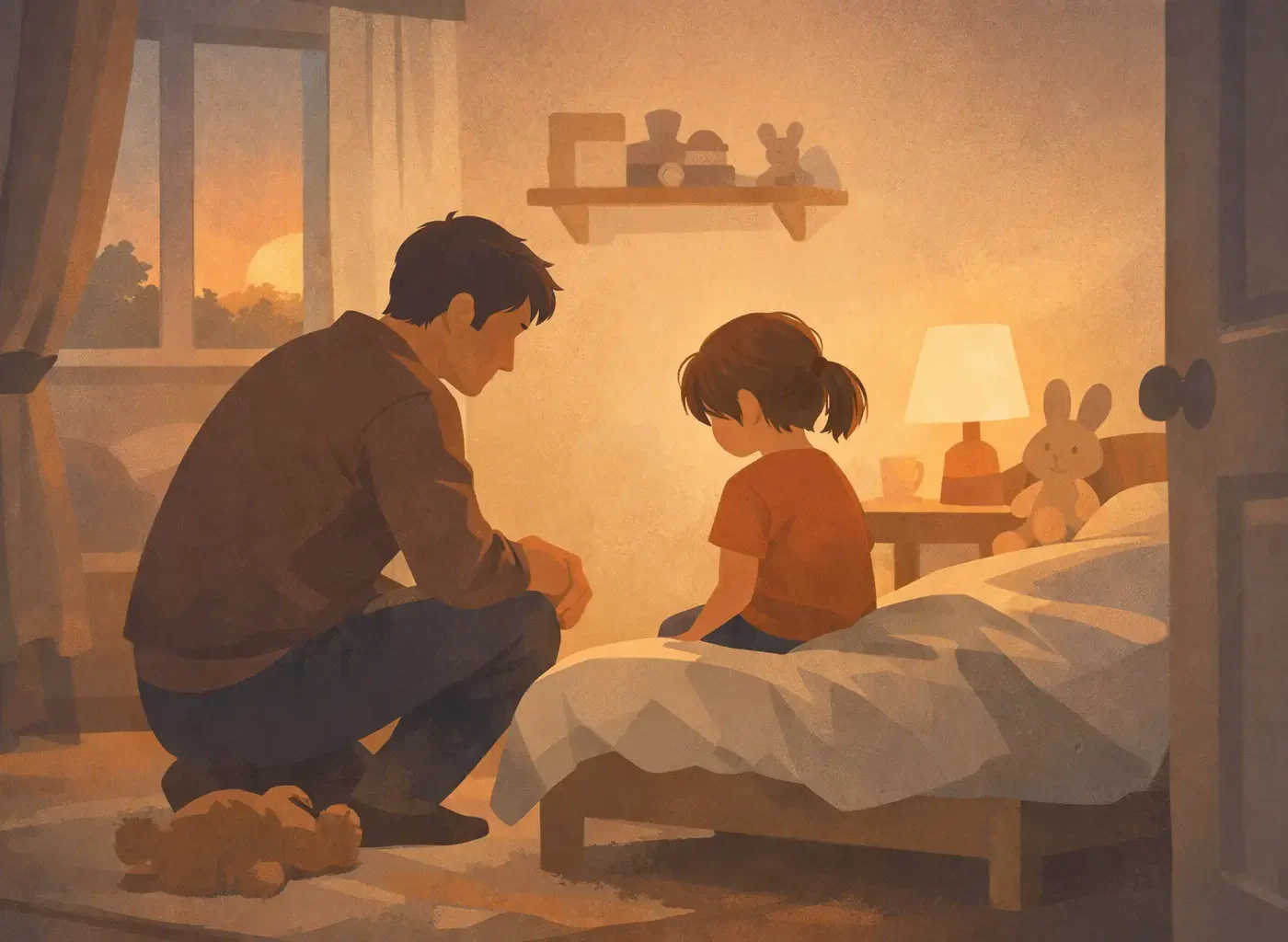
The words often catch in your throat after a hard moment. Maybe you snapped during the scramble to get out the door. Maybe you raised your voice after repeating yourself for the fifth time. Learning how to apologize to your child does not mean you have to become endlessly calm. It means you can repair the moment after you missed the mark.
Children do not need a parent who never gets frustrated. They need to see that frustration does not give anyone permission to be hurtful, and that relationships can be made steadier after a rupture. A simple apology can do more than a long speech when everyone is tired.
How to apologize to your child in the moment
Start by getting low, slowing your voice, and naming your own behavior plainly. You might say, “I yelled at you when you spilled the cereal. That was not okay. I am sorry. You did not deserve to be yelled at.”
Then stop. Let those words have some space. Your child may look away, keep playing, cry harder, or say nothing at all. They do not need to respond in the right way for your apology to count.
A good apology is clear enough that your child does not have to guess what you mean.
Try not to add a defense at the end. “I am sorry I yelled, but you were not listening” asks your child to carry part of the responsibility for your choice. You can still deal with the spilled cereal, the missed shoe, or the rule that was broken. Just separate that issue from the apology.
For a younger child, keep it very short: “I shouted. That scared you. I am sorry. I will use a quieter voice.” With an older child, you can be a little more direct: “I was stressed about being late, and I took it out on you. That was unfair.”
Say what you will do differently next time
An apology feels safer when it includes a realistic plan, not a big promise you cannot keep. “I will never yell again” may come from a sincere place, but most parents know how hard that is to guarantee during a brutal week.
Instead, name one small action. “When I feel myself getting too loud, I am going to step into the kitchen, take a minute, and come back.” Or, “Next time I need you to move faster, I will tell you the plan before I start raising my voice.”
Repair is not perfection. It is showing your child that you are willing to take responsibility and try a different response.
This matters especially in the ordinary pressure points of family life. A child who will not put on shoes, a sibling argument in the backseat, homework spread across the counter while dinner is burning, these moments can push any parent past their best intentions. Your child does not need you to pretend those moments are easy. They need you to handle your part honestly afterward.
If your partner was there, a brief repair between adults can help too. “I was too sharp with both of you. I am sorry.” That is not a performance. It is a way of showing that respect applies across the family, including when the evening has gone sideways.
Keep the apology separate from discipline
You can apologize and still hold a limit. These two things are not opposites.
For example: “I should not have grabbed your backpack and shouted. I am sorry. You still need to put your tablet away before dinner.” The limit remains. Your behavior gets addressed too.
Your apology does not erase your role as the parent, and a family rule does not erase your child’s right to be treated with respect.
Sometimes adults avoid apologizing because they worry it will make their child dismissive or defiant. In practice, a straightforward apology is not handing your child control of the household. You are modeling how people own the impact of their actions while still handling responsibilities.
The hard part is resisting the urge to turn the apology into a lesson. After a tense moment, your child may already feel embarrassed, angry, or shut down. Save the teaching for later, when both of you are more able to hear it. First, repair the part that belongs to you.
When your child does not accept the apology
Your child might say, “I do not care,” or “You always do that.” Older children, especially, may have a sharp response ready when they are hurt. It can sting, particularly when you came to them trying to make things right.
Stay with the truth instead of arguing your case. “I hear that you are still mad. You do not have to talk right now. I am still sorry for yelling.” Then give them room.
An apology is an offer of repair, not a request for immediate forgiveness.
If your child says this happens a lot, take that seriously without collapsing into shame. You can say, “You are right that I have been raising my voice too much lately. I am working on that.” Then choose one change you can actually make, such as pausing before responding to backtalk or reducing the number of instructions you give at once during a rushed morning.
If the same conflict keeps returning, look at the setup as well as the words. Is everyone trying to leave at the last possible minute? Is your child being asked to switch tasks without warning? Is a parent coming home already carrying the stress of a difficult day? None of that excuses yelling. It can help you spot where a little more margin might prevent the next blowup.
Why your apology matters more than getting it perfect
A child learns about apology from the apologies they receive. They learn that saying sorry means naming what happened, not just muttering the word to end an argument. They learn that love does not require pretending nothing hurt. They also learn that adults have limits and can still make a better choice afterward.
The goal is not to make your child feel better on your timetable, but to become a parent they can trust with the truth.
That trust is built in small moments. It may be your calm voice after you spoke too sharply at pickup. It may be sitting beside your child after they slammed a door, without demanding a hug or a cheerful reset. It may be acknowledging that the whole family had a rough evening and beginning again at breakfast.
For children under about six, repair may look more physical than verbal. After your short apology, you might offer to help rebuild the block tower you knocked over in frustration or sit nearby while they settle back into play. Do not force contact. Your presence, paired with a change in your tone, often says plenty.
For school-age children and teens, respect their growing need for privacy. A quick apology at the bedroom door may land better than calling them back into the living room for a formal talk. You can leave the door open for more conversation later without pressing them to make you feel forgiven.
Make apologies part of the family’s normal language
Children notice the difference between a parent who apologizes only after a major blowup and one who can repair the smaller misses too. “I interrupted you. Please finish what you were saying.” “I forgot you told me about your project. I am sorry.” These everyday moments make accountability feel normal rather than dramatic.
Your child does not need a flawless parent to feel loved, but they do need a parent who comes back and tries again.
There will be days when you realize you handled something badly only after your child is asleep. You can apologize the next morning. Keep it simple, avoid making them reassure you, and let your follow-through do some of the talking.
A sincere “I was wrong, and I am sorry” can feel small against the mess of a hard day. Still, it gives your child something solid: the experience of being respected by the person they depend on most. That is a steady place to begin again.