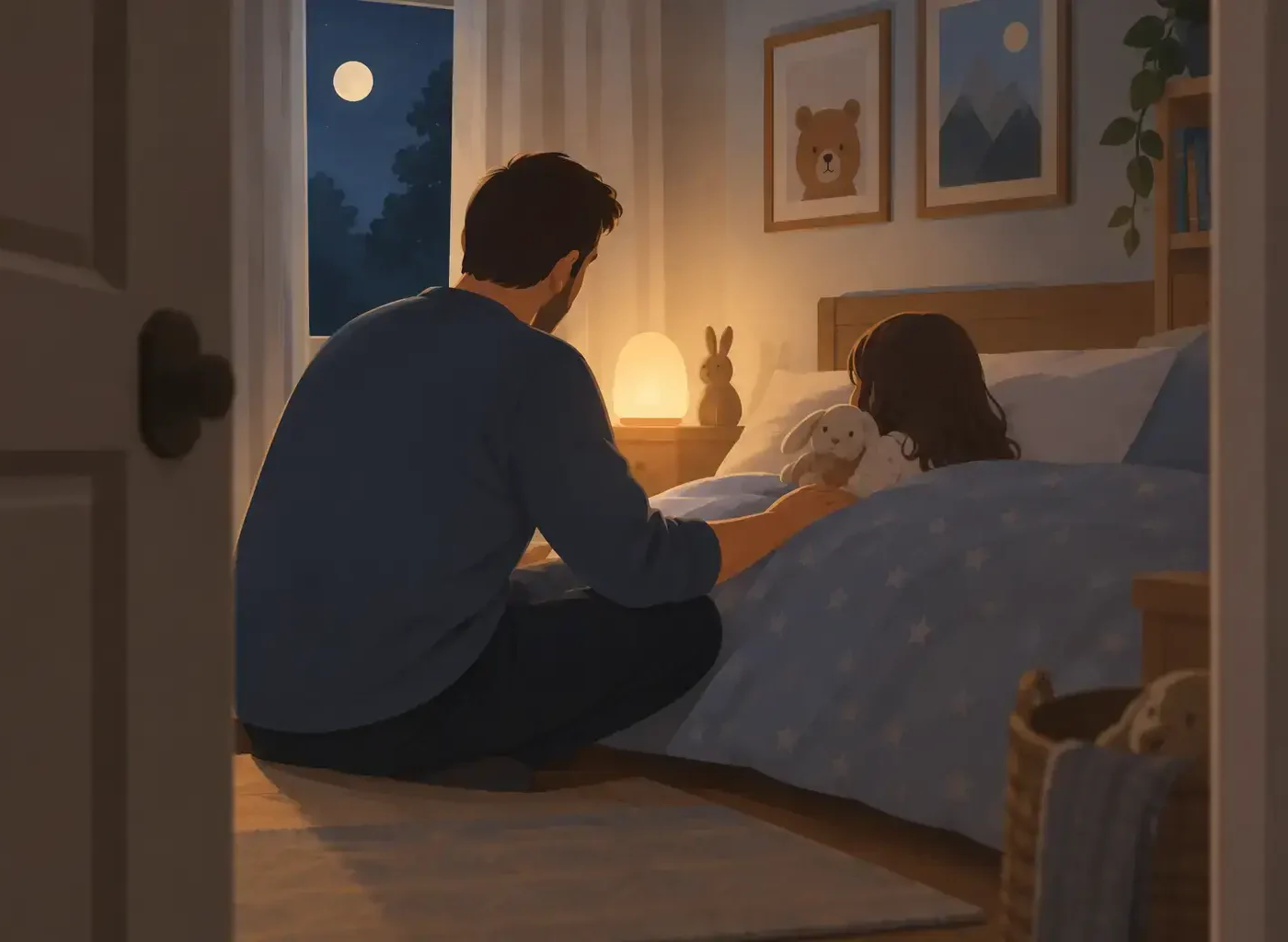
The call often comes just after you have finally sat down. Your child is crying from their room, asking you to check the corner, the closet, the hallway, then asking again. When your child is scared of the dark, the fear can feel much bigger than the room itself, especially when everyone is tired.
You are not causing this because you missed the perfect response earlier in the evening. Fear of the dark is common, and it can be genuinely hard to handle with kindness when you have already answered the same request three times.
Table of Contents
When Your Child Is Scared of the Dark, Start With Calm
Go to your child, keep your voice low, and let them know you can see that they are frightened. You do not need a long conversation in the dark, and you do not need to convince them that their fear makes no sense.
Try something simple: “That felt scary. I am here. We checked the room, and you are safe.” Then stay for a short, predictable moment before leaving again.
Your job is not to erase every worried thought, but to show your child that fear can be met without panic.
The exact words matter less than using roughly the same words each time. A child who is scared may ask for new answers because they want certainty, but fresh explanations can accidentally turn the moment into a negotiation. A steady response gives them something more useful: a parent who is calm and believable.
If they ask you to check under the bed or behind a door, it is fine to do one brief check together. Keep it matter-of-fact. You are not performing a monster hunt or trying to prove an invisible thing does not exist. You are showing your child how a calm person responds to a worry.
Use a Short Script You Can Repeat
The hard part is often not knowing what to say when the requests keep changing. A prepared script helps, particularly if you and your partner are taking turns responding.
You might say, “I know the dark feels different right now. We have checked the room. You are safe, and I will come back to check on you soon.” Use words that feel natural in your family, but aim for the same basic message: I hear you, we have done the reasonable check, and I trust you can get through this moment.
A boring, kind response is often more helpful than a creative new solution every night.
This does not mean being cold or sending your child away with their feelings. It means you are keeping the response small enough that fear does not become the main event of the evening. Your child gets comfort, but the comfort does not need to grow bigger every time they call.
If one parent tends to offer lots of reassurance while the other is more likely to get brisk after a long day, agree on a few sentences ahead of time. That small bit of teamwork can prevent a tired child from receiving two completely different messages. It also means neither parent has to invent a response while running on fumes.
Talk About It When the Sun Is Up
A frightened child is rarely ready for a useful conversation in the middle of the night. Bring it up at an ordinary, unhurried moment instead. You might say, “Last night felt scary. Tell me what your brain was imagining.”
Listen without correcting every detail. Some children will talk about shadows, sounds, characters from stories, or a feeling they cannot explain. Others will shrug. Both responses are okay.
Talking about fear in daylight helps make it feel like a feeling, not a secret emergency.
For younger children, drawing can make this easier. They can draw the scary idea, then add the people, places, or ordinary details that help them feel protected. Older children may prefer to describe what they think is happening and what they can say to themselves when the worry appears.
One thing that worked for us was giving a fear a plain, almost boring name. Not a dramatic name that made it more powerful, just “the dark worry.” That gave our child a way to say what was happening without needing to explain a whole story each time.
Help Them Practice a Small Response
Your child does not need to become fearless. They need a few calm ways to help your child settle down when they notice the fear arriving. Practice these during the day, when nobody is upset.
You could help them choose a phrase such as, “My brain is making a scary picture, but I am safe.” Or they might prefer a practical plan: take a slow breath, hold a comfort item, and call out once if they need help.
Confidence grows from having a response to fear, not from never feeling afraid.
Keep the plan short. A long set of steps can become another thing your child feels they have to get exactly right. The goal is not perfect bravery. It is helping them notice, “I felt scared, and I got through part of it.”
Praise the effort in a specific way the next day. “You were scared, and you used the words we practiced.” That lands differently than telling them they were “so brave” if they still feel shaky inside. It tells them that courage can include fear.
Why the Dark Can Feel So Big
The American Academy of Pediatrics lists a fear of being alone in the dark among the most common childhood fears, and most of these fears fade with reassurance and support. Darkness takes away the visual information children use to make sense of a room. Familiar objects can look strange, ordinary house sounds can stand out, and a tired brain is not always great at sorting a real concern from an imagined one.
Children also absorb more than we realize. A spooky image, a conversation overheard in the car, the anxiety of a new school week, or a stressful week at home can show up later as a fear that seems unrelated. You do not need to find the single cause to be helpful.
The fear may be inconvenient, but it is still real to your child in that moment.
This is why arguing usually goes nowhere. Telling a child there is “nothing to be scared of” can make them feel alone with a fear they cannot switch off. You can be honest without agreeing with the scary story: “I do not see anything dangerous here. I can tell it feels frightening to you.”
Avoid Letting Reassurance Become a Long Loop
There is a trade-off here. If you leave immediately every time, your child may feel dismissed. If each call leads to a longer visit, more checking, or a whole new activity, the fear can start pulling more and more of the evening toward it.
Aim for warm and predictable. Brief check-ins can be useful if you truly follow through, but make them less about investigating the room and more about connection. “I said I would come back, and I did.” Then keep the visit short.
Consistency is kinder than making a promise you cannot keep at 9 p.m. when you are exhausted.
There will be nights when your child is extra upset and you stay longer. Family life is not a test of perfect consistency. A difficult night does not undo the calm pattern you are building over time.
If you lose patience, here is how to apologize to your child simply. “I was tired and my voice got sharp. You did not deserve that. I am still here, and we can try again.” Your child does not need a flawless parent in the dark. They need one who can return to steadiness, even after a rough moment.
For the rest of the evening, from bedtime routines to night wakings, see our complete guide to kids and sleep.
Frequently Asked Questions About When Your Child Is Scared of the Dark
Is it normal for a child to be scared of the dark?
Yes, very. Fear of the dark is one of the most common childhood fears, especially between about three and eight, when imagination grows faster than the ability to tell what is real. For most children it comes and goes with stress, new stories, or changes at home, and it fades with calm, consistent reassurance.
Should I let my child sleep with a night light?
A dim night light is a perfectly reasonable tool. Think of it as a small comfort, not a crutch. Choose a soft, warm glow rather than a bright overhead light, and keep it the same every night. If your child still calls out with the light on, the fear needs a calm response, not more light.
What should I say when my child is scared of the dark at bedtime?
Picture a short, repeatable line: “That felt scary. I am here. We checked the room, and you are safe. I will come back soon.” Use roughly the same words every night, do one brief check if asked, and keep the visit short. Predictable words help more than new explanations each time.
At what age do kids usually grow out of being scared of the dark?
Most children ease out of it somewhere between seven and nine, though some older kids still prefer a light on, and that is fine. It often flares up again during stressful periods, like a move or a new school. A temporary return of the fear is not a step backward.
When is fear of the dark something to talk to a doctor about?
Usually it is not. But if the fear is intense most nights for several weeks, stops your child from sleeping, spreads into daytime worries, or comes with nightmares and big changes in mood, it is worth mentioning to your pediatrician. They can help you figure out whether there is more going on.
Final Thoughts
When your child is scared of the dark, the most helpful thing you bring into that room is not a perfect answer. It is a calm voice, a few familiar words, and the quiet message that fear can be handled.
Some nights will go smoothly. Others will take three trips down the hallway and more patience than you thought you had left. Both are part of it, and neither undoes the steady pattern you are building.
Over time, that quiet predictability becomes the part your child trusts most. The dark stays the same. What changes is how safe they feel inside it.
If you want calmer evenings to be part of a bigger picture, a couple that works as a team, a dad who shows up at bedtime, and a family that feels steady, The Family Blueprint Trilogy brings it together in three short, practical books, written by a mom of two who has done her share of nighttime check-ins.