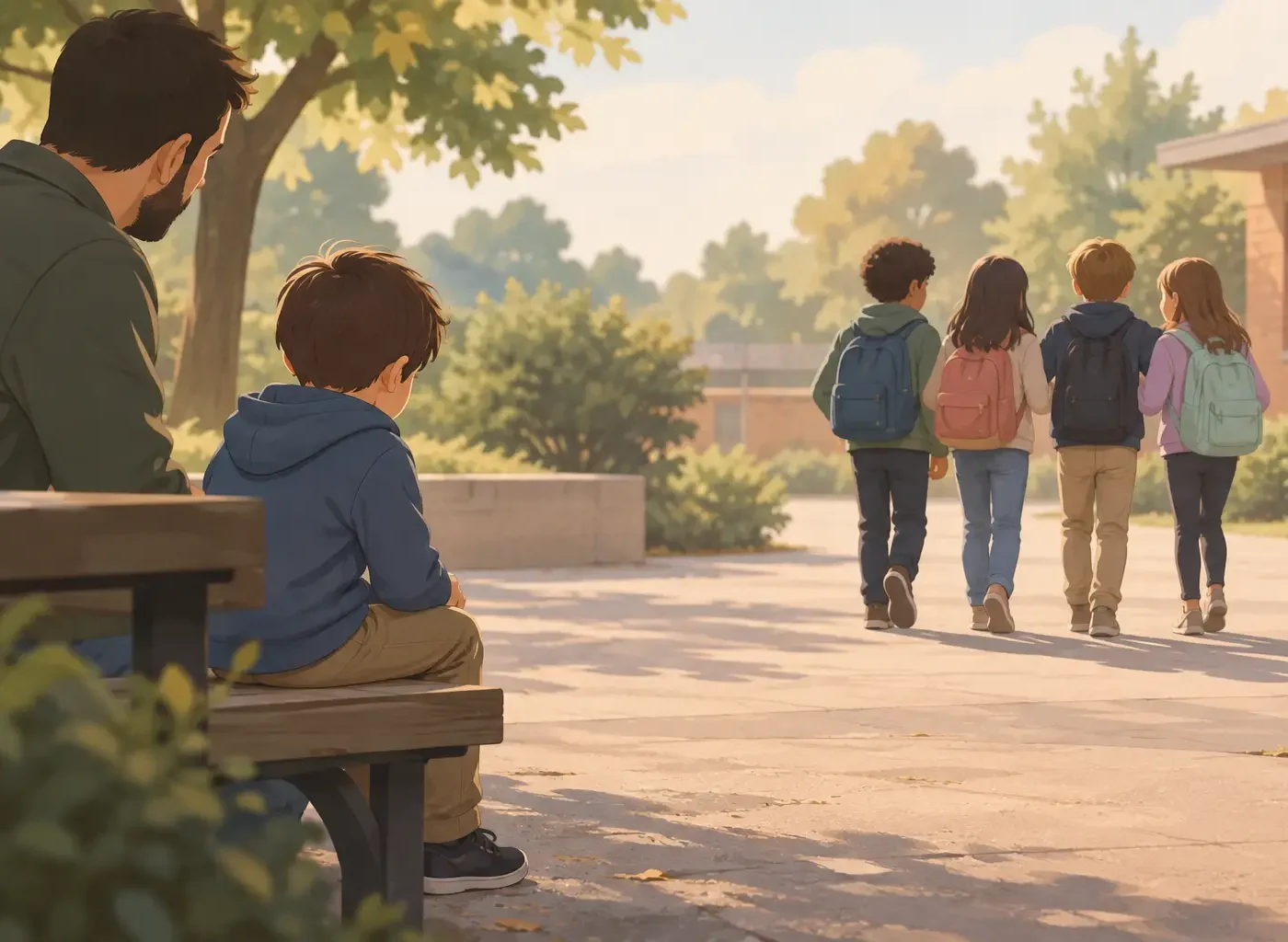
The car door closes, and your child says, “Nobody wanted me on their team.” Or you notice they were not included in the group chat, the lunch table, or the birthday plan everyone else seems to know about. When your child gets left out by their friends, it can hit a tender place in you fast. You want to fix it, call someone, or promise it will never happen again.
You are not overreacting because it hurts to see your child hurt. But you do not have to solve their whole social life in one evening. The most useful first step is helping them feel less alone in this particular moment.
Table of Contents
When Your Child Gets Left Out by Their Friends
Start by slowing down your own response. Your child may need to tell the story three times, give only two words, or act as though nothing happened until bedtime. Each version is normal.
Your job first is not to make the hurt disappear, but to make it safe for your child to bring it to you.
Try a simple opening: “That sounds really painful. I can see why you felt left out.” Then pause. A long explanation about friendship, or an immediate plan to talk to the teacher, can make a child feel as if their feelings are a problem that needs to be rushed past. The American Academy of Pediatrics reminds parents that most children feel pushed away by friends at some point, and that the most useful message is a clear one: you are on their side and you will help.
If they want to talk, stay close to the facts. You might say, “Tell me what happened right before that,” or, “Who was there?” This helps you understand whether it was one rough recess, a friendship group shifting, or a pattern that has been growing.
Try not to jump straight to, “They are not real friends,” even if you are furious on your child’s behalf. Children often still care deeply about the kids who hurt them. Asking them to reject those friendships before they are ready can leave them feeling even more stranded.
It also helps to avoid quick reassurance such as, “They probably did not mean it.” Sometimes they did not. Sometimes they did. Your child does not need you to decide that before hearing them out.
For a younger child, keep it even plainer: “You wanted to play, and they said no. That felt bad.” For an older child, you can say, “Being left out can make school feel very long. I am glad you told me.”
What to Say After the First Big Feelings
Once your child feels heard, move gently toward what they need next. Some children want comfort and a snack. Some want a practical plan. Some want you nearby while they do something ordinary, because talking face-to-face feels too exposed.
Comfort and problem-solving work better as two separate steps, not one rushed conversation.
You can ask, “Do you want me to just listen, help you think of what to say, or help with something at school?” Giving these choices does not put the burden on your child to solve it. It shows them there is more than one way to get support.
If they want to try again with friends, help them practice one short, natural sentence. “Can I play the next round?” might work for a younger child. An older child might say, “I heard you are all meeting up Saturday. I would like to come if there is room.” The goal is not to give them a perfect line. It is to make the next small moment feel less daunting.
One thing that worked for us was practicing the words while doing something else, like clearing dishes or walking the dog. It felt less like a serious family meeting, and my child could stop whenever they had had enough.
There are times when your child does not want to approach the group again, at least not yet. Respect that. Help them think about one person who has felt easier lately, even if that child is not part of the main group. A friendship does not have to look like the loudest group at recess to count.
Be careful with advice that sounds like, “Just be confident.” A child who has been excluded may already be replaying every awkward thing they said. A more helpful message is, “You deserve to be treated kindly, even on days when you feel unsure of yourself.”
Help Without Taking Over
Seeing your child left out can wake up your own memories of school. That can make it tempting to send a pointed message, arrange a gathering, or urge your child to move on before you know what happened. Those reactions come from love. They can still backfire if your child feels watched, managed, or embarrassed.
Support is strongest when your child still has a real say in what happens next.
For a one-time disappointment, give it a little room. Friend groups can be messy. A child might be left out of a game because there were limited spots, because plans changed, or because another child made a thoughtless choice. It may not become a larger problem.
For a repeated pattern, be more involved. You might help your child invite one classmate for a low-pressure activity, rather than trying to recreate an entire group. Keep the invitation specific and simple. “Would you like to come over after school Thursday?” is easier for everyone than a big, open-ended plan.
Your role may also be practical. If your child is younger, you may need to help them follow through on an invitation or make space for a new connection. If your child is older, they may prefer that you stay in the background. Ask before contacting another parent whenever possible, unless there is a school concern that needs adult attention.
This is one of those moments where a partner can be especially helpful. One parent may be carrying the details of who said what, which event is coming up, and whether an invitation needs an answer. The other can take over dinner, sit with the child, or simply say, “I heard today was hard.” Small acts of backup like that are what sharing the mental load of parenting looks like on a hard school day.
When to Talk to the School
If exclusion is frequent, targeted, or making it hard for your child to take part in the school day, it is reasonable to contact their teacher or another trusted staff member. You are not making a fuss by asking an adult to pay attention.
You do not need proof of every detail before asking the school to help your child feel included.
Keep your message calm and specific. Share what your child told you, how often it seems to be happening, and what you hope the school can watch for. For example: “My child has mentioned being repeatedly excluded at recess by the same group. Could you keep an eye on how group play is going and let us know what you notice?”
A good school response may be quiet rather than dramatic. A teacher might pay closer attention at recess, create different partner groupings, or check in with your child privately. You do not need to demand that every child becomes a friend. The reasonable goal is that your child has fair access to play, learning, and respectful treatment.
If your child asks you not to tell anyone, take that seriously. Explain what you can keep private and what may need adult help. You might say, “I will not make a big scene. But if this keeps happening, I may need to ask your teacher to watch out for you. We can decide together what I say.”
Build a Wider Circle, Slowly
When a child is focused on one friendship group, it can seem as though that group holds all the power. A wider circle takes time, and it will not erase the sting of exclusion overnight. It can make the next hard day feel less final.
Your child does not need lots of friends. They need a few places where they are welcomed as themselves.
Look for settings where connection can grow around a shared activity instead of social pressure. That could be a library program, a team, an art class, a neighborhood game, or a cousin they genuinely enjoy. Choose what fits your actual week. Adding three new activities to an already crowded schedule will not help a tired child or a tired family.
At home, keep your child connected to ordinary life. Let them help make pancakes, choose the music while you fold laundry, or sit beside you while you answer emails. These moments do not replace friendship, but they remind a child that being left out of one group does not mean they are outside of belonging altogether.
Try to notice the small wins without turning them into a lesson. If they talk to someone new at school, a quiet “I am glad you had that moment” is enough. They do not need their social life measured and evaluated at the kitchen table.
To help your child handle friendship hurts long term, these build the inner side: simple ways to teach emotional intelligence at home and real tips for raising confident kids.
If you want the whole framework, from toddlers to teens, read positive parenting: the complete guide by age.
Frequently Asked Questions About When Your Child Gets Left Out
Is it normal for kids to be left out by friends?
Yes. Almost every child gets left out at some point, especially between ages seven and twelve, when friend groups shift often. It still hurts. What matters most is that your child has a safe place to talk about it and at least one or two relationships where they feel welcome.
What should I say when my child says no one likes them?
Start by acknowledging the feeling rather than arguing with it. “That sounds really lonely” lands better than “That’s not true.” Once they feel heard, gently ask about specific moments and people. Often the picture is more mixed than “no one,” and naming one friendly classmate can help.
Should I talk to the other child’s parents?
Usually not for a one-time incident, and ideally only with your child’s agreement. Contacting other parents can embarrass a child or make things worse socially. If exclusion is repeated, targeted, or crossing into bullying, involve the teacher or school first, since they can see the dynamics directly.
How can I help my child make new friends?
Invite one classmate for a short, low-pressure activity, like a park trip or baking, instead of a big party. Look for clubs or teams built around your child’s interests, where connection grows naturally. Picture a shy ten-year-old who finds a friend through a Saturday art class. One good friend is plenty.
When is being left out actually bullying?
Exclusion becomes bullying when it is repeated, deliberate, and involves a power imbalance, such as a group targeting one child or spreading rumors to keep them out. If your child is being singled out regularly, contact the school and ask for a plan. You do not need to wait for it to get worse.
Final Thoughts
When your child gets left out by their friends, you cannot fix the playground. You can be the place they come home to where nobody leaves them out.
The hard truth is that you cannot choose your child’s friends or protect them from every exclusion. You can be the steady place they return to, help them take one manageable next step, and show them that a painful day does not get to define who they are. That kind of support stays with a child longer than any perfectly worded fix.
If you are the parent who usually hears about these days second-hand, try being the one in the car at pickup this week. Kids often open up most on the drive home.
How to Be a Better Dad is a practical guide to being the steady parent your kids turn to on hard days, written by a mom of two who has heard “nobody wanted me on their team” from the back seat more than once.