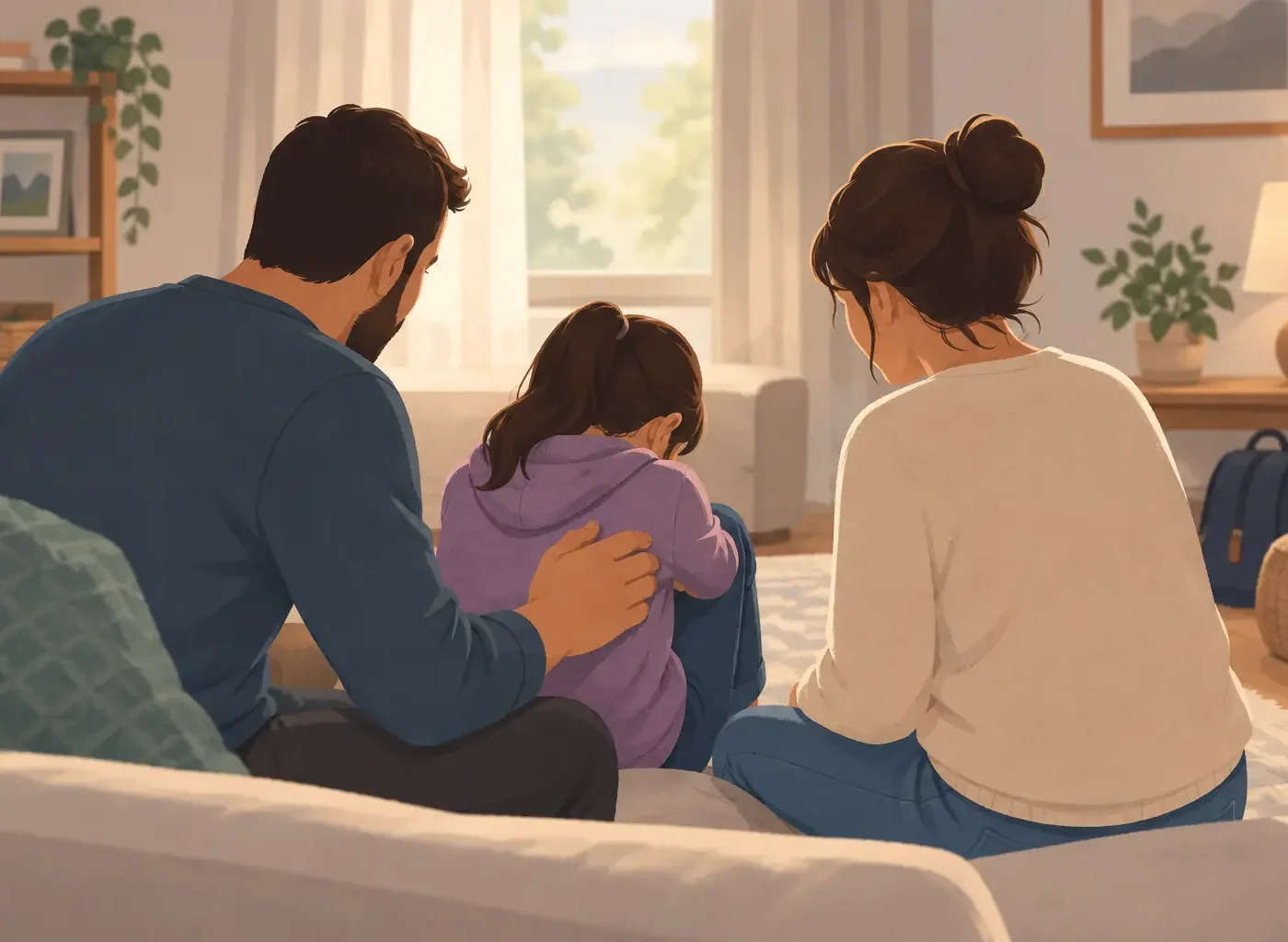
The text might arrive while you are clearing dinner, or your child may mention it in the car and then go quiet. When you are figuring out what to do when your child is being bullied, the urge to fix it immediately can feel overwhelming. Start smaller. Help your child feel believed, then take the next clear step.
You do not need to have the perfect words or a full plan in the first conversation. Your child needs to know that they do not have to carry this alone.
What to Do When Your Child Is Being Bullied Tonight
Your calm attention is more useful than a quick solution.
Find a private, unhurried moment and begin with what you know: “I noticed you seemed upset after school. I am here, and I want to understand what happened.” If your child has already told you, try, “I am really glad you told me. You did the right thing by coming to me.”
Then listen before asking for every detail. Children often share bullying in pieces, especially when they are embarrassed, worried you will make things worse, or unsure whether it counts. You can ask who was involved, what happened, where it happened, and whether an adult saw it. Keep your voice steady, even if you feel angry.
Try not to lead with questions such as, “Why didn’t you tell a teacher?” or “What did you do back?” Those questions can land like blame when your child is already feeling exposed. A better starting point is, “What felt hardest about it?” and “What would help you feel safer tomorrow?”
Avoid promising total secrecy. You can say, “I will be careful with what I share, but I may need to tell an adult at school so they can help keep you safe.” This is honest, and it lets your child know you will not go behind their back without thought.
It can also help to tell your child plainly that bullying is not caused by something wrong with them. Children sometimes focus on the part of themselves that was mocked, whether it was a friendship, a body, a habit, or simply being nearby. You do not have to talk them out of every feeling. Sit with them, name that it hurt, and make it clear that the responsibility belongs with the child doing the hurting.
What to Do When Your Child Is Being Bullied at School
A written record turns a painful, blurry situation into something the school can act on.
As soon as you can, write down what your child shared. Include the date, time, place, names, exact words or actions when possible, any witnesses, and which adults were told. Save relevant messages or screenshots if the behavior happened in a class group chat or through a school-related device.
You are not building a case against another child. You are giving the adults responsible for your child during the school day enough information to respond clearly. Details also matter when incidents look small separately but show a pattern over time.
Contact your child’s teacher, school counselor, or school office in writing. Keep the message factual and focused: explain what your child reported, when it happened, whether it has happened before, and what you need next. Ask for confirmation that the message was received and for a specific plan to support your child.
If your child is worried about recess, lunch, the bus, a hallway, or a particular class, name that directly. The school may be able to adjust supervision, make a check-in plan, change where your child sits, or identify an adult your child can go to quickly. The best plan depends on the setting and your child’s age. A first grader may need an adult nearby at recess, while a middle schooler may need a discreet way to leave a group situation and get help.
If your child says they are afraid to go to school the next day, do not brush it off as overreacting. Ask the school for a same-day response and a clear safety plan before the next school day begins. You are allowed to be direct about this without becoming combative.
Work With the School Without Losing the Thread
The goal is not a perfect meeting, it is a clear plan that someone owns.
A meeting can be useful when the behavior is repeated, when several children are involved, or when the first response has not changed much. Go in with your notes and a short list of what you need answered. Who will check in with your child? What will staff do if it happens again? When will the school update you?
Ask the school to explain its bullying policy and how it distinguishes bullying from a one-time conflict. That distinction can matter, but it should not become a reason to minimize your child’s experience. Repeated teasing, exclusion, threats, or physical behavior still deserves a response, even when adults are deciding which label fits.
After the conversation, send a brief email summarizing the plan. This does not need to sound legal or formal. A simple note such as, “Thank you for speaking today. My understanding is that Ms. Lee will check in at lunch, staff will monitor the bus line, and we will reconnect Friday,” gives everyone a shared record.
Try to keep direct contact with the other child’s family out of the first response unless the school suggests it and you feel it would be productive. A parent-to-parent conversation can sometimes help, especially in a small community. It can also create more tension, conflicting stories, or discomfort for the children. Let the school handle school behavior first.
Help Your Child Get Through the Next Day
Feeling supported at home gives your child a steadier place to stand at school.
Your child may want to talk a lot, or they may want to talk about anything but school. Both responses are common. Offer an opening without making every car ride an interview: “I am available if you want to tell me how today went.” Then let them choose how much to share.
Practice one or two simple phrases your child can use, especially if they freeze in the moment. “Stop. I don’t like that.” “I’m going to get a teacher.” “I’m sitting somewhere else.” Keep it brief and believable. A long speech may sound good at the kitchen table but be impossible when a child feels put on the spot.
You can also help them identify one safe person and one safe place at school. For a younger child, that might be a classroom aide and the library. For an older child, it might be a coach, counselor, or lunch staff member. This is not about making your child responsible for stopping the bullying. It gives them a next move while adults do their part.
Keep ordinary parts of home life as steady as you can. Your child may need extra closeness, a quiet activity beside you, or a little more time before being asked about homework. One thing that worked for us during a hard school stretch was a predictable check-in after dinner: no pressure to talk, just ten quiet minutes together. Small moments of connection can make school feel less like the whole world.
If the First School Response Is Not Enough
You can be persistent without being hostile.
Give the plan enough time to be put in place, but keep noting what your child reports. If the behavior continues, reply to the original email thread and state what has happened since the plan began. Ask what will change now.
If you are not getting a response from the teacher or staff member, contact the principal or school administrator. Bring your dates, notes, and copies of prior communication. Ask for a meeting and request a written follow-up. Staying factual helps you keep the conversation centered on your child’s safety and access to school.
At this point, it may help to ask for the school’s formal complaint process or the next level of support in your school district. This can feel uncomfortable, particularly if you know the staff well or worry about being seen as difficult. Speaking up for your child is not making trouble. It is part of the work of being their parent.
Keep your child informed in an age-appropriate way. They do not need every adult detail, but they should know that you have spoken to the school and what will be different tomorrow. Trust grows when children can see that telling you led to support, not drama or silence.
Bullying can leave a child feeling as though they have to shrink themselves to get through the day. Your steady message can push back against that: “You deserve to be safe here, and I will keep working with you until we have a better plan.”