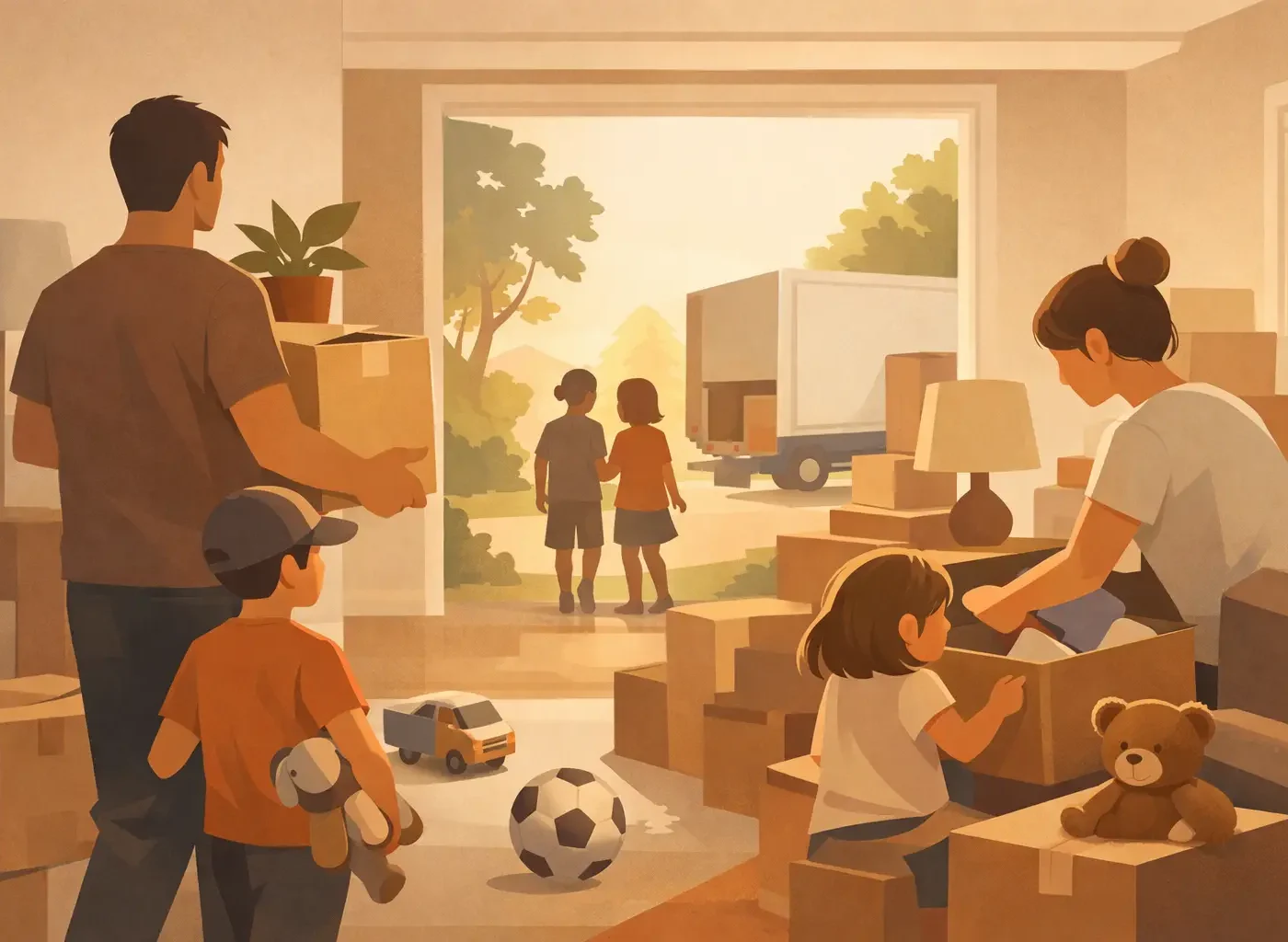
The cardboard boxes are multiplying, your usual meal plan has disappeared, and your child has suddenly become very concerned about a toy they have not touched in six months. Moving house with kids can make an already demanding job feel emotionally loaded. If your child is tearful, extra clingy, angry, or oddly uninterested, none of that means you have handled the move badly. It means their world is changing.
Table of Contents
Start Preparing Your Child Before the Move
Your child does not need a perfect explanation. They need a steady, honest one they can hear more than once.
The Child Mind Institute makes the same point about timing: talking through the move in advance, including the parts that might be hard, lets a family start problem-solving before moving day rather than during it. Tell them about the move as soon as the plan is reasonably certain. You do not need to turn it into a big family meeting, especially with a younger child. Bring it up in small, calm conversations while you are driving, folding laundry, or looking at the new home together.
Use plain language. “We are going to live in a new house. Your books, stuffed animals, and our family are all coming with us.” If you know the date, say it. If you do not know every detail yet, say that too: “I do not know which room will be yours yet, but we will figure it out together.”
Children often return to the same questions because they are trying to make a big change feel understandable. Answer without sounding frustrated, even when it is the fifth time that day. A short, familiar answer can be more useful than a long reassurance speech.
Show them the practical pieces where you can. Walk or drive by the new house. Look at photos. Point out the park, school route, or corner store if those details are part of the plan. If the move involves a new school or child care setting, explain what will stay the same as well as what will change. You will still pack lunches, read books, make pancakes on Saturdays, or call Grandma on Sunday.
For children who are old enough, give a small choice that is real. They might choose the color of a lamp, which poster goes up first, or which snacks go in the car. Avoid offering choices you cannot keep. “Do you want the bedroom upstairs or downstairs?” can create more upset if the layout or family needs make the answer obvious.
Pack With Kids in Mind, Not Just Efficiency
The goal is not to involve your child in every box. It is to protect a few familiar pieces of daily life while everything else is in flux.
Packing is where moving can start to feel alarming to children. Their room changes first, favorite objects vanish into taped boxes, and adults are often busy or distracted. If possible, leave their bed, a few books, and the objects they use most until late in the process.
Make one clearly marked “first night” box or bag for each child. Put in pajamas, a change of clothes, toothbrush, comfort item, medications they already use as directed by their clinician, favorite cup or water bottle, and a couple of quiet activities. Keep it with you, not on the moving truck.
It also helps to make a family essentials bag for the first day: toilet paper, chargers, basic cleaning supplies, snacks, paper towels, and anything needed for a simple dinner. This is not about creating a picture-perfect first evening. It is about avoiding the particular strain of searching through thirty boxes for a child’s underwear when everyone is tired.
Let your child pack a small backpack of treasures if they want to. For a preschooler, that may be three stuffed animals and a plastic dinosaur. For an older child, it may be a journal, headphones, a beloved sweatshirt, or a book. Do not correct their choices unless space or safety truly requires it. Carrying a few important things gives them a little control without making them responsible for the move.
One thing that worked for us was labeling our kids’ boxes with a simple symbol as well as words. They could spot the star or the green dot before they could read every label, and it gave them something concrete to look for when we arrived.
Make Moving Day Smaller
A successful moving day is usually one where you lower the standard, not one where everyone stays cheerful.
If you have a trusted friend, family member, or child care option, having younger children elsewhere for the busiest hours can make a real difference. This is not sending them away from an important family event. It is protecting them from a long day of open doors, heavy furniture, adults giving instructions, and very little attention available for them.
If they need to be there, create one safe, boring corner away from the main traffic. Set out familiar activities, snacks, water, and a small blanket. One adult should be clearly responsible for checking in, even if the job shifts between you and your partner. A child who keeps asking for help may not need entertainment. They may need to know who is available to them.
Expect behavior to be less flexible than usual. Your child may refuse shoes, argue over something tiny, or cry because their cereal is in the wrong bowl. The immediate job is not teaching a lesson about cooperation. Get through the day with as little friction as you can manage.
Short sentences help: “You wanted your blue cup. It is packed. You can have this cup or this bottle.” Then move on. A long explanation often lands badly when a child is already overloaded.
If you are moving with a partner, divide ownership before the trucks arrive. One person can handle movers, keys, and utility questions while the other is the child’s point person. Switch when needed, but avoid both adults being pulled into logistics at the exact moment your child needs help finding their shoes, their stuffed animal, or a snack. This kind of planning also makes the unseen work more visible: keeping track of the child’s bag, school papers, bathroom needs, and the emotional temperature of the day.
Settle In Before You Try to Organize Everything
Children usually settle through repeated ordinary moments, not through a perfectly finished bedroom.
The first few days can be messy. Your child may love the new house at breakfast and want the old one back by dinner. Both feelings can exist together. Let them say they miss their old room or neighborhood without rushing to persuade them that the new home is better.
Start with the room or space where your child sleeps, then make one shared area usable enough for family life. Unpack their familiar bedding, a few books, and the items they reach for most. If their room cannot be finished right away, tell them what is happening: “Your clothes are still in boxes, but your pajamas and favorite books are right here. We will do more tomorrow.”
The first few nights in a new room often go better when the bedtime sequence stays exactly the same, even if nothing else in the house does yet.
Keep the first week lighter than you think it needs to be. Choose easy meals, postpone optional errands, and do not schedule every free hour around fixing the house. There will be time to hang pictures and sort the garage. For now, sitting on the floor together with takeout can be a good evening.
Older children may care more about privacy, missing friends, and the work of starting over socially than about which box gets unpacked first. Give them room to be disappointed without treating their reaction as ungrateful. Help with a concrete next step, such as setting up their desk, arranging a call with an old friend, or visiting a local place they might enjoy. They do not have to feel excited on your timetable.
When Your Child Keeps Struggling After the Move
Adjustment is rarely a straight line, and a hard day does not erase the progress your child has made.
Some children settle quickly, then struggle two or three weeks later, once the boxes are gone and regular life begins again. Once the boxes are gone and regular life begins again, the loss can feel more real. You may see more tears at drop-off, extra requests for closeness, arguments over familiar routines, or resistance to leaving the house.
Stay close to the basics. Give clear information about the next day, offer connection in small doses, and keep promises you make. A ten-minute walk around the block, helping your child choose where a photo goes, or sitting beside them while they draw can matter more than an expensive outing designed to make them love the new area.
Try not to make every difficult moment about the move. Your child may be upset because they are tired, hungry, disappointed, or simply having a tough day, just as they were before. You can acknowledge the change without making it the explanation for everything.
If you and your partner are stretched thin, say that out loud to each other with kindness. The person managing calls, paperwork, address changes, and missing boxes may look busy but still need a break. The person spending hours with a dysregulated child may need someone else to take over dinner. A simple check-in at the end of the day can keep resentment from filling the spaces the boxes used to occupy.
A move asks a lot of a family, even when it is a wanted one. You do not have to make every part of it meaningful or fun. Keep showing your child, in ordinary ways, that home is still the people who know where their favorite cup is, listen when they miss the old place, and sit beside them while the new place starts to feel familiar.
Frequently Asked Questions About Moving House With Kids
How far in advance should you tell a child you are moving?
Tell them once the plan is reasonably certain, not once every detail is settled. Waiting for perfect information usually means the child hears it late, or overhears it, which is worse. A short conversation months out and a few more as the date approaches works better than one big announcement.
How long does it take a child to adjust to a new house?
Most children need somewhere between a few weeks and a few months, and younger children often settle faster than school-age ones because less of their social world is changing. Adjustment also tends to be uneven rather than steady, with good days and hard days appearing in the same week.
Is it normal for a child to get upset weeks after the move?
This is one of the most common surprises for parents. While the boxes are still out, everyone is in motion and the change feels temporary. Once ordinary life resumes, the loss becomes real, which is often when the tears at drop-off or the extra clinginess show up.
Should you unpack your child’s room first?
Yes, and it makes a bigger difference than finishing the living room. Their bed, familiar bedding, and a few reachable books give them somewhere that already feels like theirs on night one. The rest of the house can stay in boxes for a week without anyone suffering for it.
What is the hardest age for moving house with kids?
It depends more on what the move changes than on the birthday. A toddler may barely register the address but react strongly to a disrupted nap. A ten-year-old may handle the house fine and grieve the friends. Look at what your particular child is losing, not at their age.
Final Thoughts
A move asks a lot of a family, even when it is a wanted one. You do not have to make every part of it meaningful or fun. Keep showing your child, in ordinary ways, that home is still the people who know where their favorite cup is, listen when they miss the old place, and sit beside them while the new place starts to feel familiar.
Moving house with kids is one of those jobs where the standard has to drop for a few weeks, and that is not the same as doing it badly. The takeout dinners on the floor, the half-unpacked kitchen, the bedtime that happens forty minutes late: none of it will be what your child remembers.
What they will remember is whether the adults stayed reachable while everything else was in boxes.
A move puts pressure on the two adults before it puts pressure on anyone else. You are both stretched, both handling something invisible to the other, and there is no evening left to talk about it.
The Marriage Blueprint is about reconnecting during exactly these stretches, when neither of you has done anything wrong and the distance is showing up anyway. Written by a woman who has been through it.
The Marriage Blueprint: start rebuilding the connection you both miss.