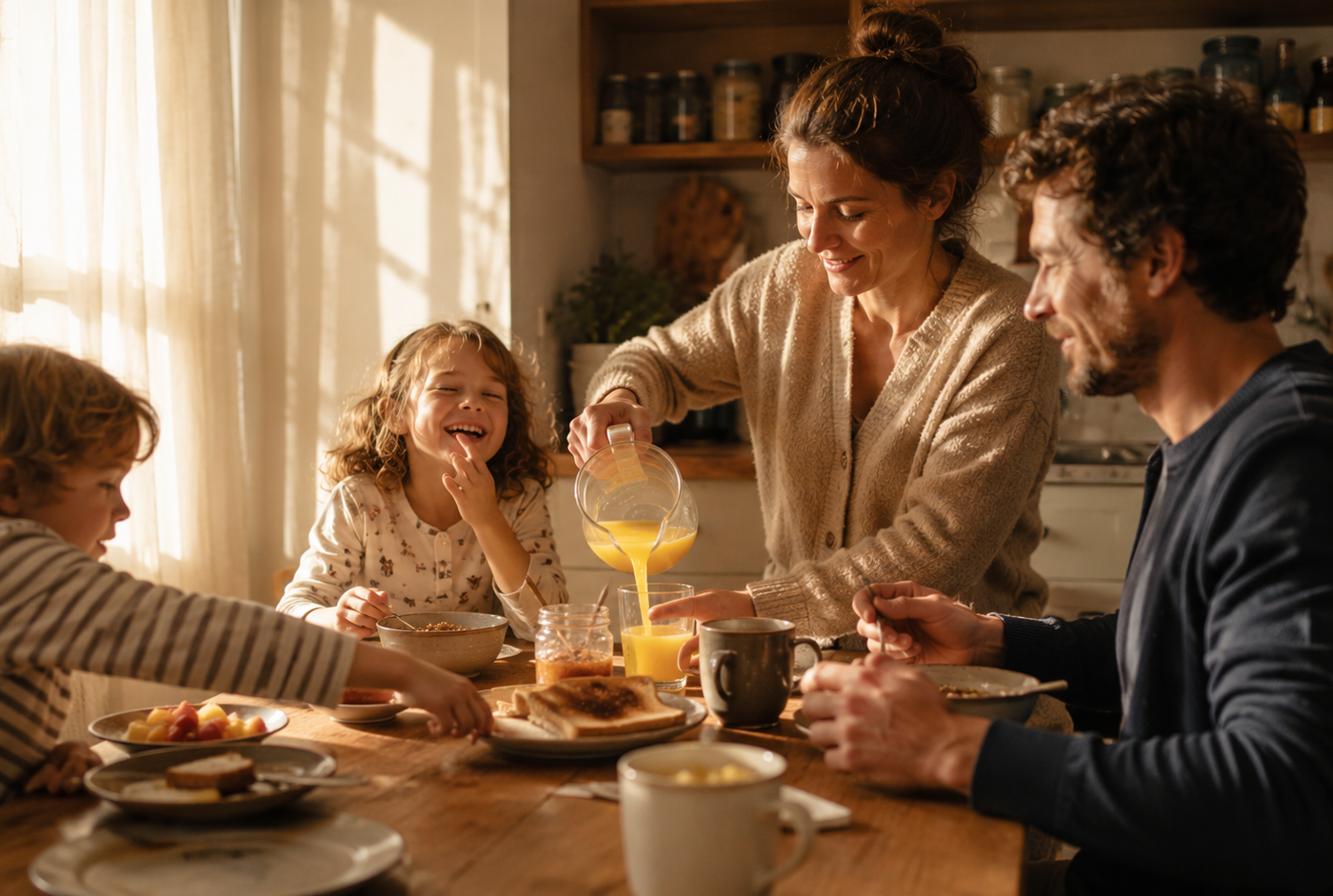
Some of the best parts of family life are not the vacations or the birthday parties. They are the small, repeating moments. The ones your kids will carry into adulthood without even knowing why. Family rituals are exactly that: the tiny, consistent things you do together that quietly say, we belong to each other.
The tricky part? Most of us never set out to build them intentionally. Life is full, kids are loud, schedules shift. What worked when your child was three falls apart at seven, and whatever held at seven barely survives the tween years. That is normal. It does not mean you failed at traditions. It means your family is growing.
This is not about pressure to do it all perfectly. It is about finding a few small things that fit your actual life, your real kids, and the season you are in right now.
Table of Contents
Why Family Rituals Matter More Than You Think
Rituals are not just nice to have. They do quiet, important work in the background of family life. Research consistently shows that children who grow up with predictable family rhythms tend to feel more secure. They have a stronger sense of identity. They know where they belong.
But here is the part that gets lost in the parenting conversation: rituals do not have to be elaborate to matter. They just have to be consistent and yours. A bedtime handshake that took three seconds to invent can become as sacred as any holiday tradition if you do it every single night.
Family traditions for kids also give them something to look forward to. In a world that can feel unpredictable, a weekly pizza night or a Sunday walk becomes an anchor. For parents, these moments become the ones we remember most when the chaos fades.
Connection rituals for parents matter too. When you share a simple ritual with your child, you are not just filling their cup. You are filling yours.
Rituals That Work for Babies and Toddlers (Ages 0 to 3)
This is the stage where family rituals are built most naturally, often without trying. Babies thrive on repetition. Toddlers worship routine. The patterns you set now will become the foundation everything else grows from.
A few things that tend to stick well at this age:
The same song every bath time. It does not matter what song. One family we know has sung the same made-up nonsense verse since their first was eight months old. Their child is now nine and still asks for it occasionally.
A simple goodbye ritual before daycare or work. A squeeze, a phrase, a special wave. Something small and repeatable. This kind of daily family routine helps toddlers feel safe at transitions, which is often when the hardest emotions show up.
A slow morning snuggle before the day starts is one of the easiest rituals to begin at this stage. Even ten minutes of quiet, unhurried contact sets a tone that children internalize over time.
Meaningful moments with kids at this age do not require any planning. They just require showing up the same way, over and over.
Rituals That Stick for Early Childhood (Ages 4 to 7)
This is the golden age for family traditions. Kids this age are old enough to feel a ritual happening, young enough to think it is pure magic, and eager enough to remind you when you forget.
A few things that have worked in families we know:
A “rose and thorn” at dinner, where everyone shares one good thing and one hard thing from their day. It sounds simple because it is. But it teaches kids to name their feelings and shows them that hard days are normal. If you want to go deeper on this, building emotional intelligence at home is something worth reading alongside this.
A special weekend breakfast. Pancakes, a fry-up, smoothies. Whatever your version is. The ritual is not the food. It is the slowness. The fact that this morning is different.
A “special time” block once a week, where each child gets 20 minutes of one-on-one attention with a parent. No phones, no siblings, no agenda. They pick the activity. This is one of the highest-return connection rituals for parents because the investment is small and the impact is enormous.
Family traditions for kids at this age benefit from a little ceremony. Let them help name it. Let them be the keeper of it.
Adapting Rituals for the Middle Years (Ages 8 to 11)
This is where a lot of families quietly lose their rituals. Kids get busier. Schedules pile up. The child who loved family game night suddenly has a friend to text and homework to avoid.
Family rituals do not have to disappear at this stage. They just need to evolve.
What tends to help is giving kids more ownership. Instead of “we do this now,” it becomes “help us figure out when.” A daily family routine that a child helped design is one they are far more likely to actually participate in.
Cooking together becomes more possible at this age. A child who helps make Sunday dinner develops pride, skill, and a connection to the family that goes deeper than they can articulate. It is also just a good time. Flour on the counter and all.
For working parents especially, staying connected with your kids when time is short matters. A brief, predictable ritual, like always eating breakfast together even if dinner is chaotic, can hold a family together through demanding seasons.
Meaningful moments with kids this age often happen sideways, in the car, during a walk, while you are both doing something else. Building a ritual that creates that kind of side-by-side time tends to produce more honest conversation than anything face-to-face.
Rituals for Tweens That Actually Work (Ages 11 to 15)
This is the stage that surprises most parents. Tweens seem to want distance. They roll their eyes at family time. They would rather be anywhere else.
And yet, the research on adolescents is clear: teens who feel a strong sense of family connection do better across almost every measure. They are more resilient, more likely to make safer choices, and more likely to come to a parent when something goes wrong.
The trick is not forcing old rituals on a new person. It is finding new ones that fit who they are becoming.
A few things that tend to work:
A low-pressure weekly ritual that requires nothing emotional. A show you watch together. A Saturday errand you always run as a pair. A shared podcast or playlist that gives you something neutral to talk about.
Letting them lead something. A tween who chooses the Friday night film, picks the restaurant, or plans the weekend outing feels seen in a way that matters to them. Family rituals at this stage succeed when the young person has some power in them.
A nighttime check-in that is brief and optional. Just knocking on the door and asking “how was it?” without needing a long answer. Consistency over intensity. The door being open matters more than what comes through it.
If you are a dad wanting to stay close during this stage, simple ways to connect with your kids as a present father has some ideas worth sitting with.
When Rituals Fall Apart (And How to Restart Them)
Every family goes through seasons where their rituals quietly disappear. A new baby, a job change, a move, illness, a difficult year. You look up one day and realize you have not done the thing you used to do in months.
This is not a failure. This is just life doing what life does.
Rituals can always be restarted. Sometimes they come back exactly as they were. Sometimes they come back in a new form that fits better. Sometimes you realize the old one no longer serves your family and you get to invent something new.
A simple way to restart: name it. Say out loud to your kids, “I miss our Sunday walks. Can we bring those back?” Naming the gap gives it dignity. It tells your children that these things matter to you, that they matter to you.
Connection rituals for parents benefit from the same grace. If you and your co-parent have lost your own rhythm, that is worth noticing too. The family culture flows from the adults in the home.
Meaningful moments with kids are rarely lost permanently. They are waiting for you to reach for them again.
Final Thoughts
Family rituals are not about doing more. They are about doing the same small things with love and consistency. A handshake at bedtime. A song in the car. A dinner question everyone groans at but secretly looks forward to.
Your kids will not remember the years. They will remember the moments that repeated. The ones that felt like yours.
Whatever stage your family is in right now, there is a ritual that fits. You do not have to build it from scratch or follow a script. Start with one thing. Do it again tomorrow. Let that be enough.
If this article resonated and you are a dad thinking about how to show up more consistently for your kids, what you need is not a longer to-do list. It is a framework that fits your real life. The Father Blueprint was written for exactly that.
What are simple family rituals I can start with young kids?
Many parents find that the easiest family rituals to start are ones tied to something you already do every day, like a song at bath time, a special handshake at bedtime, or a silly phrase you say before school. The ritual does not need to be creative or elaborate to matter to your child. Consistency is what turns a small moment into something your kids will carry with them.
How do family rituals help children feel more secure?
Family rituals give children a predictable rhythm in their day and week, which tends to build a stronger sense of safety and belonging. Research shows that kids who grow up with consistent family traditions have a clearer sense of identity and know where they fit. Even small rituals like a weekly pizza night or a Sunday walk act as anchors in a world that can feel unpredictable to young kids.
What family traditions work well for different ages and stages?
What tends to work is matching the ritual to where your child actually is right now, since a bedtime routine that fits a toddler will look very different for a tween. Many families find success by keeping rituals simple and repeatable, like a shared meal question, a Friday movie night, or a morning goodbye routine. The goal is to find a few small things that fit your real life and then do them consistently.
How do I start family rituals when life feels too busy?
It is completely normal for family rituals to shift as your kids grow, and many parents find that adapting a tradition is better than abandoning it altogether. A bedtime story can become a bedtime chat, and a toddler song can evolve into a shared playlist. What tends to matter most to kids of any age is not the specific ritual but the sense that your family has its own unique ways of being together.
Do family rituals have to change as kids get older?
It is completely normal for family rituals to shift as your kids grow, and many parents find that adapting a tradition is better than abandoning it altogether. A bedtime story can become a bedtime chat, and a toddler song can evolve into a shared playlist. What tends to matter most to kids of any age is not the specific ritual but the sense that your family has its own unique ways of being together.
The Father Blueprint: become the dad they will always remember
For more daily insights, follow me on X.