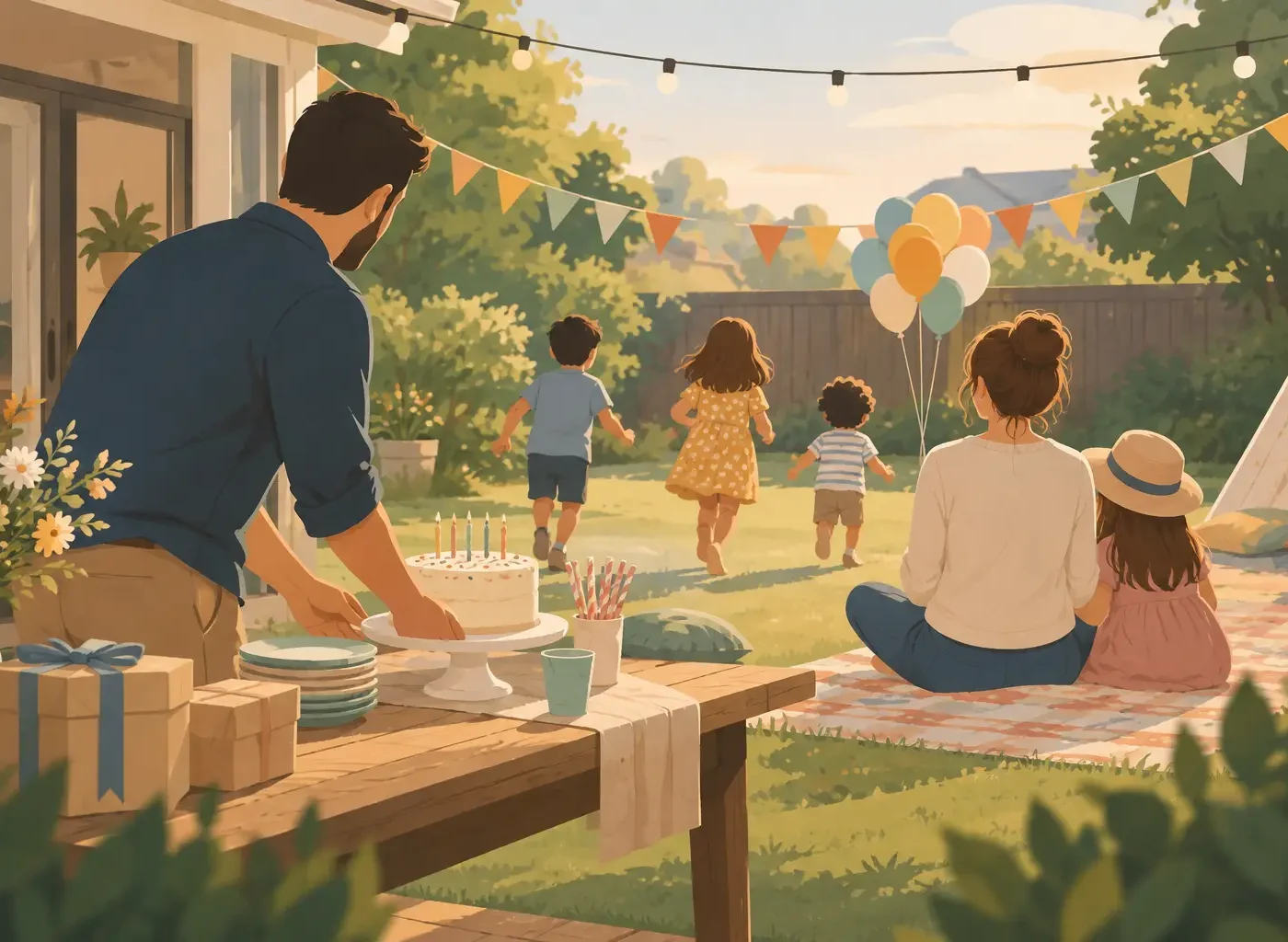
The wrapping paper is still on the table, someone needs to reply to the last invitation, and your child has changed their mind about the cake twice. Kids birthday parties without the stress spiral can sound like a nice idea from someone with more free time than you. But a calmer celebration is possible, even when work is busy, money is tight, and your child has very firm opinions about balloons.
The goal is not a picture-perfect party. It is a day where your child feels celebrated and the adults are not so worn out by 3 p.m. that nobody enjoys it.
Kids Birthday Parties Without the Stress Spiral Start Smaller
A birthday party can be meaningful without becoming a production.
Start by choosing the smallest version of the celebration that would still make your child feel seen. For a preschooler, that may be a few familiar children, cake, and an hour at a playground. For an older child, it may be pizza with three friends, a movie at home, or one activity they genuinely care about.
The bigger version is not automatically wrong. Some children love a loud room and a full guest list. But more guests usually mean more food, more transitions, more cleanup, and more chances for the plan to wobble. If you are already stretched, choosing fewer people is not depriving your child. It is protecting the atmosphere you want them to remember.
It can help to decide early whether this is a friend party, a family gathering, or a special day with just your household. Trying to fit all three into one afternoon often creates the stress you were hoping to avoid. Your child can have a birthday dinner with grandparents on one day and a small friend celebration on another. They do not need every person they love in the same room at the same time.
Decide What Matters Most to Your Child
Your child needs a few moments that feel like theirs, not a schedule packed with entertainment.
Ask simple, concrete questions: “What would make this feel like your birthday?” A child may say they want a dinosaur cake, to wear a cape, to invite their cousin, or to play a particular game. Listen for the one or two things underneath the long wish list.
Then let those things lead the plan. If the cake is the main event, there is no need to spend hours organizing elaborate activities. If being with friends matters most, choose a setting where children can play without constant adult direction. If your child hates being watched, skip the big candle moment and bring out dessert quietly.
This is also where you can be honest about limits. “We can invite five friends, or we can have the party at the trampoline place, but not both” is clear and kind. Your child may be disappointed. That does not mean you chose badly. You are showing them that a celebration can include choices without requiring every wish to become a purchase or a promise.
For younger children, keep the party short. For older children, leave more room for them to shape the plan. A 10-year-old may care deeply about who comes and very little about themed plates. A 4-year-old may be happy with bubbles and a cupcake. Let their age, temperament, and interests do more of the work than party trends do.
Put the Plan on One Page
A simple plan gives you more room to be present when the day gets noisy.
You do not need a detailed event schedule. You do need to know the basic shape of the day: when guests arrive, when food appears, when you will do cake, and when the party ends. Write it down in one place that your partner can see too.
Leave empty space between the big moments. Children rarely move from arrival to game to meal with the tidy timing adults imagine. Someone will need the bathroom just as food is served. A child may cling to a parent at the door. Two friends may become absorbed in a cardboard box and have no interest in the activity you prepared.
That is all ordinary party behavior. You do not have to redirect every minute.
Keep food uncomplicated, especially if the party sits across a meal time. Serve something filling, add a birthday treat, and let that be enough. A table that looks less impressive than the inspiration photos can still feed children well and save you from preparing three separate options while answering the door.
For gifts, decide ahead of time whether your child will open them during the party or afterward. Opening them later often protects playtime and spares you from trying to manage excitement, comparisons, and discarded packaging in front of guests. If your child wants to open gifts there, set aside a short time near the end rather than making it the center of the whole gathering.
Give Each Adult a Real Job
The person hosting should not also have to notice and solve every small problem.
Before the party, talk through who owns which part of the day. Not who will “help,” but who is fully responsible for a task from start to finish. One adult can greet families and manage the door. Another can handle food, candles, and the kitchen. If guests are arriving at a park or activity venue, one person can be the contact for late arrivals while the other stays with the birthday child.
This matters because parties create dozens of tiny decisions. Where should coats go? Has everyone arrived? Is there enough water? Who has the lighter? Where are the extra napkins? The person who has carried the planning in their head all week can easily become the automatic answer to every question, even when another adult is standing right there.
If you are reading this as a dad or partner, choose a job that removes decisions, not just a visible chore. Send the reminder text. Pick up the order. Keep track of the timing. Do the final sweep of the bathroom and entryway. These details may look small, but they are often what lets the other adult sit down for five minutes before guests arrive.
If you are hosting alone, simplify further. Ask one trusted friend or relative to be your designated practical person for the first half hour. They can point people toward the bathroom, carry a bag, or stay near the snack table while you help your child settle in.
Build a Party That Can Bend
A flexible party is not a poorly planned party.
Weather changes, children arrive shy, and a carefully planned game can fall flat within two minutes. Choose activities that can run in the background instead of requiring every child to participate at once. Sidewalk chalk, a simple craft table, a basket of balls, music, or free play give children different ways to join in.
It is fine to have one planned activity, particularly for children who like structure. Just do not make the entire party depend on it. A scavenger hunt may be fun at a park with a small group and frustrating in a crowded backyard with mixed ages. A craft may work beautifully for a quiet group and leave a room full of energetic 7-year-olds asking when they can run around again.
Watch the room instead of forcing the next item on the plan. If the children are happily playing, let them play. If energy is getting rough, bring out snacks or shift outdoors if you can. If your child becomes overwhelmed, give them a quiet minute with you or another familiar adult. You do not need to announce it or turn it into a lesson.
Let the Birthday Child Have a Real Day
Your child is allowed to be excited, tired, bossy, clingy, or disappointed on their birthday.
Birthdays can be a lot, even for children who asked for a party. They may struggle to share new toys, feel unsure when everyone sings, or become upset when a friend does not play the way they hoped. You can hold the limit without expecting them to act grateful every second.
Try a quiet, specific response: “You wanted that game to go differently. I see you. We still need to let everyone have a turn.” If they need a break, step away with them briefly. The party does not have to stop because your child is having a hard moment. It also does not have to continue at full speed while they are left alone with it.
At the end, do not rush to judge the day by whether every child smiled in every photo. If your child felt loved, ate cake, played for a while, and came home with a story to tell, the party did its job. Leave the unopened favors, the crumbs, and the thank-you messages for tomorrow if you can. Tonight, let the day be over.