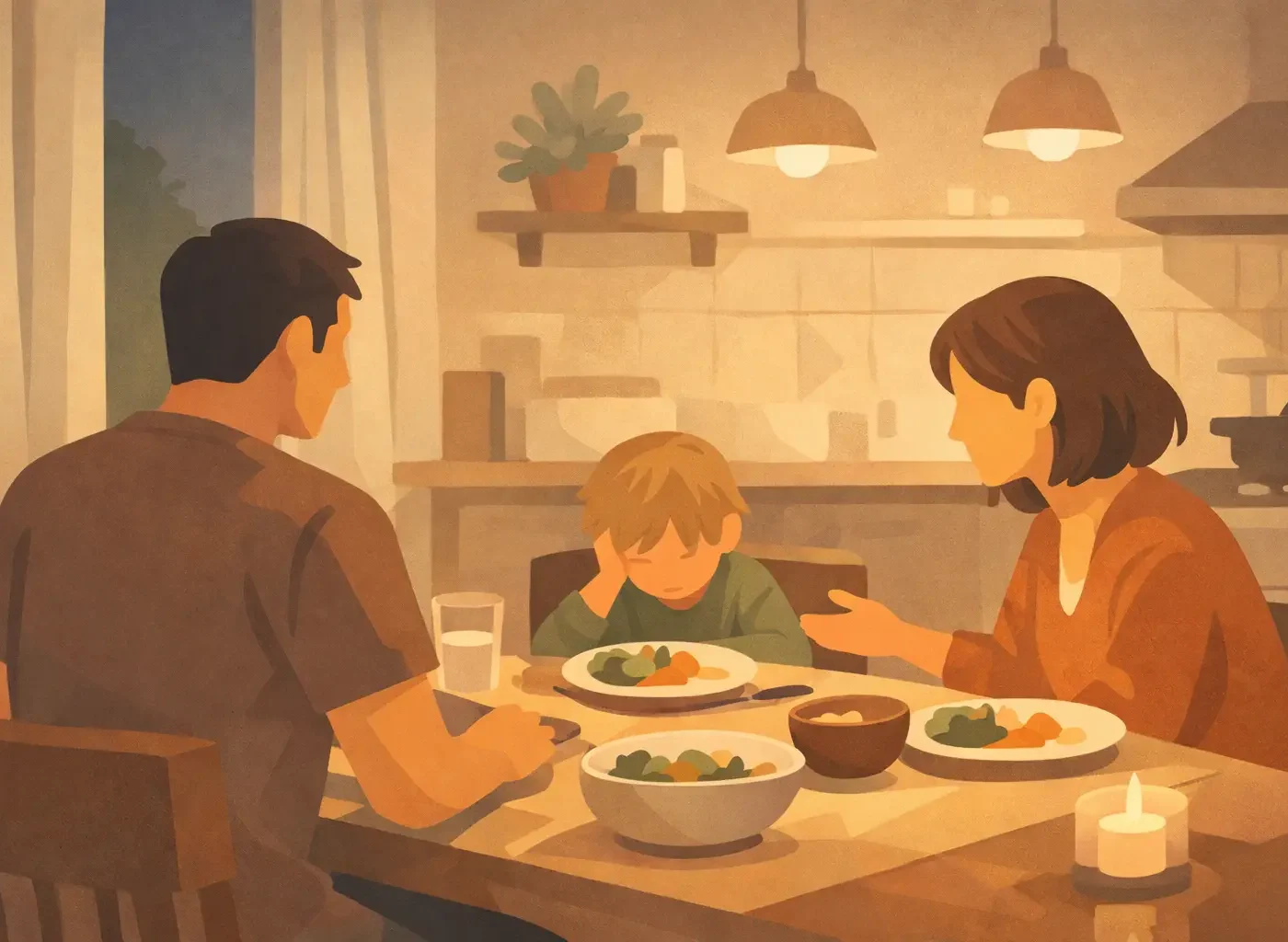
The pasta is suddenly the wrong shape. Your child wants crackers, not the meal you made. You are hungry too, the kitchen is a mess, and dinner has become the hardest 20 minutes of the day. Having a picky eater at dinner can make a perfectly ordinary family meal feel like a daily referendum on whether you are doing this parenting thing right.
You are not failing. Food preferences can be intense, and evening is a particularly hard time to work through them. Your child may be tired, hungry enough to be cranky but not patient enough for something unfamiliar, while you are trying to get everyone fed before the night moves on.
Start With a Picky Eater at Dinner
Your first job at dinner is not to get your child to eat a certain amount. It is to make the table feel safe enough to come back to tomorrow.
Begin by serving one food your child usually accepts alongside the family meal. This does not mean cooking a separate dinner on demand. It can be plain rice beside a saucy dish, bread next to soup, or fruit with a meal that has several unfamiliar parts. The familiar food gives your child a place to begin without turning you into a short-order cook.
Then let the meal be the meal. Sit down if you can, offer the food without a sales pitch, and keep your language simple. “You do not have to eat that.” “It can stay on your plate.” “You can have more rice if you are still hungry.”
This is less dramatic than persuading, bargaining, or insisting on one bite. That is the point. The more attention a disliked food receives, the more it can become the main event.
If your child says, “I hate it,” try not to argue with the verdict. You can say, “You do not like it today,” and move on. Children often use big, final language for a small, immediate feeling. You do not need to match its intensity.
Keep the food where it belongs
Put a small portion of new or disliked food on the plate, or place it in a serving bowl within reach. Either can work. A plate may feel less overwhelming for one child, while another does better seeing the food nearby with no expectation attached.
Your child is allowed to leave it untouched. They may sniff it, separate it, lick a tiny bit, or ignore it completely. Those are all ways of being near a food without being ready to eat it. The win is not a clean plate. The win is a dinner that does not end in a power struggle.
Make the Table Predictable, Not Perfect
A calm dinner is built from a few repeatable choices, not from making the perfect meal.
Picky eating gets harder when everyone is improvising while tired. A little predictability lowers the temperature for you as much as for your child.
Try serving dinner at roughly the same point in the evening when your schedule allows. Keep the expectation clear: this is the food available now, and nobody has to perform excitement about it. If your child is finished, they can be finished. You do not need to extend dinner into a negotiation about what might be made next.
This can be especially useful when one parent gets home near dinner. The returning parent may walk into a child refusing food and understandably jump in with questions, encouragement, or a new suggestion. A quiet handoff helps. Agree on a short shared approach, such as offering the meal, keeping one familiar item on the table, and avoiding pressure. Your child benefits when the adults sound steady rather than urgent.
One thing that worked for us was putting the familiar item directly on the table instead of announcing it as a backup plan. That small shift made it feel like part of dinner, not a prize for rejecting everything else.
It also helps to keep conversation away from intake. Talk about the funny thing that happened at school, the dog next door, or what everyone is doing this weekend. You are not ignoring the food issue. You are showing your child that family connection does not depend on eating the right thing.
Why Pressure Usually Makes Dinner Harder
When food becomes a test, a child often protects their sense of control by saying no even more firmly.
It makes sense that parents reach for pressure. You have put time, money, and care into dinner. You may worry that your child will go hungry, waste food, or never move beyond a narrow group of favorites. At the end of a long day, “Just take one bite” can feel like the smallest possible request.
But a child who feels watched or cornered may focus less on the food itself and more on escaping the moment. Promising dessert for bites, pleading, counting bites, or commenting on how little they ate can all make the table feel like a stage.
That does not mean you must sound detached or pretend you do not care. You can be warm and matter-of-fact. “That is what we are having tonight.” “You can choose what goes in your mouth.” “I will save your plate if you decide you are hungry later.” Use the version that fits your household, and say it without a long explanation.
The trade-off is real. Your child may eat very little at some meals while you are changing the pattern. It can feel uncomfortable to stop trying to fix it in the moment. Still, a child who learns that dinner is not a battle has more room to become curious over time.
Help Your Child Get Used to Food in Small Ways
Trying food is a skill that grows through low-pressure exposure, not a one-night breakthrough.
A child does not need to eat a full serving to make progress. Seeing roasted chicken repeatedly, helping rinse berries, choosing whether carrots are cut into coins or sticks, or putting cheese on a plate all create familiarity. These small moments count because they reduce the newness.
Keep the request smaller than you think it needs to be. Instead of asking your child to “try vegetables,” you might say, “You can put one pea on your plate,” then let that be enough. If they say no, do not turn it into a debate. Offer it another time.
You can also separate foods when mixed dishes are a sticking point. A child who rejects a casserole may be more willing to eat rice, chicken, and vegetables when each part is visible. This is not catering to a preference forever. It is a practical bridge that lets your child recognize what is being offered.
Avoid disguising foods as a regular strategy. It may get nutrients into a meal, but it does not give your child much chance to learn what foods look and taste like. There is room for a blended sauce because your family enjoys it. Just try not to make secrecy the foundation of dinner.
Handle the Hard Version of Picky Eating
Some dinners will still be messy, and a rough meal does not erase the calmer pattern you are building.
The hardest nights are usually not about green beans. They are about a child who is exhausted, a parent who has had no break, and a meal that lands at the wrong moment. On those nights, keep your response shorter, not smarter.
If your child is yelling, refusing the chair, or throwing food, pause the meal and deal with the behavior plainly. “Food stays on the table.” “I will move your plate if you throw it.” You can remove the food that is being thrown without shame or a lecture. When things settle, offer a simple path back: “You can come sit with us when you are ready.”
If you made a meal that nobody touches, it is okay to call it a miss. Put away what can be saved, make a mental note, and resist turning it into a verdict about your cooking or your child. Tomorrow can include a familiar dinner and another small chance to see something new.
It may help to plan a few low-effort meals for the evenings when work, activities, or general life have stretched everyone thin. Repeating meals is not lazy. It gives you fewer decisions when your patience is already in demand.
Give It Time, and Let Dinner Be Dinner
The goal is a child who feels secure at the table, not a child who eats to make you feel reassured.
You can offer variety, keep boundaries around respectful behavior, and stop carrying the impossible job of controlling another person’s appetite. Your child may not become adventurous quickly. Some children need a long runway with new foods, and some remain selective in ordinary ways.
For tonight, make one meal, include something familiar, and let the conversation be bigger than what is on the plate. A quieter dinner may be the most useful thing you serve.