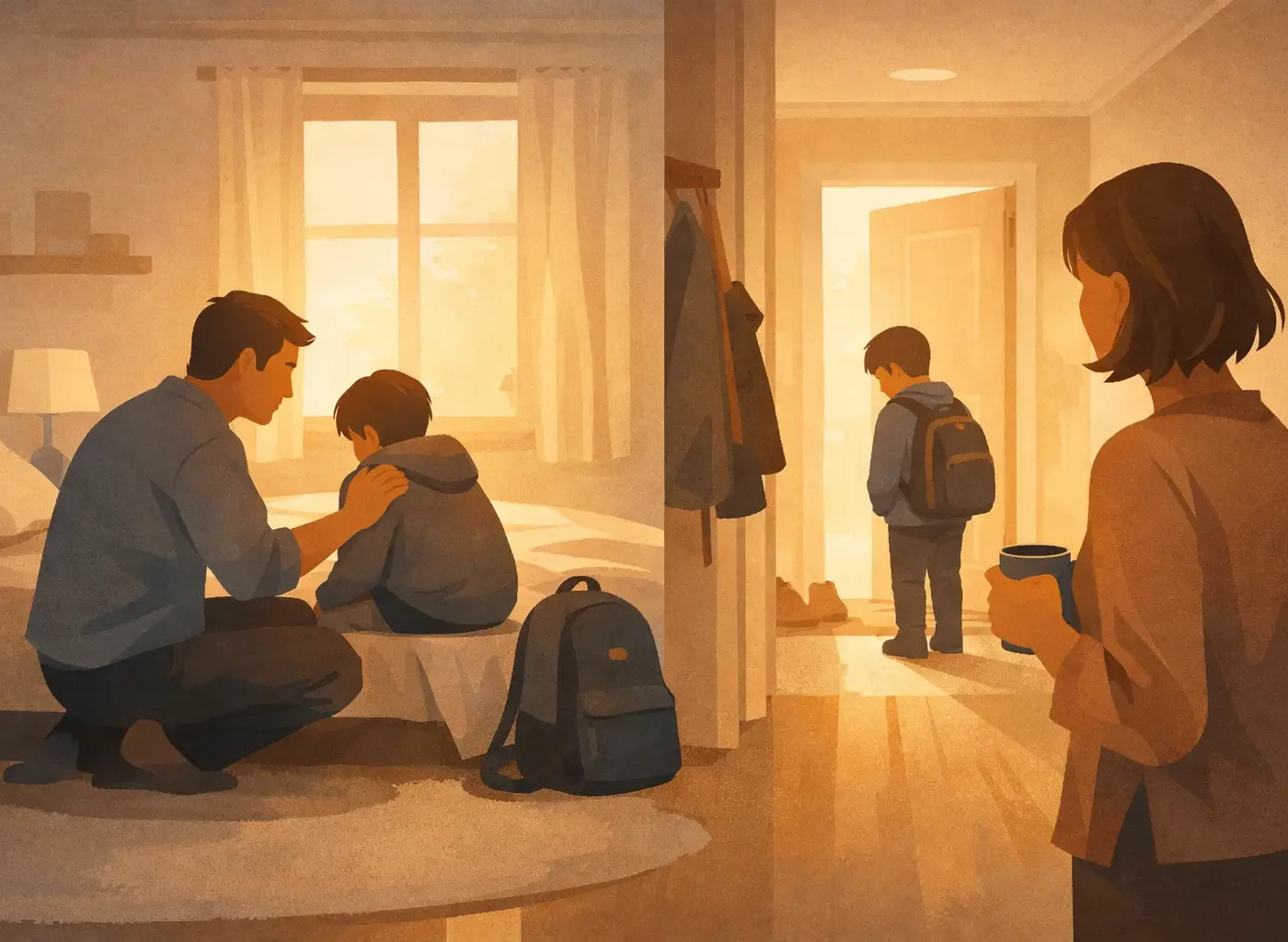
The shoe is on, the backpack is packed, and the clock is doing what it always does. Then your child plants themselves by the door, cries, or says their stomach hurts. When your child doesn’t want to go to school, it can turn an ordinary weekday into a standoff before either of you has had breakfast.
This is a hard problem because you are trying to hold two things at once: your child’s distress and the fact that school still needs to happen. A difficult school morning does not mean you have caused it, and it does not mean your child is being difficult on purpose. Start by making the next few minutes less explosive.
Start With the Next Ten Minutes
Your first job is not to solve the whole school problem before 8 a.m. It is to lower the temperature enough to get through the immediate moment.
Use fewer words than you think you need. A calm, plain sentence can give your child something steady to lean against: “You really do not want to go today. I hear that. We are still getting to school, and I will help you get there.”
You do not need to persuade them that school is fun. In fact, trying to talk them out of their feelings can make them work harder to prove how bad it feels. Name the feeling, hold the boundary, then move to one small action: socks on, into the car, walk to the gate.
If your child is younger, offer a limited choice that does not reopen the decision about attendance. They can carry their backpack or wear it. They can walk beside you or hold your hand. Older children may want a little more privacy, but the same principle applies. Keep the choice small and real.
It also helps to decide ahead of time which parent handles the school handoff when possible. The parent who can stay most even should take the lead, while the other handles lunch boxes, siblings, or the logistics at home. This is not about who is the “better” parent. It is about using the calmest available adult for the hardest part of the morning.
Make a Small Plan With School
You and the school are on the same side, even when the handoff feels messy. A brief, practical conversation with your child’s teacher, counselor, or front office can change what happens at the gate.
You do not need a long explanation or a perfect account of every morning. Say that your child has been struggling to get in, explain what the hard moment looks like, and ask for one specific support at arrival. That might be a familiar staff member meeting them at the door, a predictable job to do when they enter, or permission to go straight to a quieter space for a few minutes.
A short goodbye plan matters. Lingering often makes separation harder for both of you, especially if your child learns that crying brings another ten minutes of negotiation. You can be warm without stretching it out: hug, repeat the same goodbye words, hand them to the agreed adult, and leave.
This can feel awful. Your child may cry harder when you walk away, and every instinct may tell you to go back. But a consistent handoff gives them a clearer message than a long, uncertain goodbye: “You are safe here, and I trust the adults who will help you today.”
Ask the school to tell you how the first part of the day went, especially at the beginning. Often, parents only see the hardest two minutes. Knowing whether your child settled after you left helps you choose the next step based on what is actually happening, not only on the scene at the door.
When Your Child Doesn’t Want to Go to School Again
Repeated resistance is information, not proof that your child or your family is broken. The goal is to get curious outside the rushed morning, when nobody is trying to find missing shoes.
Choose a quiet time later that day and keep the conversation gentle. You might say, “Mornings have felt really hard lately. I want to understand what part of school feels tough.” Then pause. Some children answer right away. Others will talk while drawing, in the car, or after you have stopped asking direct questions.
The problem may be a friendship shift, work that feels confusing, a noisy lunchroom, a teacher they are still warming up to, a change in routine, or the simple weight of a long day away from home. Sometimes children cannot explain it clearly. They may only be able to say, “I don’t know,” or “I just hate it.”
Take that answer seriously without treating it as the final word. You can say, “Okay. You do not have to explain it all right now. I am going to keep paying attention, and we will make a plan together.”
Try not to turn every afternoon into an investigation. One or two calm questions are enough. Your child needs to know you care about the reason, but they also need room to come home and be a kid rather than report on every difficult moment.
Build a Return Your Child Can Manage
Confidence usually grows after a child gets through a hard moment, not before it. That is why tiny, repeatable steps can be more useful than grand promises or rewards.
Work with the school on a plan that fits the actual sticking point. If the doorway is the problem, focus on getting through the doorway. If the first class is hardest, arrange a settled activity waiting at the desk. If lunch is the worry, see whether a staff member can help your child connect with a familiar peer or know where to sit.
At home, keep the message simple and steady. Avoid making school the only topic at dinner, and avoid big bargains that turn each day into a negotiation. A small acknowledgment after a hard drop-off can be enough: “That was really hard this morning, and you did the next step anyway.”
One thing that worked for us during a rough patch was making the car ride predictable. The same short playlist, the same parking spot when possible, and the same goodbye sentence did not make the feelings disappear. It did make the morning feel less like a new emergency every day.
Some weeks will improve quickly. Other situations take more patience and more coordination with school. If your child is repeatedly unable to enter school or the struggle is growing rather than easing, keep the school informed and ask for a meeting to make a more detailed support plan. You do not have to carry that problem alone from your kitchen table.
Protect the Relationship During Hard Mornings
A firm school boundary and a close relationship can exist in the same morning. Your child may be angry with you for making them go, and you can still be the safe parent they come back to afterward.
Try not to demand a cheerful goodbye, an apology, or gratitude once the immediate crisis has passed. Later, reconnect in a low-pressure way. Sit nearby while they have a snack, take a short walk, or let them tell you about something completely unrelated to school. The repair is often ordinary.
If you snapped because you were late for work or your other child was crying in the hallway, repair that piece too. “I was stressed, and I raised my voice. I am sorry. School still had to happen, but I want to handle the hard part more calmly tomorrow.” This teaches your child that adults can own their behavior without giving up the boundary.
For the parent carrying the morning details, the forms, the teacher messages, the clothes, and the emotional weather forecast, this can become exhausting fast. Let your partner know the specific job that would make tomorrow lighter. Maybe it is packing bags the night before, driving the drop-off, or sending the message to school. Small, visible help is often more useful than general reassurance.
A child who does not want to go to school needs calm structure, but so do you. Tomorrow does not need a perfect script. It only needs one steadier handoff, one clear message, and the sense that your child is not facing the hard part alone.