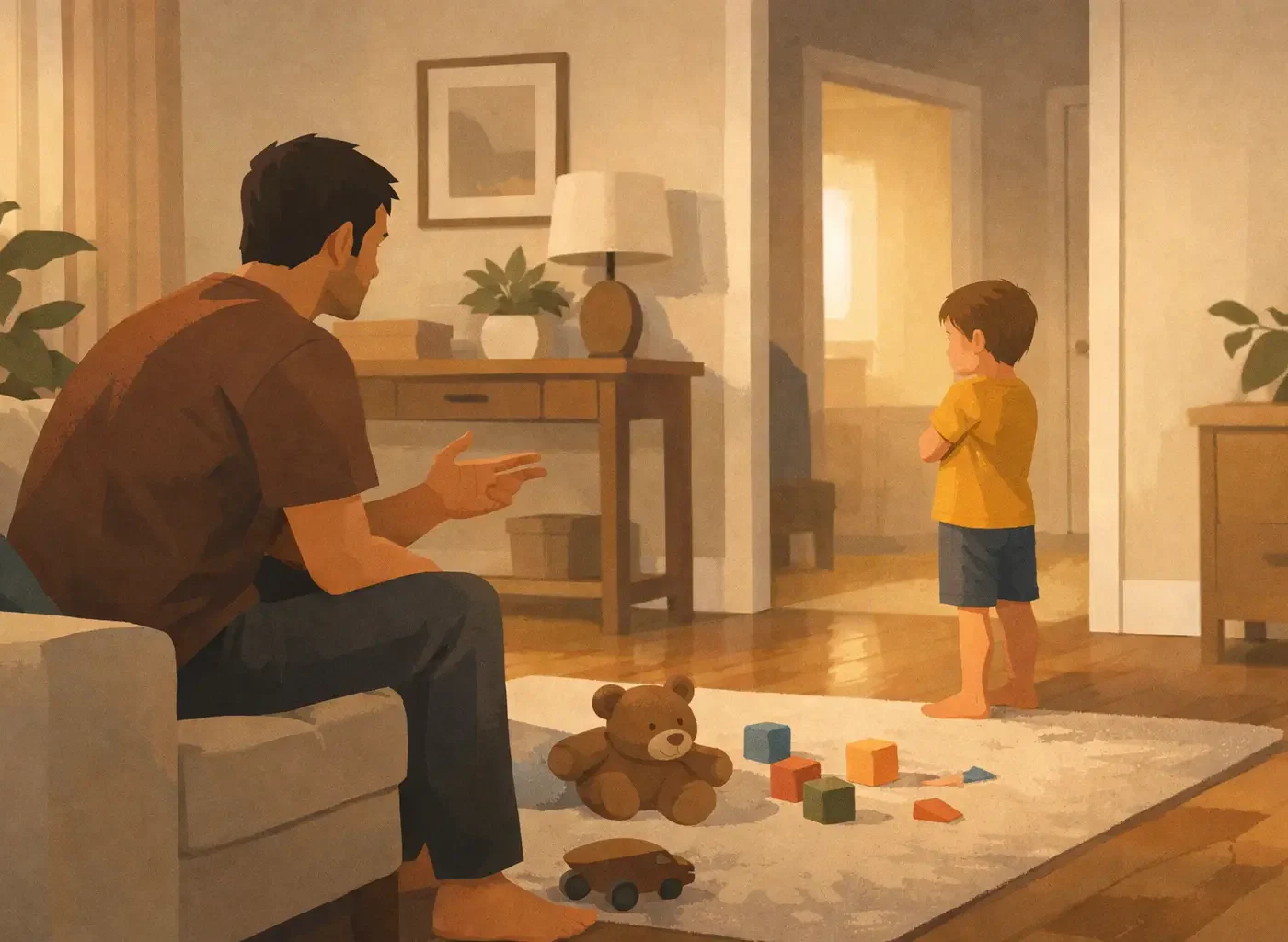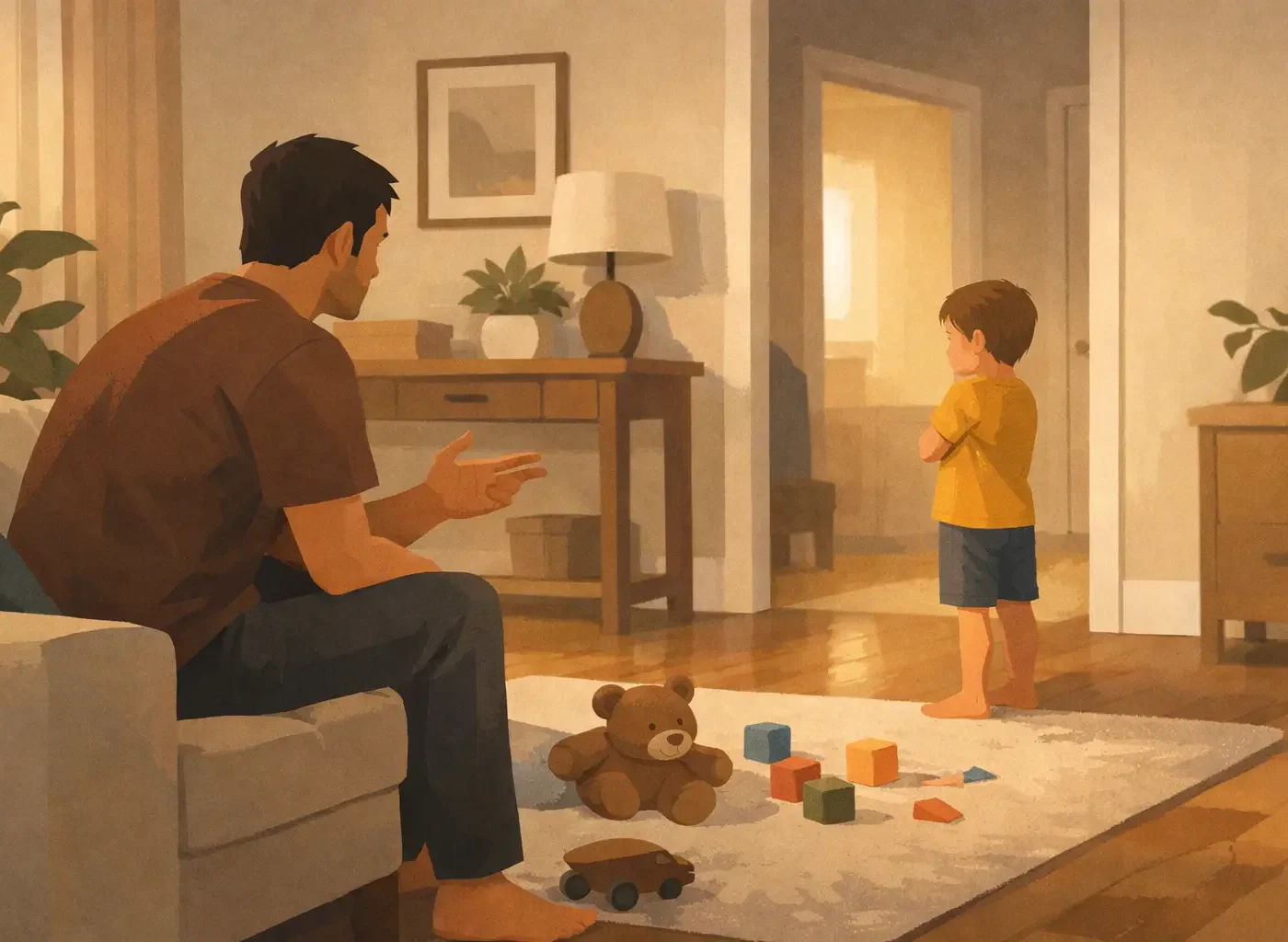
At 5:12 p.m., you are trying to get shoes on, dinner started, and a child moving toward the car. You have asked three times. Your preschooler won’t listen, or at least that is how it feels when they look right at you and keep building with blocks.
This is one of the most draining parts of life with a young child because it can make a simple request feel like a personal challenge. It is not. You are not failing, and your child is not trying to ruin the evening. They need more help moving from what they are doing to what needs to happen next.
When Your Preschooler Won’t Listen, Start Closer
Calling directions across a room usually creates more repeats, more volume, and more frustration. Before you ask, move close enough to touch your child’s shoulder gently or crouch beside them. Say their name, wait for them to look up, then give the direction in a few plain words.
Instead of, “How many times do I have to tell you to put your shoes on?” try, “Sam, shoes on now. I will help you start.” Then pause. Preschoolers often need a few seconds to shift their attention before they can act.
Connection before a direction makes cooperation more likely, not because you are giving in, but because your child can actually take in what you said.
This can feel painfully slow when you are late. Still, walking over once is usually faster than shouting five times from the kitchen. If your child is deeply involved in play, name the next step and offer a small bridge: “You can park the truck by the couch, then we are putting shoes on.” You are not asking permission. You are helping them leave one task and enter another.
Use Fewer Words and One Clear Direction
A preschooler can hear a long explanation as a blur, especially when they are tired, hungry, excited, or disappointed. The more words you add, the more room there is for the conversation to slide away from the actual task.
Give one direction at a time. “Put the crayons in the box” works better than, “Clean up your crayons, find your sweater, use the bathroom, and please stop climbing on the chair because we need to leave.” The whole plan may be clear in your mind, but it is too much to hold at once for a young child.
Clear does not have to mean harsh.
Use statements more than repeated questions. “It is time to wash hands” is easier to understand than “Can you go wash your hands now?” If washing hands is not optional, a question can accidentally invite a debate neither of you has time for.
You can offer a choice inside the limit when there is a real choice to give. “Do you want to hop to the bathroom or walk like a giant?” may sound small, but it gives your child a little control without changing the plan. If both choices are refused, stay calm: “You do not have to choose. I will help you walk.”
Make Follow-Through Boring and Predictable
Children learn that a direction matters when your actions match your words. That does not mean you need a dramatic punishment or a raised voice. It means you say less, then calmly help the next step happen.
If you say, “Blocks go in the bin before we start dinner,” and your child keeps playing, move beside them and begin cleanup together. You might say, “I see you want to keep playing. It is cleanup time. I will put in the blue blocks, and you can do the red ones.” If needed, you can gently guide their hands toward the job.
Follow-through is not about winning a standoff. It is about showing your child that your words are steady.
Some days they will protest loudly. That does not mean the approach is wrong. You can allow disappointment without changing the limit: “You wanted more time. You are mad. We are still leaving.” Keep your voice as neutral as you can. A child who is upset does not need a speech. They need an adult who can hold the line without adding heat.
The hard version is when you have already repeated yourself ten times. If you can, stop talking for a moment, take one breath, and walk over. Begin again with the next physical step. Your child does not need you to handle every moment perfectly. They need enough calm, clear moments to know what happens next.
Notice the Requests That Go Wrong Most Often
Listening problems are rarely spread evenly through the day. They tend to show up during transitions: leaving the park, stopping a favorite activity, getting into the bath, or climbing into the car when everyone is already running late.
Look for the two or three requests that regularly go sideways in your home. Then change the setup before you change your tone. For example, if leaving the playground is always rough, tell your child when there are five minutes left and again when there is one minute left. At the final reminder, walk over and help them choose one last thing to do.
A predictable transition asks less of your child than a sudden demand.
One thing that worked for us was giving the next activity a job-like purpose. “We need to go home and feed the dog” landed better than a vague “Time to go.” It will not work every time, and it will not erase disappointment. But concrete language gives a preschooler something understandable to move toward.
Also consider your own timing. If you tend to issue directions while answering a work message, stirring dinner, or talking with your partner, your child may have learned that the first request is not the real request. Save directions for the moment you can follow through. A pause of thirty seconds can prevent a much longer clash.
Why Preschoolers Push Back So Often
Preschoolers are practicing independence with very little power over their days. Adults decide when they wake up, where they go, what must happen, and when play ends. Saying “no” or ignoring a request can be their clumsy way of testing whether they have any say at all.
Your child’s resistance is usually a sign that a skill or transition is hard, not proof that they do not respect you.
That does not mean every request becomes negotiable. It means you can see the behavior clearly enough to respond usefully. A child may need help stopping an enjoyable activity, understanding an instruction, or doing a task that feels big. They may also be checking whether the boundary will hold. Your calm response teaches more than a long explanation ever could.
This is why threats often backfire. “If you do not listen, I am never taking you here again” may get movement in the moment, but it raises the temperature and gives you a promise you may not want to keep. Small, immediate follow-through is more workable: “You are having trouble walking beside me, so I am holding your hand to the car.”
If You Lost Your Temper, Repair the Moment
Every parent has moments when the pressure catches up with them. Maybe you shouted after the fourth ignored request. Maybe your words came out sharper than you intended. That is worth naming, but it does not erase the boundary or make you a bad parent.
When things are quieter, keep the repair simple. “I yelled earlier. That was too loud, and I am sorry. You still needed to put your shoes on. Next time I will come closer and help you.” This teaches your child that adults can take responsibility for their behavior while still expecting cooperation.
Repairing after a hard moment builds trust without pretending the hard moment did not happen.
If you share parenting with a partner, it helps to agree on just one or two phrases for recurring conflicts. Maybe both of you use, “I am going to help you start,” rather than one person bargaining while the other raises their voice. You do not need a perfect system. You need enough consistency that your child is not asked to guess where the line is.
Tomorrow, pick one request that has been wearing you down. Walk over, get close, say it simply, and help your child begin. It may not look graceful at first. But these small, steady moments are how a home gets a little calmer.