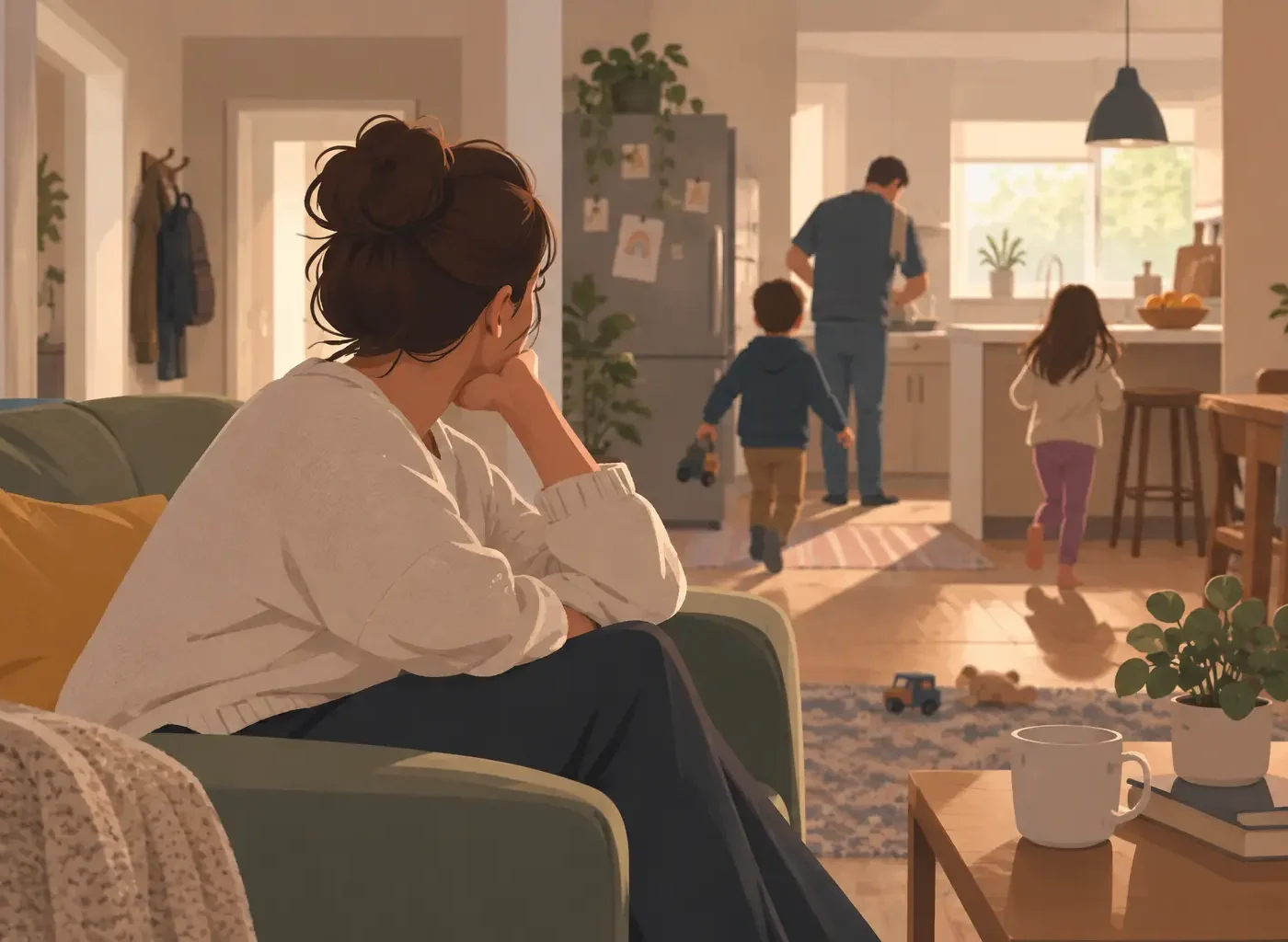
You used to have answers ready when someone asked what you liked to do. Maybe you read novels on the train, played pickup basketball, made elaborate plans for a weekend, or simply had a preference about what to watch after dinner. Now, when a rare pocket of time appears, you may stand in the kitchen scrolling your phone, too tired to know what you want.
Losing your identity after kids can feel unsettling because parenthood is not just a new role. It can rearrange your time, attention, friendships, body, work, home, and relationship to rest. Feeling less recognizable to yourself does not mean you love your children any less. It means a very full season has taken up a lot of room.
Start Smaller Than a New Version of You
The pressure to “find yourself again” can make this harder. It suggests there is a polished former version of you waiting to return, as if the years since your child arrived did not change you at all.
You do not need to become your old self again to feel like yourself. You need a little regular contact with parts of you that are not organized around keeping everyone else moving.
Start with something so small it does not require a family overhaul. Ten minutes with a book you chose for yourself counts. So does putting on music you actually like while making dinner, taking a walk without using the time to make calls, or writing down one thought before bed that has nothing to do with the next day’s logistics.
The activity matters less than the signal it sends: your preferences still belong here.
For fathers, this may mean noticing the gap between being needed and being known. You may be the person who gets backpacks packed, handles a work deadline, fixes the loose cabinet handle, and keeps the Saturday schedule on track. Those things matter. But if every spare moment has a purpose, it becomes hard to hear your own thoughts.
For moms, the gap can show up in quieter ways. You might know your child’s current shoe size, which permission form is due, and exactly how much time you have before a small disagreement becomes a late departure. Yet someone asking what you would enjoy can feel strangely difficult. That is a common effect of spending so much attention outward.
Choose one small practice and protect it twice this week. Not forever. Not perfectly. Twice is enough to begin.
Make Room Without Making More Work
A personal interest only helps if it does not create another job. A complicated class, an ambitious fitness goal, or a new side project may be wonderful later. At 9pm, with a child calling for water and tomorrow already waiting, it may be too much.
The right amount of personal time is the amount you can return to without paying for it afterward. If an hour away means you come home to more stress, resentment, or an impossible catch-up, begin with a smaller arrangement.
Talk plainly with your partner about one protected window each week. Keep the request concrete: Tuesday from 7:30 to 8:00, Saturday morning before the house wakes up, or a solo errand that takes the long route home. This is not a request for permission. It is a practical agreement that both of you need room to be people as well as caregivers.
One thing that worked for us was treating personal time as ordinary calendar time. Not a prize for finishing everything, because family life rarely offers a finished moment. When it had a place on the calendar, it was less likely to disappear under laundry, email, and the thousand small tasks that always look urgent.
If your partner is the one who seems far away from themselves, do not assume they need a grand gesture. Ask a specific, low-pressure question: “Would thirty minutes alone on Saturday help, or would you rather do something together that feels like us?” Specific choices are easier to answer when someone has spent months responding to everyone else’s needs.
This can feel awkward at first. You may both be used to using free time for catching up. Sometimes that is genuinely what needs to happen. But catch-up cannot be the only thing free time is for, or life starts to feel like maintenance with children in it.
Why Losing Your Identity After Kids Can Feel So Sharp
Parenthood asks for repetition. The same meals, the same reminders, the same shoes that vanish five minutes before leaving. Repetition is not meaningless, but it can narrow the view of yourself when there is little time for novelty, mastery, or adult conversation.
There is also a difference between choosing to set something aside for a season and realizing it has quietly disappeared. The second one often brings grief. You may miss a hobby, a career direction, the version of friendship you had, or the ease of making plans without calculating naps, pickups, cost, and energy first.
Missing a former part of your life does not mean you are rejecting the life you have now. Both feelings can be true in the same afternoon.
It also depends on your circumstances. A parent with a flexible schedule may be able to reclaim time more easily than a parent working shifts, caring for several children, or living far from support. The answer is not to try harder than your actual life allows. The answer is to look for the smallest available opening and let it be enough for now.
Sometimes the loss is less about an activity and more about being seen in only one role. Friends may ask about the kids before they ask about you. At work, you may feel behind. At home, you may feel like the person who handles whatever is next. Naming that shift can reduce the shame around it.
Let Your Children See a Whole Person
You do not have to disappear into a room for hours to show children that adults have interests. They can see you sketching at the table, tending plants, following your team, practicing guitar badly, calling a friend, or making a meal because you enjoy it rather than because it has to be done.
Your child benefits from seeing that love does not require a parent to erase themselves. This is not about making your child responsible for your happiness. It is about letting them grow up around adults with ordinary needs, interests, and limits.
It may be tempting to wait until children are older, schedules calm down, or you have more energy. Some seasons will truly be too demanding for much more than survival. Still, a tiny expression of self can fit inside a constrained life. You can keep a library book by the couch. You can listen to a favorite podcast while folding clothes. You can text the friend who knew you before parenthood and say, “I miss talking about things that are not kid-related.”
The point is not productivity. You do not need to turn an interest into income, expertise, or a personal brand. Pleasure without a purpose is allowed.
When You Cannot Name What You Want Yet
The hardest version of this is not having time. It is having a little time and feeling blank. If that is where you are, skip the demand to identify your passion. Start with noticing.
Pay attention to what makes you feel a little lighter, even briefly. Notice the topics you linger over, the places you miss, the skills you admire in other people, and the moments when you forget to check the clock. These are not instructions. They are clues.
A blank answer is not proof that you have lost yourself for good. It may simply mean you have been busy responding to what everyone else needs.
Try a short sentence starter on your phone: “Before kids, I enjoyed…” Then add a second: “Lately, I have been curious about…” You do not need to act on either answer immediately. Seeing the words can be a quiet reminder that your inner life is still there.
If sadness or disconnection feels heavy and persistent, it can help to talk with someone you trust or seek professional support. You deserve care too, not because you have failed to cope, but because carrying a lot alone is hard.
Your identity after kids may be less spontaneous, more interrupted, and still in progress. It can include the parent you have become and the person you were before. Start with one small choice that belongs to you, then make space to choose it again.