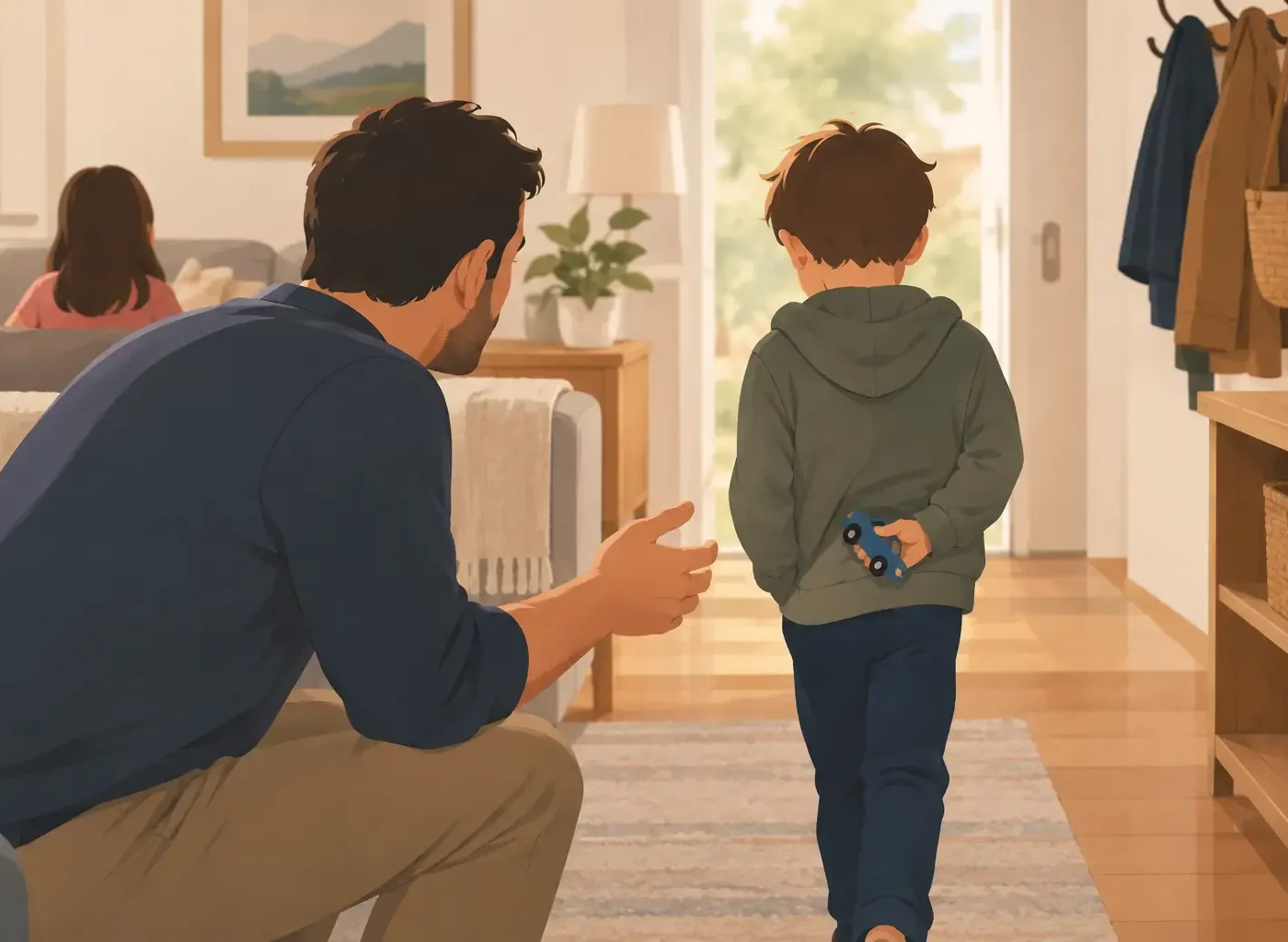
The tiny toy appears in a coat pocket. A classroom pencil shows up in the back seat. Your child insists it was given to them, then goes quiet when you ask again. When your child takes something that isn’t theirs, it can bring up a sharp mix of worry, embarrassment, and fear about what the behavior means.
Take a breath before you decide it means anything big. Children can know a rule and still make a poor choice when they want something, feel left out, worry about asking, or simply act before thinking. You can be clear about the limit without making your child feel like they are the limit.
Table of Contents
What to do when your child takes something that isn’t theirs
Start privately and keep your voice low. If you found the item, describe what you see rather than leading with an accusation: “I found this in your pocket. It belongs to someone else, and I need to understand how it got here.” Then stop talking long enough for your child to answer.
They may deny it, cry, shrug, or give a story that changes halfway through. That can be hard to sit with, especially if you are already late, tired, or standing in a store with other people nearby. Still, a public lecture usually turns the moment into a fight about humiliation rather than a chance to put things right.
Your first job is to make the situation safe enough for honesty, not comfortable enough to avoid repair.
You can say, “You are not in trouble for telling me the truth. Taking something that belongs to someone else is not okay, and we will fix it.” This gives your child two steady messages at once: they can come to you with a hard truth, and the rule has not moved.
If the item is small and the owner is clear, put your energy into returning it promptly. If it belongs to a store, return it to the store. If it belongs to a classmate, neighbor, or sibling, help your child get it back directly when possible. Do not quietly replace it yourself and hope the moment disappears. Your child needs to see that repair is part of what happens next.
Help your child make it right without doing it all for them
The repair should fit your child’s age and the situation. A preschooler may hand back a toy with you close by and say, “I’m sorry.” An older child may need to return an item to a teacher, write a short note, or speak to the owner with you nearby. Keep the language plain. Long apologies can become another form of pressure.
If returning the item in person would create a bigger scene or expose your child to unnecessary shame, contact the adult involved first. You might say, “My child came home with an item that was not theirs. We are returning it, and I wanted to let you know.” You do not need to offer a long explanation or turn your child into a cautionary tale.
Repair is not about making your child feel bad for as long as possible. It is about showing them how to put harm right.
There may also need to be a practical limit at home. If your child took money to buy something online, for example, access to purchases may need closer adult oversight for a while. If they repeatedly bring home objects from a particular place, you may need to check pockets together before leaving. Make the limit connected to the problem, brief, and calm.
Avoid adding unrelated losses just because you are upset. Taking away every pleasure for a week may feel satisfying in the moment, but it can blur the lesson. Your child is more likely to hear, “I am bad and everything is ruined,” than “I need to return what is not mine and ask next time.” If you and your partner see the consequence differently, settle it privately first, because disagreeing on discipline in front of your child tends to pull the focus away from the repair.
Why children take things that do not belong to them
Sometimes the reason is simple desire. Your child sees something they like, knows they probably will not get it, and grabs it. Sometimes it is about belonging. A child might take the same kind of pen their friend has, or keep a trinket because it feels connected to someone they admire.
Younger children are still learning what ownership means in real life. They may understand that a toy belongs to another child, yet feel that wanting it strongly makes it fair to use. Older children usually understand the rule more clearly, but they can still get caught in a quick, unwise moment, especially around money, collectibles, or social pressure.
There can be a practical need underneath it too. A child who takes school supplies may be worried about not having what they need or about asking an adult for help. That does not excuse the choice. It does tell you what to address after the item is returned.
The reason behind the behavior can guide your response, but it does not erase the boundary.
Later, when nobody is rushing out the door, try a short conversation. “What was happening right before you took it?” “What did you hope would happen?” “What could you do next time if you want something that is not yours?” You are looking for a usable plan, not a confession with perfect wording.
One thing that worked for us was practicing the exact sentence a child could use in the moment: “Can I borrow this?” or “I really like that. Can I ask my dad?” It sounds almost too basic, but children often need the words ready before they can use them under pressure.
When your child lies about taking something
The lie can sting more than the item. You may feel as if your child looked straight at you and chose to break trust twice. Try to separate the two pieces. Address the taking first, then explain that telling the truth helps you solve problems together. The broader pattern of what to do when your child lies to you applies here too.
You can say, “I can handle a mistake. I need you to tell me the truth so we can fix it.” If you already have clear proof, do not set up a long interrogation. State what you know and leave room for your child to join you in putting it right. Psychologists at the Child Mind Institute suggest offering a “truth check”, a chance for a child to change their first answer without getting in trouble, since many children lie on the spot out of fear of disappointing a parent.
Honesty grows better in a home where mistakes are handled firmly and without a personal attack.
This does not mean accepting every explanation. If your child says a friend gave them an expensive item, check with the other adult before treating the matter as settled. Be matter-of-fact. Children learn that honesty is expected when they see you follow through calmly, not when they see you explode.
If this happens more than once, increase your involvement for a while. Know what comes home in backpacks and pockets. Keep cash and online payment details secure. Talk with the school or another caregiver when the pattern involves shared spaces. The goal is not surveillance forever. It is temporary structure while your child practices a better choice.
Keep the label off your child
Words said in anger can stick. Calling a child a thief, dishonest, or untrustworthy turns one behavior into an identity they may begin to carry. It can also make them more defensive the next time they make a mistake.
Be specific instead: “You took something that was not yours.” “You told me it was yours when it was not.” “We are going to return it.” Specific language leaves room for growth while still being direct.
If you reacted harshly, you can repair that too. “I was really upset, and I raised my voice. The rule still stands, but I want to talk about it more calmly.” That does not weaken your authority. It shows your child what it looks like to own a mistake and try again.
This is one piece of a bigger approach, which we lay out in our positive parenting guide.
Frequently Asked Questions About When Your Child Takes Something That Isn’t Theirs
Is it normal for young children to take things that aren’t theirs?
Yes, especially before age six or seven. Young children are still learning what ownership means, and wanting something badly can feel like reason enough to take it. It is a teaching moment, not a sign of a deeper problem. Calm repair and clear words usually work far better than a big reaction.
Should I make my child return a stolen item to the store?
Yes, in a way that fits their age. A young child can hand it back with you beside them, while an older child can explain briefly and apologize. Returning it is the lesson. Quietly paying for it yourself or hiding the item teaches that the problem can simply disappear.
What consequence should I give when my child steals?
Keep it connected to the behavior. Returning the item and apologizing is the main consequence. If money or online purchases were involved, closer supervision for a while makes sense. Stacking unrelated punishments tends to make kids focus on feeling bad rather than on making it right.
Why does my child steal from their siblings?
Sibling taking is often about fairness, attention, or a feeling of not having enough of something. Picture a six-year-old who takes a sister’s markers because hers always seem better. Return the item, then look at the underlying need. Sometimes a few items of their own solves more than any lecture.
When should I worry about a child who keeps stealing?
If taking things continues after calm, consistent responses, involves lying and secrecy over months, or comes with other behavior changes, it is worth talking with your pediatrician or school counselor. Repeated stealing can sometimes signal stress, unmet needs, or something going on with friends that deserves a closer look.
Final Thoughts
When your child takes something that isn’t theirs, the moment can feel bigger than it is. Most of the time, it is a skill your child has not mastered yet, not a character flaw.
A child who takes something is not handing you a verdict on your family or your parenting. They are showing you a skill they still need to practice: stopping, asking, telling the truth, and repairing harm. Meet that moment with a clear boundary and a steady hand. The lesson will last longer than the lecture.
If you are the parent who tends to react loudest in moments like this, staying calm is the most powerful thing you can model. Kids learn honesty from the parent who makes the truth feel safe to tell.
How to Be a Better Dad is a practical guide to being the steady parent your kids can come to with the hard truths, written by a mom of two who has found more than one mystery toy in a coat pocket.