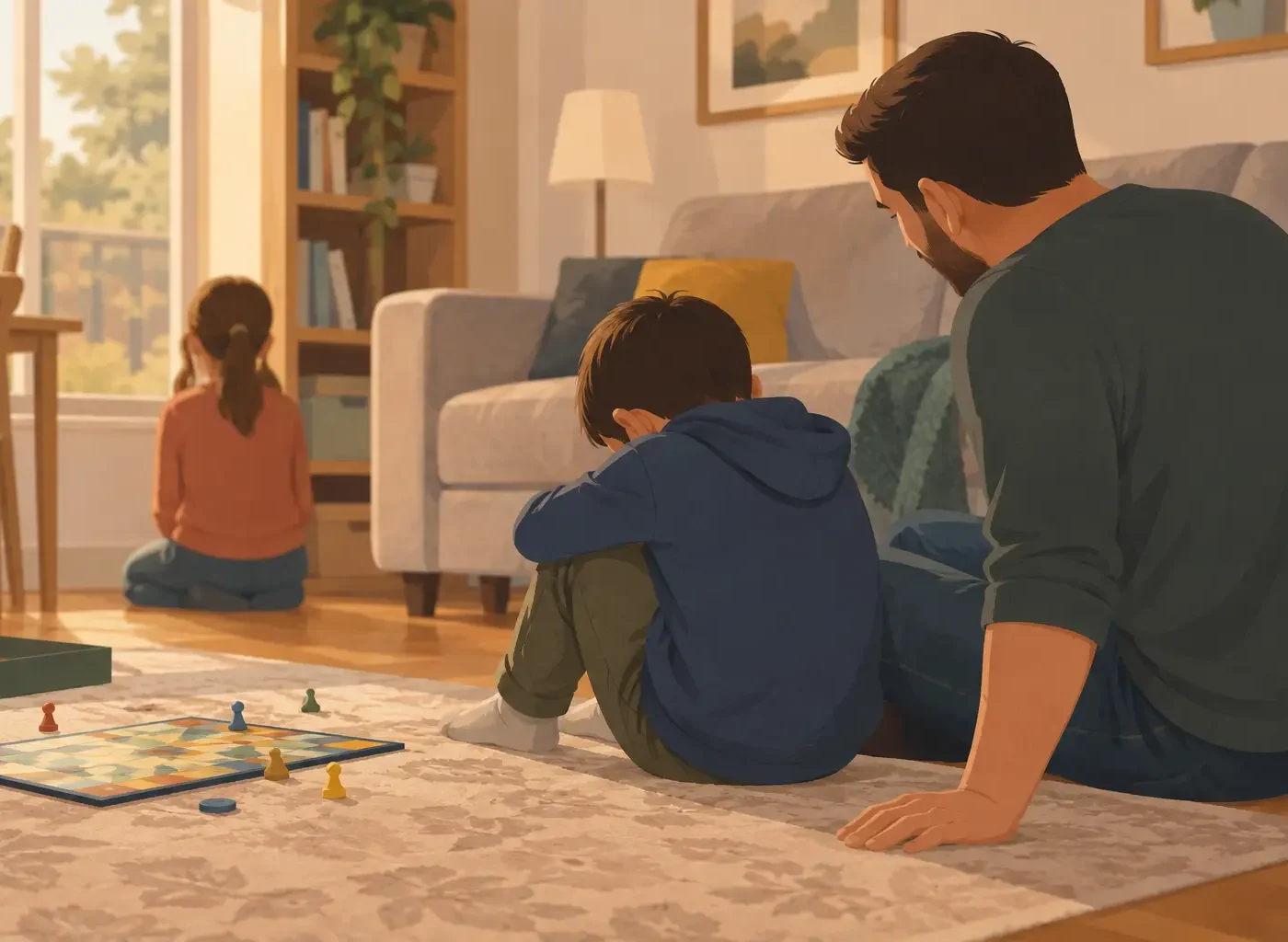
The board game is barely underway when your child knocks over the pieces, quits the race, or insists the rules were unfair. When your child hates losing at everything, even a casual game can leave everybody tense. This is exhausting, especially when you were only trying to fill half an hour before dinner. It does not mean you have raised a sore loser, and it does not mean your child is destined to struggle with every disappointment.
Table of Contents
What to do in the moment when losing goes badly
Start by making the game smaller than the conflict. If your child shouts, throws a piece, or storms away, do not try to teach a lesson while they are flooded. Calmly stop the activity and protect the people and objects around you. You might say, “You are really mad about losing. I won’t let you throw the pieces. This game is paused.”
The first goal is not graceful losing. It is a safe, steady pause.
Keep your voice boring and brief. A long explanation about sportsmanship can feel like more proof that everyone is watching them fail. If a sibling won, attend to the winner too: “You played fairly. We are taking a break now.” This avoids asking the winning child to shrink their happiness to manage someone else’s reaction.
Once the noise has dropped, offer a simple choice. Your child can put the game away for today, watch the next round without playing, or try a different activity later. They do not have to finish every game. Stopping is allowed. Throwing, insulting, or changing the rules after they lose is not.
The hard version is when you are already tired and the outburst happens in public, at a birthday party, or during a game with cousins. You may need to leave the game without resolving the feeling neatly. A quiet, “We are done playing right now,” is enough. You can handle the conversation later, when neither of you has an audience.
Help your child practice losing in manageable doses
Do not make family game night a test your child has to pass. Choose short games with plenty of turns, low stakes, and a clear ending. Skip games that combine luck, complicated rules, long waiting, and a public score board until this skill feels less raw.
Practice works better when your child gets small chances to recover, not one giant chance to prove themselves.
Before you start, say out loud what will happen: “Someone will win and someone will not. We can be disappointed, and we still keep the game safe.” Then model it when things do not go your way. Let them hear, “Oh, I wanted that card. I don’t like that result. My turn is over, so I am going to keep playing.” Keep it natural. A performance can make a child feel managed.
At first, choose cooperative activities sometimes, where everyone is working toward the same goal. These give your child practice with rules, turns, mistakes, and finishing something when it gets frustrating, without the sharp edge of one person beating another. Competitive games still matter. The point is to mix them in rather than making every family activity about who came first.
You can also set a tiny, realistic goal before a game. Maybe your child practices saying, “Good game,” after one round. Maybe they place the pieces back in the box after losing. Maybe they take a break without slamming a door. Notice that specific effort afterward: “You were upset, and you put the cards down instead of throwing them.” Praise for winning will always be easy to find. This is the part they are learning.
Why losing can feel so big to a child
For some children, losing feels less like a single result and more like a verdict. They may hear, “I am bad at this,” even if nobody said it. They may be especially bothered when an older sibling, a skilled parent, or a fast-moving group makes the gap obvious.
A child can be trying to protect their pride, even while their behavior makes the room harder.
Development matters too. Younger children are still learning that a rule can apply when it disappoints them, and that another person’s win does not erase their own effort. Older children may understand those ideas perfectly in a calm moment but struggle when the loss happens in front of friends.
Temperament plays a part. Some kids feel competition in their whole body. The American Academy of Pediatrics notes that children with an especially competitive spirit may melt down when they lose at board games, and suggests playful back-and-forth games to build flexibility. Others have had a run of hard losses at school, on a team, or with friends, so one more loss at home hits a tender spot. You do not need to solve every reason before setting a limit. Understanding the feeling helps you respond with care. It does not require you to let the game become chaotic.
Be careful with labels such as “bad loser,” “competitive,” or “dramatic.” Children often repeat the role they think the family has assigned them. Describe the moment instead: “Losing felt huge today,” or “You had trouble stopping when the score changed.” This leaves room for growth.
Words that help without pretending losing is fun
You do not have to sell losing as wonderful. Most adults do not enjoy it either. Your child is more likely to trust you if you tell the truth: “It stinks to want to win and not win.” Then add the boundary: “It is okay to be mad. It is not okay to call your brother names.”
You are teaching that feelings get room, while hurtful behavior still has a limit.
After a settled moment, keep the repair conversation concrete. “You threw the dice and they hit the wall. Next time, you can put them on the table and say you need a break.” If they insulted someone, help them make it right in a straightforward way. They might say, “I was mad and I said something mean. I am sorry.” Do not force a long apology speech while they are still angry.
Avoid rescuing them by secretly changing every outcome. Letting a young child win occasionally can be playful, but arranging constant victories teaches them that games are only safe when they control the result. It can also put you in an awkward spot when siblings notice. A better middle ground is adjusting the challenge openly: use a shorter round, offer a fair handicap, or play a game designed for different ages.
When your child hates losing at everything
If the reaction shows up in sports, homework, video games, races to the car, and nearly every shared activity, reduce the number of unnecessary contests for a while. Not every task needs a winner. At home, it can help to say, “We are getting shoes on, not racing,” or, “We are cleaning up together, not counting who finishes first.”
Less competition is not lowering the bar. It gives your child more room to build the skill underneath it.
Then choose one low-pressure setting to practice. A five-minute card game once or twice a week may teach more than a long family tournament that ends in tears. Keep the expectation modest and repeatable. Your child may still protest. Progress can look like recovering in ten minutes instead of forty, or being upset without wrecking the activity.
If your partner usually plays the competitive games, agree on a shared response before the next blowup. One parent can pause the game while the other checks on siblings or clears dinner. This is not about being perfectly united in every sentence. It is about not turning a child’s hard moment into a disagreement between adults.
This is one piece of a bigger approach, which we lay out in our positive parenting guide.
Frequently Asked Questions About Kids Who Hate Losing
At what age do kids learn to lose gracefully?
Most children start handling losses more calmly somewhere between ages 6 and 8, as their ability to manage frustration grows. Before that, big reactions to losing are very common. Even older kids can struggle when they are tired or losing in front of friends, so progress tends to come in waves rather than all at once.
Should I let my child win at games?
Occasionally, with a very young child, it does no harm. Arranging constant wins teaches that games are only safe when they control the result. A better approach is adjusting the challenge openly, with a shorter game, a fair head start, or a game built for mixed ages, so a win still feels real.
Is it normal for a child to cry every time they lose?
It is common, especially under age seven or in children who feel things intensely. Tears after losing usually mean the disappointment is bigger than their coping skills right now, not that something is wrong. Keep games short, stay calm, and notice small improvements, like recovering a little faster each time.
How do I stop my child from cheating when they are losing?
Name it calmly and keep the rule. “That is not how this game works. We play by the rules, even when it is hard.” Avoid big lectures. Cheating usually comes from the fear of losing, so lowering the stakes with shorter, lighter games often reduces it more than punishment does.
When should I worry about a child who cannot handle losing?
If the reaction is intense, happens across nearly every setting, and is getting worse rather than better over months, it is worth mentioning to your pediatrician or a school counselor. Imagine a nine-year-old who regularly hits or destroys things after small losses. That pattern deserves extra support.
Final Thoughts
When your child hates losing at everything, the goal is not a child who smiles through every defeat. It is a child who learns, slowly, that losing is a moment and not a verdict.
Over time, your child will get more practice seeing a loss as one moment, not a statement about who they are. Until then, offer the same calm message: you can be disappointed, you can take a break, and you can try again another day. That is a sturdier lesson than forcing a smile at the end of a game.
If you are the parent who usually plays the competitive games, you have a lot of influence here. How you lose in front of them teaches more than any speech.
How to Be a Better Dad is a practical guide to being the steady parent in the hard moments, game night included, written by a mom of two who has picked up more scattered board game pieces than she can count.