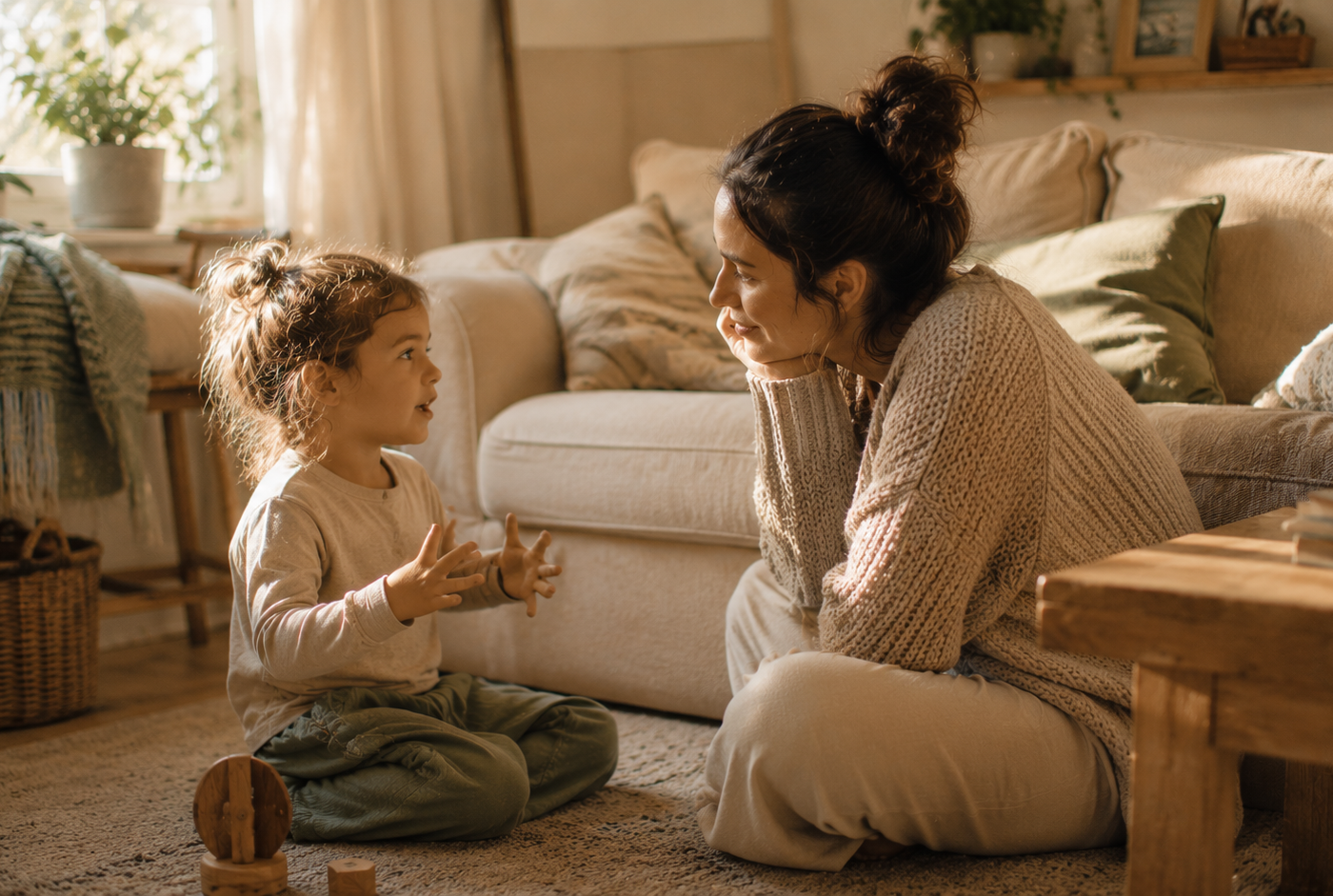
If you’ve ever watched your child completely fall apart over the wrong color cup, you already know how intense big feelings in children can get. One minute everything is fine, the next there are tears on the floor and you’re wondering what just happened. If you’re trying to teach kids to regulate emotions without yelling, bribing, or sending anyone to their room in shame, you’re in the right place.
The good news is that emotional regulation isn’t something kids either have or don’t have. It’s a skill, and like any skill, it’s learned over time with a lot of patient practice. Most of the time, the meltdown isn’t a behavior problem. It’s a developmental one.
In this article, we’re going through what emotional regulation actually means for kids at different ages, why gentle approaches tend to work better long-term, and the real everyday strategies you can start using this week, without needing a script or a psychology degree.
Table of Contents
What Emotional Regulation Actually Means for Kids
Before we talk about how to teach kids to regulate emotions, it helps to understand what we’re actually asking of them. Emotional regulation is the ability to notice a feeling, tolerate it without being overwhelmed, and find a way to return to calm. That’s a genuinely complex set of tasks, and the part of the brain responsible for it, the prefrontal cortex, isn’t fully developed until the mid-twenties.
So when a seven-year-old screams because they lost a board game, they are not being dramatic on purpose. They genuinely cannot talk themselves down the way an adult might. That doesn’t mean the behavior is fine to ignore, but it changes how we respond to it.
Understanding this takes a lot of pressure off parents. You’re not failing because your kid has big reactions. You’re doing exactly the right thing by looking for a gentler, more effective path.
Why Gentle Parenting Emotions Makes a Difference
There’s a reason gentle parenting emotions has become such a common phrase. It’s not about being permissive or letting everything slide. It’s about addressing feelings before behavior, and staying connected even when things get hard.
When we respond to a meltdown with punishment or shame, the child’s nervous system stays in a state of stress. They can’t learn anything in that moment. They’re just trying to survive the feeling. What tends to help more is co-regulation, which means you help regulate their system with your calm, before expecting them to regulate themselves.
Think of it like a phone battery. A child who feels safe, seen, and connected has a full charge. When something goes wrong, they have reserves to draw from. A child who regularly receives shame or dismissal is running on empty, and every bump in the day is a potential crash.
Research consistently backs this up, but you probably already feel it intuitively. When you stay calm, your child has a better chance of coming back to calm. That’s not a coincidence.
How to Start Teaching Emotional Regulation at Home
The everyday work of emotional regulation for kids doesn’t happen in the middle of a meltdown. It happens in the quiet moments before one. Here are the approaches that tend to make the most difference over time.
Name feelings out loud and often. When you narrate emotions as they happen, you give your child the language to understand their own inner world. « You look frustrated that the tower fell down. » « I can see you’re really disappointed. » You’re not solving anything, just naming it. That alone can lower the temperature.
Create a calm-down corner, not a timeout chair. This is a big shift. A calm-down corner is a spot a child can go to by choice, with soft things, a few sensory items, maybe some playdough or a glitter jar. It’s not a punishment. It’s a resource. Some kids take to it immediately. Others need to be shown how to use it first, ideally when they’re not upset.
Practice calm-down strategies for kids when things are already calm. Belly breathing, counting slowly, squeezing a pillow, these tools are only useful if a child has practiced them before the storm hits. Try a slow breath at bedtime, not as a crisis tool, just as a habit.
Validate before you redirect. It can feel counterintuitive, but saying « I know you’re really upset » before trying to fix anything tends to shorten big feelings in children rather than extend them. Kids who feel understood tend to de-escalate faster than kids who feel managed.
Age-by-Age Guide to Emotional Regulation for Kids
Emotional regulation looks different at different stages, and it helps to know what’s realistic to expect.
Ages 2 to 4. These little ones are just beginning to identify emotions. Tantrums are completely typical and very physical. Your job is mostly to stay safe, stay calm, and stay close. Co-regulation is almost everything at this age. They need your regulated nervous system more than they need your words.
Ages 5 to 7. Kids this age can start to learn simple calm-down strategies for kids with your help. They can begin to name a few core emotions and tell you what triggered them, but they still need a lot of support. Don’t expect them to use the tools independently yet. Practice together.
Ages 8 to 10. This is when things start to click. Children can begin to notice physical cues in their body, a tight chest, hot face, clenched hands, and connect those to feelings. They can start to choose a strategy with some prompting. Conversations after the storm can be genuinely useful now.
Ages 11 to 15. Puberty throws a wrench in everything, and the emotional regulation work can feel like it resets. That’s normal. Tweens and teens still need co-regulation, just more subtly. Staying physically present without demanding conversation tends to help more than direct intervention.
Wherever your child is on this spectrum, progress is rarely a straight line. A week where everything clicks can be followed by a week that feels like you’re starting over. That’s just how this works.
What to Do in the Middle of a Meltdown
When the meltdown is already happening, the goal shifts. You’re not teaching in that moment. You’re helping them through it.
Stay as calm as you can. This is the hardest part, and nobody gets it right every time. But your nervous system genuinely leads theirs. Even slowing your own breathing can help.
Get low and get close. Crouch down to their level. Speak quietly. Avoid commands if you can. « I’m right here » tends to land better than « Stop crying. »
Don’t try to reason mid-storm. Save the talking for after. The window for a productive conversation opens once they’re calm, and you’ll know when it does because they’ll usually soften and come toward you. That’s the moment.
Avoid shame. Nothing shuts down future emotional openness faster than a child who learned that big feelings got them rejected or humiliated. Keeping the relationship safe is the whole foundation here.
If evenings especially tend to fall apart, this guide to helping your child calm down without punishment walks through the specific language and steps that help in those harder moments.
Building Emotional Vocabulary Together
One of the most underrated ways to teach kids to regulate emotions is simply to expand how many words they have for feelings. A child who only knows « mad » and « sad » has a much smaller map to navigate their inner world with. A child who can say « I feel embarrassed » or « I’m overwhelmed » has far more power to communicate before things escalate.
You can build emotional vocabulary in low-pressure ways throughout the day. Talk about how characters in books and shows might be feeling. Share your own feelings in simple, honest language. « I felt a bit left out today » or « I was nervous about that meeting » shows your child that adults have feelings too, and that talking about them is normal, not weak.
Books are genuinely wonderful for this. There are dozens of picture books built around single emotions that work beautifully as conversation starters, with no agenda, no lesson plan, just a story and a chat.
For a deeper look at this kind of daily emotional groundwork, building emotional intelligence in kids has practical ideas you can weave into the everyday without it feeling like a curriculum.
And when the inevitable setbacks happen, because they will, the work you’ve done with emotional regulation feeds directly into how your child handles failure and disappointment. If you want to explore that side of things, helping kids build resilience after setbacks is worth a read alongside this one.
Final Thoughts
If there’s one thing to carry away from all of this, it’s that emotional regulation for kids is a long game. You’re not going to fix big feelings in children with one conversation or one calm-down corner. You’re building something over months and years, a relationship where your child learns that feelings are safe to have, and that they have the tools to move through them.
Some days you’ll handle a meltdown beautifully and feel like you’ve got this. Other days you’ll lose your patience and say the thing you didn’t mean to say. That’s parenting. You’re allowed to repair, and repair actually teaches your child something powerful too: that relationships survive hard moments.
Keep going. The fact that you’re here, reading this, looking for a gentler way, already says a lot about the kind of parent you’re trying to be. That effort is not invisible to your kids. Not even close.
How do I teach my child to regulate their emotions without yelling?
What tends to help most is staying calm yourself first, since kids co-regulate by picking up on your nervous system. Simple strategies like naming the feeling out loud, offering a hug, or sitting quietly nearby give your child what they need to move through the emotion without either of you escalating.
What is emotional regulation in children and when do kids develop it?
Emotional regulation is a child’s ability to notice a big feeling, tolerate it without completely falling apart, and find their way back to calm. The brain region responsible for this is still developing well into the mid-twenties, so meltdowns in young kids are a normal part of development, not a sign that something is wrong.
What are gentle parenting strategies for dealing with kids’ big emotions?
Many parents find that acknowledging the feeling before addressing the behavior makes a real difference, something like saying ‘You’re really disappointed right now’ instead of jumping to consequences. Keeping the connection strong during a hard moment helps your child’s nervous system settle faster than punishment tends to.
Why does my child have such intense emotional reactions over small things?
When kids fall apart over something that seems minor, like the wrong color cup, it usually means they are genuinely overwhelmed rather than trying to be difficult. Their prefrontal cortex is still developing, so they lack the tools to talk themselves down the way adults can, and what looks like overreacting is often just a brain that hasn’t fully learned to regulate yet.
How can I help my child calm down during a meltdown without making it worse?
What tends to work well is staying physically present and keeping your voice low and steady, which signals safety to your child’s nervous system. Avoiding lectures or problem-solving in the middle of the meltdown gives the emotion space to pass, and many parents find the conversation about behavior lands much better once everyone is calm.
If you’re working on staying more present and connected with your kids, the practical side matters just as much as the emotional one. The Father Blueprint is a complete framework for the dads who want to show up differently, written by a woman who has watched what works and what quietly doesn’t.
The Father Blueprint: become the dad they’ll always remember