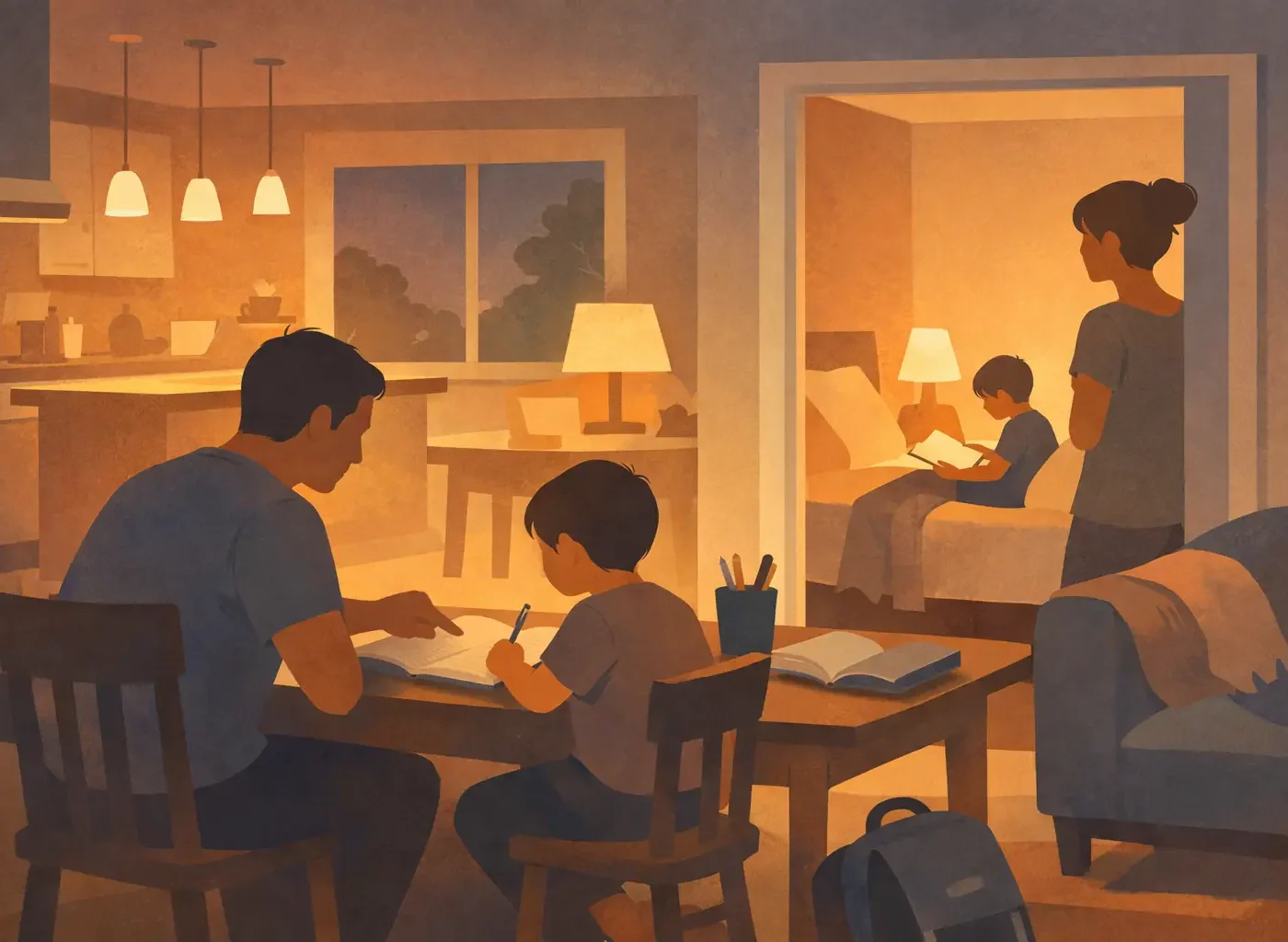
At 5:40 p.m., the backpack is still on the floor, someone is hungry, dinner needs attention, and a simple worksheet has somehow become the loudest thing in the house. Homework battles are exhausting because they rarely stay about homework. They pull in stress from the school day, the clock, unfinished work, and the fear that your child is falling behind.
You are not doing something wrong because this part of family life feels hard. The goal is not to make your child love homework. It is to stop schoolwork from taking over the evening and give your child a workable way to get started.
Stop Homework Battles Before They Start
The most useful change often happens before the folder comes out. Give your child a clear landing routine after school: bag in one place, a snack or drink if needed, a few minutes to move or be quiet, then a predictable time to check what schoolwork is due. This does not need to be a long, carefully planned break. It just needs to be familiar.
A predictable start removes one argument from an already full evening. Instead of calling reminders from another room, try a simple statement: “Homework check is at 5:15. You can choose the table or the counter.” A choice of place gives your child a little control without making the task optional.
The timing will depend on your family. Some children do better getting it done soon after getting home, before they settle into play. Others need dinner first, especially if the school day has left them worn out. Watch for the pattern that creates the fewest conflicts for a week or two, rather than assuming there is one correct schedule.
Keep the setup plain. A charged device if it is needed, a pencil, paper, and a reasonably clear spot can prevent a surprising amount of delay. This is not about creating a picture-perfect homework station. It is about making the next step easy enough to take.
Use a Short, Predictable Homework Plan
Children can hear “finish your homework” as one large, impossible demand, particularly when they have several assignments or do not know where to begin. Help your child turn it into a short plan: look at what is due, choose the first task, work for a set period, then pause and check what is left.
Small chunks make effort feel more manageable than a long lecture ever will. For a younger child, ten focused minutes may be enough before a brief break. An older child may manage twenty or thirty. The point is not to time every second. It is to give the work an edge, so your child can see where the first effort ends.
You might say, “Let’s just get the first three math problems open. After that, we will see what you need.” That language matters. It does not promise that the work will disappear, but it stops your child from having to carry the whole assignment at once.
If your child has an assignment that will take several nights, write down the first piece that needs doing tonight. A poster board project can become “find the topic,” then “write three facts,” then “make a title.” Your child still owns the work. You are helping make the workload visible.
During Homework Battles, Lower the Temperature
When voices rise, more pressure usually brings more resistance. It can be tempting to repeat yourself louder, threaten the loss of every enjoyable thing, or start explaining why grades matter. At that moment, your child is unlikely to hear the lesson underneath the frustration.
Calm does not mean letting homework slide, it means holding the boundary without adding heat. Try using fewer words: “I can see you are upset. The homework still needs a start. Sit with me for two minutes, and we will choose the first part.” Then pause.
This may feel slower than demanding immediate compliance. Some nights, it is slower. But a five-minute reset can be far shorter than a forty-minute argument that leaves everyone angry and the work untouched.
If you are getting pulled into the fight yourself, step back before saying something you will regret. Get a glass of water, turn to another small task, or ask your partner to take over for a few minutes if they are available. Your child does not need a perfect response. They need an adult who can avoid turning one hard assignment into a larger conflict.
When Your Child Refuses to Begin
Refusal can look stubborn from the outside, but it often has a more ordinary cause. The work may feel confusing, boring, too long, or embarrassing because your child does not know how to do it. Sometimes they are testing whether the evening will become a negotiation. More than one thing can be true.
Treat refusal as a problem to solve, not proof that your child does not care. Start with a calm, direct question: “Is the hard part getting started, knowing what it means, or wanting to do it?” Your child may shrug or say “all of it,” but that still gives you a place to begin.
Avoid sitting beside them and supplying every answer. Instead, read the directions together, ask what they think the first step is, and let them make an attempt. If they say they cannot do it, try, “Show me the part that does not make sense.” This is more useful than arguing about attitude.
If the answer is simply, “I do not want to,” you can be honest too. “I know. You do not have to like it. You do need to give it ten minutes.” A clear, limited expectation is easier to hold than a long discussion about motivation.
Help Without Taking Over
It is hard to watch your child struggle when you know you could finish the page in a fraction of the time. But doing too much can quietly teach them that the work belongs to you. Then homework becomes another job a parent has to remember, chase, explain, and complete after a full day.
Your job is to provide structure and support, not to become the second teacher at the table. Sit nearby for the first few minutes if that helps. Ask them to read instructions aloud. Offer a spelling word or a reminder of a method their teacher has already taught. Then let the pencil return to their hand.
One thing that worked for us was staying available without hovering. I would say, “I am folding laundry for ten minutes. Bring me one specific question if you get stuck.” It gave my child support, but it also stopped me from watching every eraser mark and taking over the emotional weight of the assignment.
For older children, agree on a check-in rather than constant supervision. They might show you their planner, tell you the first task they plan to do, and check back when the timer ends. Independence grows gradually, and it may look uneven for a while.
Make the Homework Load Visible Between Adults
Homework can become invisible work for the adult who notices the permission slip, knows the reading log is due, finds the missing library book, and absorbs the complaints. If that is usually your partner, you can help without waiting to be asked.
Shared responsibility begins with noticing the task before it becomes an emergency. Ask what needs tracking this week, then take a defined part of it. You might handle checking the school portal on Tuesday and Thursday, supervise homework on certain evenings, or be responsible for supplies and signed forms.
This is not about keeping score. It is about preventing one parent from becoming the default homework manager while the other feels unsure how to step in. A simple agreement also helps your child, who benefits from seeing that both adults can offer the same calm, basic support.
When Schoolwork Is Genuinely Too Much
There are times when the assignment load, confusion, or level of distress keeps repeating despite a calmer routine. You do not have to solve that alone at the kitchen table. Keep a brief note of what is taking a long time or where your child gets stuck, then contact the teacher with specific details.
Asking for clarity is part of supporting your child, not making excuses for them. You might explain that your child is regularly spending far longer than expected on a certain type of task, or that the directions are leading to repeated confusion. A teacher can often clarify expectations, suggest a starting point, or tell you what matters most.
For tonight, aim for the next workable step, not a flawless evening. Put the bag in its place, choose one task, stay close without taking over, and let the rest of the house stay as ordinary as it can. A calmer homework night is built in small repairs, one school night at a time.