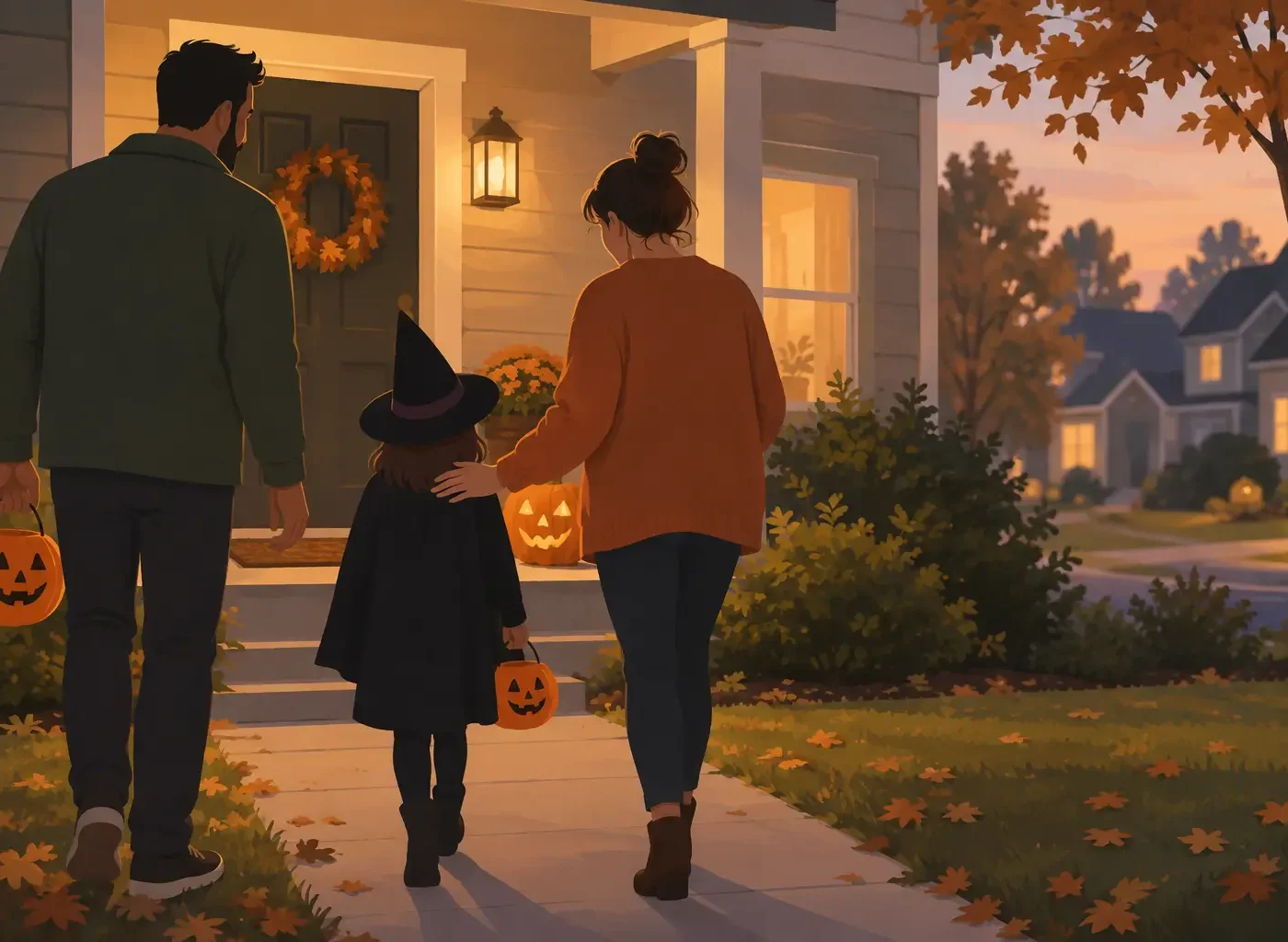
The costume is ready, the neighborhood is buzzing, and your child suddenly says they do not want to go. Halloween with an anxious child: how to make it work is usually less about persuading them to be brave and more about making the night feel manageable. A child can be excited about candy and still find masks, doorbells, darkness, crowds, and changed plans like too much all at once.
You are not ruining Halloween by adjusting it. You are showing your child that family fun does not require them to push past every limit just because a calendar says it is a big night.
Halloween with an anxious child starts with a smaller plan
A successful Halloween is the one your child can actually enjoy, not the one that looks fullest from the outside.
Start by deciding what counts as enough before the evening begins. For one child, that may be five houses with a parent beside them. For another, it may be walking around the block to see decorations, then coming home for a favorite movie and two pieces of candy. A child who seems fine in the afternoon may have very little bandwidth once it is dark and noisy.
Give your child a simple picture of the plan. You might say, “We will go to the houses on this block. After that, we will check in and decide if you want to do more or head home.” Specific plans are easier to hold than a vague promise that you will trick-or-treat until everyone is done.
If your child is young, practice the basic sequence earlier in the day. Put on the costume for a few minutes. Walk to your own front door. Knock, say “trick-or-treat,” and come back inside. Keep it light. The point is not to rehearse until they stop feeling nervous. It is to remove a few surprises.
Costumes deserve a little flexibility too. An outfit that looked perfect online can feel scratchy, hot, stiff, or suddenly scary when the sun goes down. Let your child wear sneakers, carry the mask instead of wearing it, layer a sweatshirt underneath, or change into regular clothes halfway through. One thing that worked for us was treating the costume as an option, not a contract.
Choose a starting time that works for your child
Going out early can make a real difference. There is more light, fewer groups on the sidewalk, and a better chance that your child will still have energy for the novelty. You do not need to wait for the neighborhood rush to begin.
If you have more than one child, this can be tricky. One may want to keep going while another is already done. When possible, divide and conquer for an hour. One adult can take the child who wants more houses while the other heads home with the child who has had enough. If you are solo, choose the smaller plan. Nobody needs a perfect family photo more than they need a peaceful ride home.
Build an exit plan before big feelings take over
Leaving early is not giving in when the plan included leaving early from the start.
An anxious child often does better when they know they are not trapped in an experience. Tell them exactly how they can let you know they need a break. It could be a phrase like, “I am all done,” or a hand squeeze if talking feels hard in the moment.
Then be ready to follow through without a debate on the sidewalk. You can say, “Okay, I hear you. We are heading home.” Your child may change their mind two minutes later, or they may not. Either way, they learn that you meant what you said about listening.
A break does not have to end the night immediately. You might step to a quiet curb, sit in the car for five minutes, or walk behind the group for a block. Sometimes the pressure drops once a child is no longer trying to match everyone else’s pace. But if the break is not enough, heading home is a reasonable call.
This is also where partners can make the night easier for each other. Before you leave, agree on the signal and the exit plan. The parent carrying the candy bag, watching traffic, adjusting a costume, and reading a child’s face should not also have to convince everyone that it is time to go. A quick, calm “I have this, take them home” can change the whole evening.
Give your child a role that does not require performing
Participation can be quiet, partial, and still completely real.
Some children dislike the attention that comes with standing at a stranger’s door, especially when neighbors comment on their costume or ask questions. They may be more comfortable holding the bag while you say “trick-or-treat,” staying a few steps back, or choosing only houses with lights they recognize.
Let them decide whether they want to speak, knock, or take candy. You can quietly tell a neighbor, “They are feeling a little shy tonight,” if you need to. Most people understand, and you do not need to make a bigger story out of it.
The same idea applies to school parades, trunk-or-treat events, and community parties. Your child might be happy to arrive, look around, and leave after ten minutes. They might prefer helping hand out candy from home, where the setting is familiar and they can step away whenever they need to. That is Halloween too.
Try not to use a sibling or friend as the standard. “Look how easily they are doing it” tends to add pressure, even when you mean it as encouragement. Notice the specific thing your child did manage instead: “You walked up to that door even though it felt hard,” or “You told me you needed a break.” Keep your voice matter-of-fact, not overly celebratory. Some children pull away when every small step becomes a big public moment.
Prepare for the parts that tend to surprise kids
Predictability will not remove every hard moment, but it can make the hard moments less startling.
Think through the sensory parts of your route. Houses with jump scares, loud music, smoke machines, or adults in elaborate costumes can be fun for some kids and overwhelming for others. You do not have to make a dramatic detour. Simply cross the street, skip that house, or say, “That one looks too loud for us tonight.”
It helps to set expectations with other children too. If cousins or neighbors are joining you, tell them your family may take a shorter route or leave without much notice. A simple heads-up protects your child from feeling like they are holding everyone back.
Do not promise that nothing scary will happen. There may be a sudden decoration, a barking dog, or a noisy group coming around the corner. Instead, offer a plan: “If something feels like too much, come close to me and we will move on.” That is more believable, and it gives your child something to do.
You can also protect the next part of the night. Keep the return home low-key. Put candy somewhere safe to sort later, help them get out of the costume, and avoid turning the evening into a long discussion about whether they were brave enough. They may need quiet more than a recap.
When your child refuses at the last minute
Your child’s “no” may be disappointment and overload colliding, not a verdict on your effort.
This is the hard version, especially if you spent money on a costume, arranged plans with friends, or were looking forward to sharing something from your own childhood. It is okay to feel disappointed. Try to keep that feeling separate from the message your child receives.
You might say, “You do not have to go door to door. We can stay home and hand out candy, or we can save your costume for another day.” If they want neither, let the night be ordinary. Make popcorn, watch something familiar, or sit together while the doorbell rings. A quieter Halloween can still hold a good family memory.
If this happens year after year, keep planning smaller than you think you need to. Some children grow into the busier version of Halloween. Some remain happiest with a short walk and a quick return home. Your job is not to train them into liking every tradition. It is to make room for who they are while giving them gentle chances to try.
The candy will be there tomorrow. The bigger win is a child who knows that when something feels too big, you are a safe place to come back to.