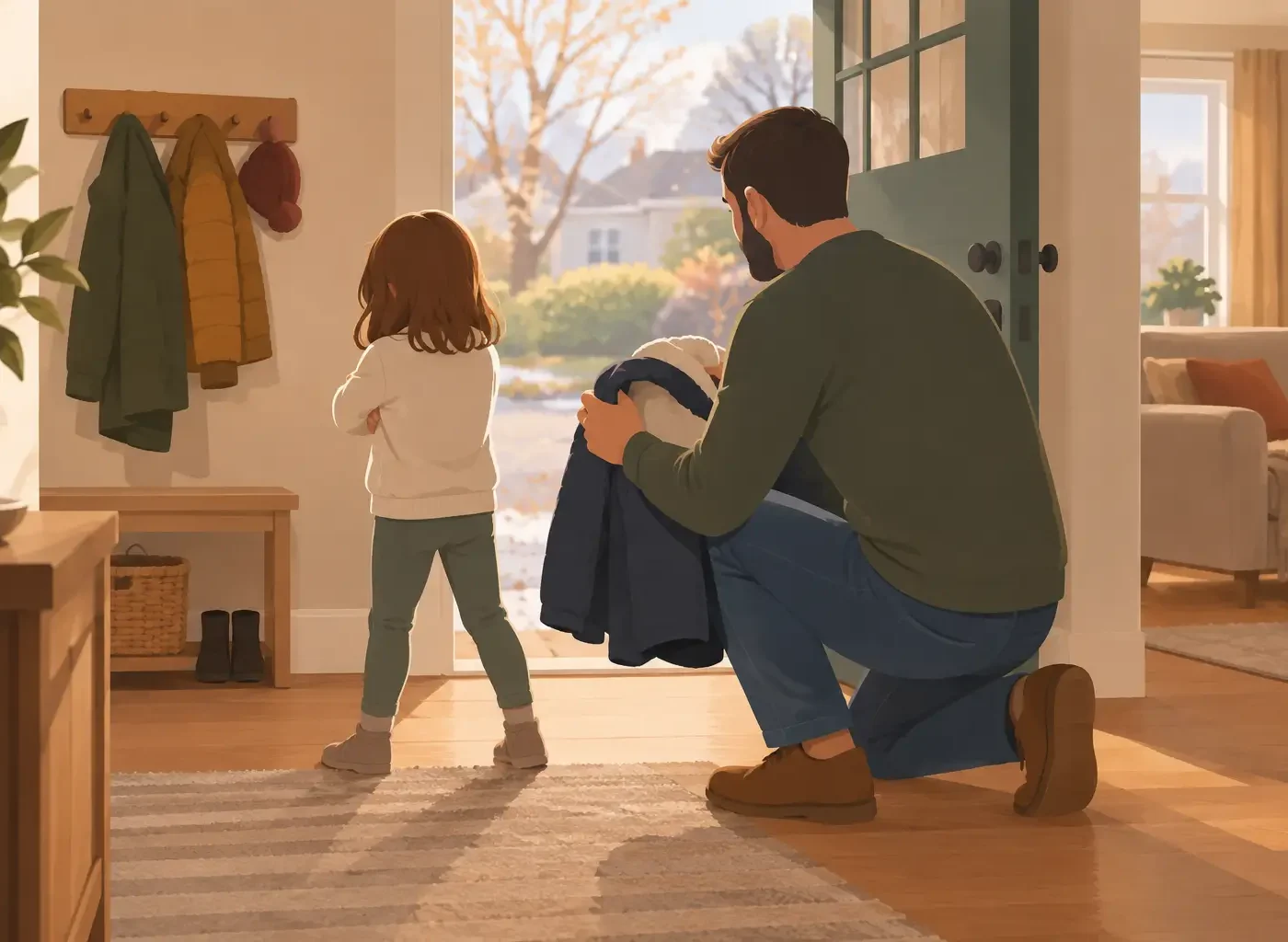
The coat is by the door. You have five minutes before you need to leave. Your child is suddenly made of pure determination, insisting they are not cold, while you picture the walk from the car, the school drop-off, and everyone being late.
When your child refuses to wear a coat, it can feel like a small disagreement with a very big clock attached to it. You are not failing because this keeps happening. Children often want control over what goes on their bodies, especially when the day is already asking a lot of them.
Table of Contents
When Your Child Refuses to Wear a Coat, Start Here
Start by separating the decision from the argument. You do not need to persuade your child that coats are wonderful. You need a simple plan for getting through the conditions outside without turning the doorway into a courtroom.
The goal is warmth and forward movement, not getting your child to agree with you.
Take a quick look at the actual situation: how cold, wet, or windy it is, how long your child will be outside, and whether they will be walking, standing around, or going straight from a warm car into a warm building. A coat may be nonnegotiable for a long walk in bad weather. For a brief trip from the driveway to school, carrying the coat may be a reasonable middle ground. As a rough guide, the American Academy of Pediatrics suggests dressing young children in one more layer than an adult would wear in the same conditions.
Try a calm, plain sentence: “It is cold and wet outside. Your coat is coming with us. You can wear it now or carry it to the car.” Then stop explaining. Repeating your case usually gives the disagreement more energy.
If your child chooses to carry it, follow through without a lecture. Put it within reach in the car or hand it to the adult who will be with them. They may put it on once they feel the air. They may not. Your job is to make the protective option available and keep the moment from swallowing the whole morning.
Make the Coat a Choice, Not a Standoff
Children can need a real say without being handed the whole decision. Offer two options you can live with: the blue puffer or the lined raincoat, zipped up or carried to the car, hood up or hood down.
Small choices give your child some control without asking you to abandon the boundary.
Keep the options honest. Do not offer a choice and then override it because you dislike the answer. If the weather requires outerwear, the choice might be between two warm layers rather than between a coat and nothing.
It can also help to name the part they dislike. “You do not like how this one feels at your neck.” “You wanted to keep wearing your sweatshirt.” Feeling understood does not mean they get the final call, but it often lowers the need to fight for it.
One thing that worked for us was keeping two acceptable coats at the door rather than searching closets while everyone was already frustrated. The choice was ready before anyone had to make it.
Make Leaving Easier Before the Last Five Minutes
Coat battles are rarely only about coats. They show up when shoes are missing, someone is hungry, the dog needs to go out, and you are calculating whether you can still make the train or pickup line. The coat becomes the final straw because it is the final task.
A little preparation protects your patience when time is tight.
Put the coat where your child naturally exits, not where it looks neat. If they leave through the garage, it belongs by the garage door. If they leave through the front hall, hang it low enough for them to reach. This is not about creating a picture-perfect entryway. It is about removing one unnecessary instruction from a rushed moment.
For younger children, help them start the coat before the conflict becomes a full-body struggle. Hold it open and say, “Arms in, then you choose the zipper.” For older children, give a predictable cue: “We are leaving in two minutes. Get your outside layer now.”
If your partner is handling departure, agree on the same simple rule ahead of time. Children notice quickly when one adult persuades, another bargains, and a third gives up. Consistency does not require identical wording. It means the basic plan stays the same: weather-appropriate outerwear comes along, and there is no long debate at the door.
Keep Your Voice Low When Your Child Pushes Back
Your child may cry, flop, shout, or run away when you bring out the coat. That response can make you feel like the situation has become much bigger than it should be. In that moment, your calm matters more than the perfect phrase.
You can be firm without making discomfort something your child must be ashamed of.
Try fewer words. “You are mad. The coat is coming.” If they refuse to put it on, return to the plan you chose: wear it or carry it, unless the conditions mean wearing it is necessary before you go outside.
Avoid turning the weather into a scary prediction. Statements like “You will freeze” may get a coat on in the moment, but they can also make ordinary discomfort feel frightening. Stick to what is true and useful: “It is raining,” or “We will be outside for a while, so this layer stays with us.”
There will be mornings when you raise your voice anyway. If that happens, you can repair it later with something simple: “I was stressed about getting out the door. I should not have yelled. The coat still needed to come.” Repairing does not erase the limit. It shows your child that limits and respect can exist together.
Listen for the Real Objection
Sometimes a child is objecting to the idea of a coat. Sometimes they are objecting to one particular coat. A scratchy tag, stiff zipper, bulky sleeves, or a hood that blocks their view can make getting dressed feel miserable to them.
You do not have to win an argument about a coat that genuinely feels awful to wear.
Ask at a calm time, not while everyone has shoes on and keys in hand: “What bothers you about that coat?” You may get a useful answer, or you may get “I just hate it.” Either response gives you information.
Look for a workable substitute within the weather need. That might mean a softer layer underneath, a different style of outerwear, or a coat that stays unzipped until they are ready. The trade-off is that flexibility works best when you choose it before the rushed moment, not after twenty minutes of arguing.
Older children may also care about how a coat looks. You do not need to pretend that appearance does not matter. You can say, “I get that you do not like this one. We still need something warm today. Let’s find an option you will actually wear before the next cold day.”
Let This Be a Small Problem
It is easy to see a coat refusal as proof that your child is becoming defiant or that you are losing control. Usually, it is just a child testing independence in a place where independence is visible and immediate.
Not every disagreement needs a lesson attached to it.
Save your energy for the part that matters: getting safely through the weather and leaving without making either of you feel worse than necessary. Some days that means the coat is zipped. Some days it means it is carried. Some days you will arrive late and annoyed, then try again tomorrow.
If you want the whole framework, from toddlers to teens, read positive parenting: the complete guide by age.
Frequently Asked Questions About a Child Who Refuses to Wear a Coat
Should I force my child to wear a coat?
Only when the weather truly requires it, like a long walk in freezing rain. For short trips from a warm car to a warm building, letting your child carry the coat is usually a fair middle ground. Many kids put it on themselves once they feel the cold, which teaches more than a struggle at the door.
Why does my child say they are not cold when it is freezing?
Children run warmer and move more than adults, so they may genuinely feel less cold at first. They are also often protecting their independence. Picture a five-year-old who has been told what to do all morning. The coat is one place they can push back. Usually it is about control, not temperature.
What if my child hates how their coat feels?
Take it seriously, because sensory discomfort is real. Ask at a calm time what bothers them, then look for alternatives, like a softer lining, a coat without a stiff collar, or a warm fleece under a lighter shell. A coat they will actually wear beats a warmer one that stays on the hook.
Is it bad for kids to go out without a coat?
A few minutes without a coat on a cool day is not harmful. Colds come from viruses, not cold air. What matters is longer exposure in very cold, wet, or windy weather, where proper layers protect against getting chilled. Use the length of time outside and the conditions as your guide.
How do I stop the coat fight every morning?
Move the decision earlier. Keep two acceptable coats by the exit door, give a two-minute warning, and offer a simple choice: wear it or carry it. Agree with your partner on the same rule. When the coat is ready and the plan is predictable, there is much less to argue about.
Final Thoughts
When your child refuses to wear a coat, it is rarely about the coat. It is a small, visible place to practice independence, and you can let them practice it without giving up on keeping them warm.
Your child does not need a perfect response from you at the front door. They need the steady message that you will take care of the practical things, listen when something feels hard, and keep going even when the morning does not go to plan.
If mornings are usually one parent’s job, this is an easy one to take over. Calm, boring follow-through at the door is a gift to everyone in the house.
How to Be a Better Dad is a practical guide to being the steady parent in the small daily battles, from the front door to bedtime, written by a mom of two who has carried a lot of unworn coats to the car.