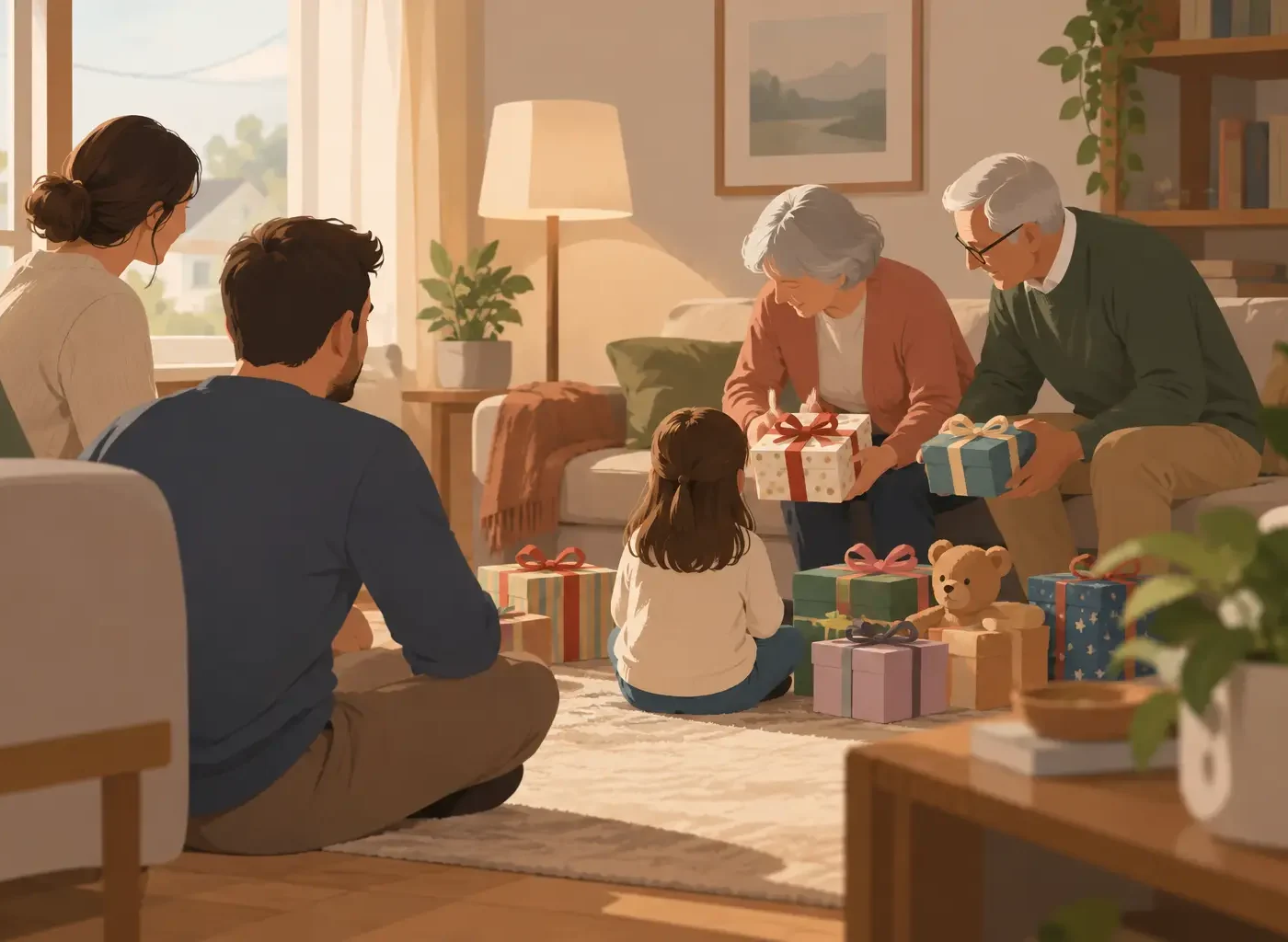
The toy pile grows while your child is still opening presents. A new package arrives two days after the last one. You can feel grateful for the love behind it and still feel stressed about where it will all go, what it teaches your child to expect, and who will manage the clutter later. Too many gifts from grandparents: how to handle it is less about finding perfect words and more about setting a family limit without making generosity feel unwelcome.
You are not ungrateful for wanting less. You are trying to protect your home, your child’s ability to enjoy what they have, and the ordinary rhythm of your week.
Table of Contents
Too Many Gifts From Grandparents: Start With One Clear Ask
The kindest approach is usually direct, specific, and early. Do not wait until everyone is frustrated after a birthday or holiday. Bring it up on a calm day, before the next gift-giving occasion is close enough to create pressure.
A clear limit is more respectful than hoping someone will notice your discomfort.
You are far from the only parent dealing with this. The Gottman Institute lists giving a child too many gifts among the most common reasons parents need to set boundaries with grandparents, alongside unsolicited advice and ignored routines.
Choose one request that your family can actually maintain. You might ask grandparents to give one larger gift and one small item, or to keep gifts to a wish list. If your child receives packages throughout the year, you might ask that surprise gifts be saved for birthdays, holidays, or visits.
Try words like: “We can see how much you enjoy treating her, and she loves knowing you thought of her. We are getting overwhelmed by the number of things in the house, so for her birthday we are keeping gifts to one item from each household.”
If experiences fit your family better, say so plainly: “A zoo trip, art class, or a day with you would mean a lot. We are trying to keep physical gifts simple.” The point is not to make grandparents guess the acceptable alternative. Give them a way to be generous that works for your child and your home.
Be careful not to overexplain. A long case about clutter, behavior, spending, and values can invite a debate on every point. One warm explanation and one concrete boundary are enough.
Get on the Same Page With Your Partner First
Gift overload can quietly become a relationship problem when one parent handles the storage, thank-you notes, broken pieces, and the upset that follows when a child wants every new thing opened immediately. The other parent may only see a generous grandparent and a child having fun.
The best family message is one that does not leave either parent carrying the awkward conversation alone.
Talk privately about what is actually bothering you. Is it the number of toys? The cost? Gifts arriving without permission? A grandparent buying things you had planned to give? The pressure your child feels to perform gratitude? You may agree on some parts and not others, and that is normal.
Then decide who will speak to their own family. This is often easier on everyone. A father can tell his parents, “We appreciate how much you love the kids. We are keeping birthdays smaller this year, so please choose one gift.” A mother can say the same to hers. The wording does not need to be identical, but the limit should be.
If one of you has a softer spot for a particular grandparent, lead with that understanding rather than forcing agreement. Maybe a grandpa grew up with very little and expresses love through giving. Maybe a grandma lives far away and sends packages because it helps her feel connected. You can honor that meaning while still asking for fewer items.
When Grandparents Do Not Take the Hint
Some grandparents will adjust right away. Others may laugh off the request, say “You can never spoil a grandchild,” or keep bringing gifts because it is a habit. This is the hard version, especially when you do not want every family gathering to feel tense.
Kindness does not require you to abandon a boundary after it has been ignored.
Repeat the same request without building a bigger argument. “I know you enjoy giving him things. We are still keeping it to one gift.” Calm repetition can feel uncomfortable, but it gives the other person less to push against than anger or a long defense.
If extra gifts continue to arrive, decide in advance what will happen to them. Some families keep a small number and donate unopened items. Others leave certain toys at the grandparents’ house for visits. If you choose either option, tell grandparents beforehand when possible: “Anything beyond the one gift will stay here for him to play with when he visits.”
Do not make your child deliver the message. A young child should not have to choose between pleasing a beloved grandparent and following your family’s limit. You can say thank you for the thought while handling the item later.
There may be some disappointment. A grandparent may feel hurt, or you may feel guilty when the conversation is awkward. That does not mean the request was wrong. It means you are changing a familiar pattern.
Help Your Child Receive Gifts Without Making It a Big Lesson
When gifts are abundant, it is tempting to correct every reaction. You may worry if your child opens one present and immediately reaches for another, or if they say, “Is that all?” Those moments can feel embarrassing in front of family.
Gratitude is taught more effectively through steady practice than through a public correction.
Keep your response short in the moment. “Let’s look at this one before opening another.” Or, “Grandma chose that because she knows you like dinosaurs. Let’s say thank you.” Your child does not need a speech about how lucky they are while adults are watching. The quieter habits that help you teach kids gratitude without the lecture work far better than a correction in front of the whole family.
At home, slow the pace. Put some gifts away and rotate them later. This is not a punishment or a trick. It gives your child room to enjoy what they received, and it makes the post-celebration cleanup less overwhelming.
One thing that worked for us was leaving a few unopened gifts aside after a busy holiday. Bringing one out on a rainy afternoon made it feel new again, without adding another rushed hour of opening and organizing.
If your child is old enough, include them in choosing items to pass along before a birthday or holiday. Keep the language simple: “We are making room for new things by sharing toys we do not use anymore.” Avoid turning it into a threat tied to what grandparents give.
Make Gift Giving Easier, Not Just Smaller
A limit lands better when grandparents can still see their place in your child’s life. Offer options that fit their interests and budget. A book with a note inside, supplies for a hobby, pajamas, a contribution toward an activity, or an outing together can all feel personal without filling every shelf.
Your goal is not fewer signs of love, it is a version of love your household can live with.
A shared wish list can help if grandparents like clear direction. So can a family tradition where grandparents give a special ornament, a photo book, or one item connected to something your child genuinely enjoys. The exact tradition matters less than making it predictable.
There will be seasons when you let more slide, such as a major holiday visit or a grandparent you see only once a year. It depends on your child, your space, and the relationship. Flexibility is useful when it is your choice, not when it comes from feeling unable to speak up.
If you want the full picture, from discipline to the mental load, read our guide to parenting as a team.
Frequently Asked Questions About Too Many Gifts From Grandparents
How do I politely tell grandparents to stop buying so many gifts?
Lead with appreciation, then give one specific limit. Something like “The kids love how much you think of them. We are keeping it to one gift each this year” is clear and kind. Offer an alternative they will enjoy, such as an outing together, so the limit feels like a redirection rather than a rejection.
What should I do with extra gifts from grandparents?
Decide before the holiday, not in the moment. Options include rotating toys so only a few are out at once, leaving some at the grandparents’ house for visits, or donating unopened items. Tell grandparents your plan in advance when you can, so nobody feels blindsided later.
Is it rude to ask grandparents for experience gifts instead of toys?
Not at all, especially if you frame it around time together. Many grandparents are delighted to hear that a zoo trip, a class, or a day out with them would mean more than another toy. Picture a grandpa taking your seven-year-old fishing. That gift lasts longer than most things in a box.
Why do grandparents buy so many presents?
Usually it is love finding the easiest outlet. Some grew up with very little and enjoy giving what they did not have. Others live far away and send packages to feel close. Understanding the reason makes it easier to ask for less without hurting their feelings.
What if my partner does not mind the extra gifts?
Talk about what actually bothers each of you before you say anything to the grandparents. The parent who handles storage, thank-you notes, and broken toys often feels the overload more. Agree on one shared limit, then let each of you speak to your own side of the family.
Final Thoughts
Handling too many gifts from grandparents is really about protecting two good things at once: their love for your child, and a home that does not feel buried every December.
You do not have to choose between appreciation and limits. A warm thank-you, a specific request, and a consistent follow-through can make room for both. Your child gets the gift of loving grandparents, and your family gets a home that still feels manageable on an ordinary Tuesday night.
If the hardest part has been getting your partner to see the problem the way you do, that conversation is worth having before the next holiday rather than in the middle of it.
The Marriage Blueprint is a practical guide to staying a team on the family decisions that test you, grandparents included, written by a mom of two who has navigated her share of overflowing toy bins.