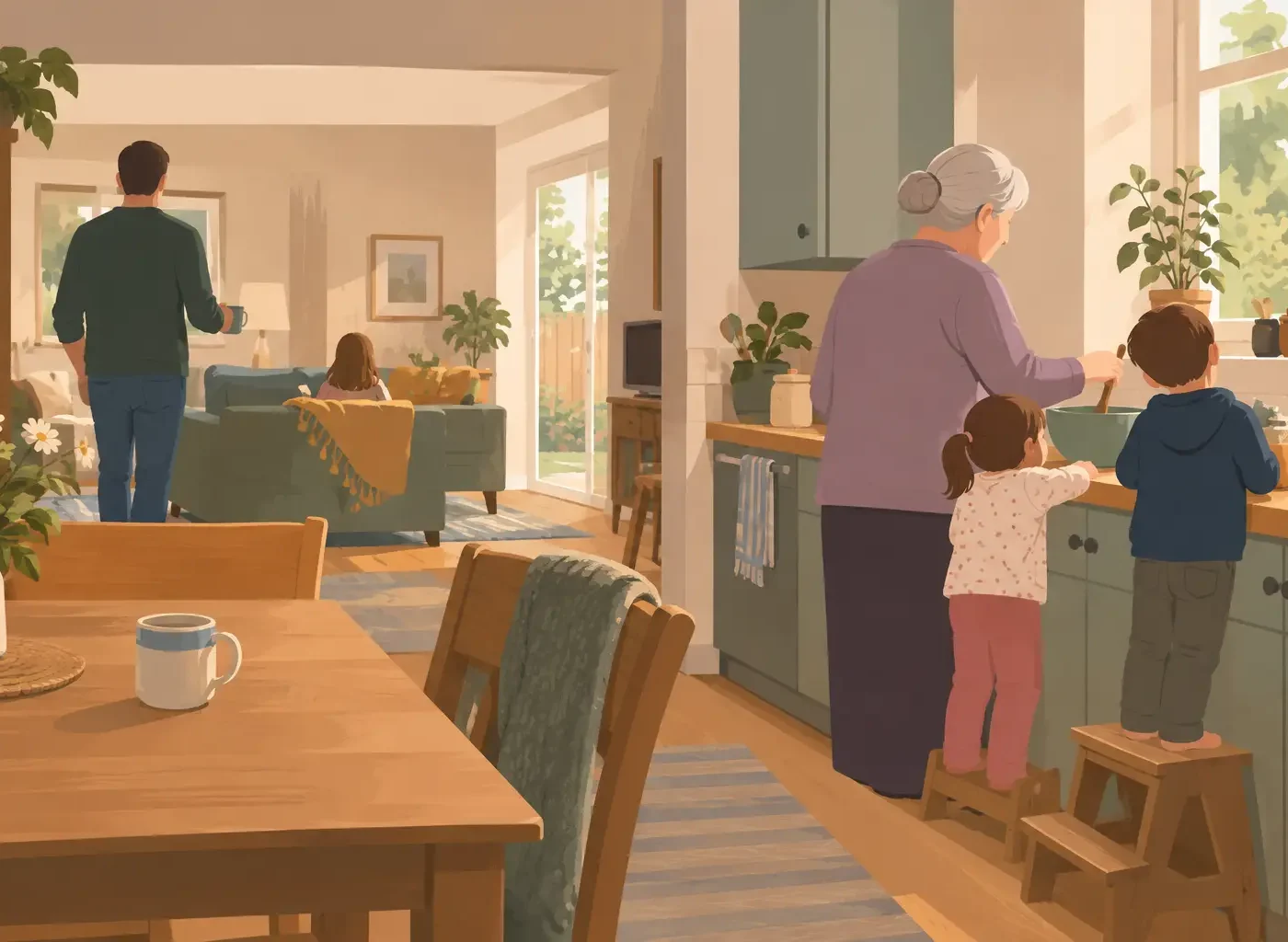
Grandma hands your 6-year-old a second cookie before dinner, lets him stay up past the time you normally allow, and laughs when he says no to putting his shoes on. You are grateful she loves him so freely. You are also already picturing the pushback waiting for you at home. Different rules at grandma’s house can feel small in the moment, then turn into a hard handoff for everyone.
You are not being controlling for wanting some consistency. And grandparents are not automatically trying to undermine you because they make a visit feel special. Most of the time, this is a family logistics problem with feelings attached to it. A few clear agreements can make visits warmer, not stricter.
Start with the rules that matter most
You do not need to bring your entire household rulebook to Grandma’s. Trying to manage every snack, every game, and every little phrase she uses will wear everybody out. Pick the two or three things that have the biggest effect on your child’s safety, behavior afterward, or your ability to get through the rest of the day.
You are not asking Grandma to parent exactly like you, you are asking for help with the parts that follow your child home.
For one family, that might mean car seats are used correctly and adults hold hands in parking lots. For another, it could mean no soda in the afternoon because the evening afterward is reliably rough. If your child has a firm school-night expectation, that may belong on the short list too.
Keep the request concrete. “Please do not offer more candy after lunch” is easier to hear and follow than “We need you to respect our food rules.” “He needs to leave by 6:30 so we can have a manageable evening” gives a reason without inviting a long defense of your parenting.
The hard version is when a grandparent sees your limit as personal criticism. Stay with the present need rather than arguing about whose childhood was better. You can say, “I know you did things differently when we were young. This is what helps us right now.”
Talk before the visit, not during the cookie moment
A conversation in the kitchen while your child is watching is rarely the conversation you mean to have. You are trying to respond quickly, Grandma may feel corrected in her own home, and your child gets a front-row seat to a disagreement between adults.
A calm conversation before a visit protects the relationship better than a correction made in the heat of it.
If you can, have it privately with the grandparent who needs to hear it. Your partner can take the lead with their own parent, which often removes some of the awkwardness. That does not mean either of you has to handle your family alone. It means you are working as a team, with the person closest to the relationship opening the door.
Use a warm, plain opener: “We love that the kids get time with you. We have noticed that leaving late makes the next day harder for all of us. Could we plan to wrap up by 6:30?” Then pause. Let the person react without rushing to fill the silence.
If Grandma says, “But they are only little once,” you do not need a perfect answer. Try, “I agree. I want them to have fun with you. We also need tomorrow to be workable.” Both things can be true.
This conversation may need repeating. Longstanding family patterns do not usually change after one kind request. Repeating a boundary calmly is not escalating it.
Give your child a simple explanation
Children can understand that different homes have different expectations, especially when the message is not loaded with adult frustration. Avoid making Grandma the bad guy. “Grandma lets you do whatever you want” may feel satisfying after a difficult pickup, but it teaches your child to look for sides.
Different rules do not confuse children nearly as much as adults speaking about them as if they are a battle.
Try something simple: “At Grandma’s house, Grandma chooses some things. At our house, we choose some things. In both places, we speak kindly and stay safe.” This gives your child a map without suggesting rules are optional whenever another adult says yes.
Before a visit, name the one expectation your child needs to know. “Grandma may have a special dessert. We are still leaving when Dad says it is time.” Do not give a long speech in the car. A short reminder is more likely to stick.
When it is time to leave, be clear and steady. “It is time to go. You can have one more hug or help Grandma carry your cup to the kitchen.” A small choice can make the moment less sharp, but it should not reopen the decision to leave.
Your child may protest anyway. That does not mean the visit went badly. Leaving a place they enjoy is hard, and they are allowed to be disappointed while you hold the plan.
Plan for the handoff back home
The part that often catches families is not the visit itself. It is the first hour afterward, when a child is tired, full of excitement, or upset that the fun ended. If you expect them to switch instantly back to home expectations, both of you may end up frustrated.
The goal after Grandma’s house is not a perfect reset, it is a gentler landing.
Keep the first part of the return home low-demand when you can. Put bags down, offer a drink of water, and give your child a little time to reconnect before asking them to do the next necessary thing. If you are driving home, a familiar song or quiet conversation can help mark the change.
You can also name the shift without scolding. “Grandma’s house was fun. Now we are home, and it is time for our usual evening.” Say it as information, not a warning.
One thing that worked for us was avoiding big corrections in the car after a family visit. If a child has behaved in a way you need to address, wait until everyone has had a moment to settle. A public post-visit lecture tends to turn a manageable issue into a bigger one.
When a grandparent will not respect a key limit
Sometimes this is more than extra treats or a later departure. A grandparent may repeatedly ignore a safety expectation, pressure your child to do something you have said no to, or dismiss you in front of your child. That deserves a firmer response.
You can be grateful for a grandparent’s love and still set conditions for access to your child.
State the boundary plainly, along with what you will do if it is not followed. “We need the car seat used every time. If that cannot happen, we will drive her ourselves.” Or, “We have asked that you do not tease him about his body. If it happens again, we will end the visit for the day.”
This is uncomfortable, particularly when you want family gatherings to stay easy. But vague requests leave room for everyone to interpret things differently. A clear limit gives the relationship its best chance to become more respectful.
Follow through quietly if needed. You do not need a dramatic speech, and your child does not need to hear every adult detail. “We are heading out now. We can try again another time” is enough.
Grandma’s house can be a place of extra stories, extra attention, and a few special exceptions. Your home can still be the place where your child knows what to expect. You are allowed to protect that steadiness, even when it takes a few patient, repeated conversations to get there.