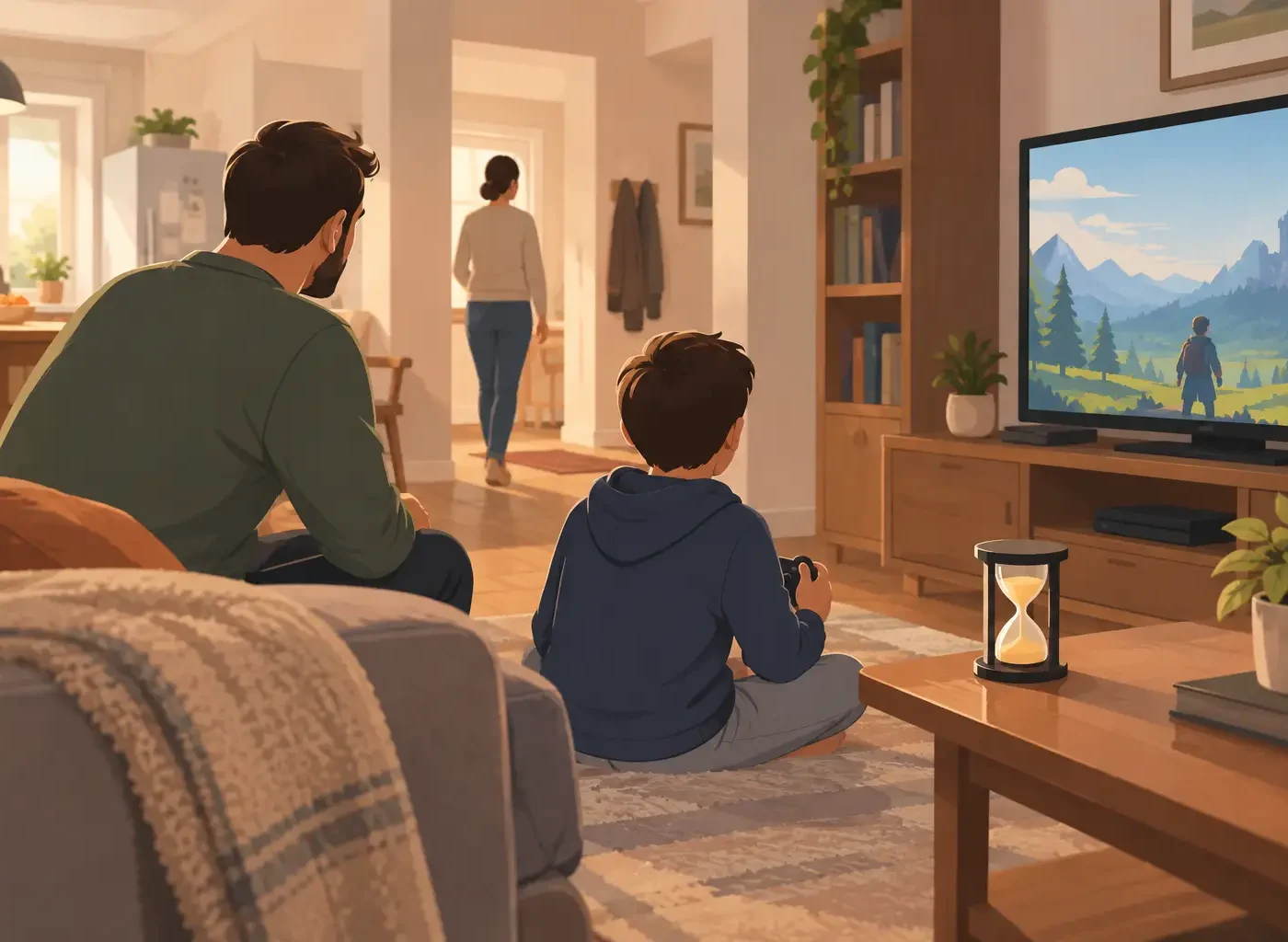
The hard part is rarely the number of minutes on the game. It is the moment you say, “Time’s up,” after a long day, when your child is absorbed and you are already out of patience. If you are trying to figure out how to limit video games without a nightly fight, you are not failing because this has become tense. You are dealing with a transition that asks a child to stop something rewarding while the whole household is tired.
Start with a plan your child hears before playing
The most useful change happens before the controller is picked up. Decide when gaming fits in your family’s evening and say it plainly before play begins. “You can play from 6:00 until 6:40. At 6:35, I’ll let you know you have five minutes left.”
A limit feels less personal when it was known before the game started.
This does not mean your child will be pleased. They may still argue, bargain, or insist they are almost done. But you are no longer inventing a rule at the worst possible moment. You are following through on an agreement they already heard.
Keep the first plan modest enough that you can actually hold it. A vague “not too long” invites a different argument every night. A clear ending time gives you something steady to return to: “I know you want more time. The plan was 6:40.”
For younger children, use a clock they can see or a simple timer they can hear. For older kids, it may work better to agree on a natural stopping point, such as the end of one match or round. Be careful with this approach if a game has endless rounds, though. “One more” can quietly become forty more minutes.
If your child plays online with friends, plan for that reality instead of pretending it does not exist. Ask them to tell friends early that they are leaving soon. A child who can say, “I have to get off after this round,” has a much easier exit than one who is pulled away mid-conversation.
Make the ending easier, not longer
You do not need to negotiate the limit into existence each evening. You do need to help with the landing. Give a warning at the same point each time, then return when you said you would. Five minutes is often enough. For a child who gets deeply absorbed, ten minutes and five minutes may work better.
Your job is to hold the boundary with a calm voice, not to make your child like it.
At the end, use fewer words than you think you need. “Time is up. Please save your game and turn it off.” If they protest, try not to open a case you have already decided. Long explanations can sound like an invitation to keep arguing.
It can help to name the disappointment without changing the answer. “You were in the middle of something and wanted to keep going. That is frustrating. It is still time to stop.” This is not giving in. It tells your child that their feelings are allowed, even when the answer stays no.
One thing that worked for us was making the first five minutes after gaming predictable. The controller went in its spot, then there was one small next step already waiting: pajamas, a shower, helping clear the table, or choosing music while we finished a chore. The activity itself was not magical. The predictability was.
Avoid replacing gaming with a punishment-like task every time. If stopping always means being handed the least pleasant job in the house, your child will push harder to stay on the game. A neutral next step is usually enough.
When the fight has already started
Some evenings will go badly, even with a good plan. Your child may yell, refuse to turn the game off, or say something sharp. You may hear yourself getting louder because you have repeated the same instruction four times. This is the hard version, and it does not mean the plan was pointless.
A rough ending is information about what needs adjusting, not proof that your family cannot do this.
In the moment, aim for simple and safe. Lower your voice if you can. Repeat the limit once. “I hear that you are mad. Gaming is over for tonight.” Then pause rather than filling the silence with threats you do not want to carry out.
If your child refuses to turn it off, you may need to step in and end access. Do this as calmly and matter-of-factly as possible. You do not have to pretend it feels easy. “You are having trouble stopping, so I am ending it now. We can talk later when we are both calmer.”
Try not to use the next day’s gaming time as a bargaining chip in every conflict. Sometimes a shorter session the following day makes sense because your child needs more support practicing the stop. But if every difficult feeling leads to a much bigger punishment, the game can become the center of the family’s power struggle.
Later, when nobody is arguing, have the short repair conversation. “Last night got loud. I do not want us talking to each other that way. We still need a way to end the game. What would help you stop at the time we agree on?” Listen for practical answers. They may need an earlier warning, a chance to finish a round, or a clearer time to start.
Choose limits that fit the child and the day
A limit that works for a 7-year-old will not always fit a 13-year-old. Younger kids usually need adults nearby and a very concrete finish line. Older kids may be ready to help shape the agreement, especially if gaming is part of how they connect with friends.
Fair does not always mean identical, it means the expectation is clear and makes sense for this child.
Look at the pressure points around gaming, not just the game itself. Is your child asking to play when homework, chores, family plans, or basic responsibilities are unfinished? Is gaming becoming the only thing they want to do in their free time? Or is the conflict mostly about an abrupt stop after a reasonable session?
Those are different problems. A child who needs help starting responsibilities may need gaming to happen after those tasks. A child who can manage the rest of the evening but melts down at the cutoff may need a better transition. Do not make a bigger rule than the actual problem calls for.
It also helps if the adults are aligned before the moment arrives. This is not about one parent policing the other. It is about sparing your child the confusing experience of hearing two different answers and learning to keep asking until somebody is too tired to hold the line. A quick check-in before dinner can prevent a much larger disagreement later.
Keep the relationship bigger than the rule
Gaming can become loaded because it is visible. You can see the screen, hear the protests, and feel the clock moving. But your child may also be using games for fun, challenge, friendship, or a little control after a day full of demands. Seeing that does not require you to allow unlimited play.
You can take gaming seriously without treating your child’s interest in it as a character flaw.
Be curious at a calm time. Ask what they like about a particular game, who they play with, or what they are trying to achieve. A child who feels understood is not guaranteed to cooperate, but they are less likely to hear every limit as a dismissal of something that matters to them.
Then let the boundary stay ordinary. You do not need a perfect speech or a flawless evening. You need a plan you can repeat, a few calm words, and a willingness to try again after a hard night. Tomorrow’s stop can be cleaner than tonight’s, and that is enough to build from.