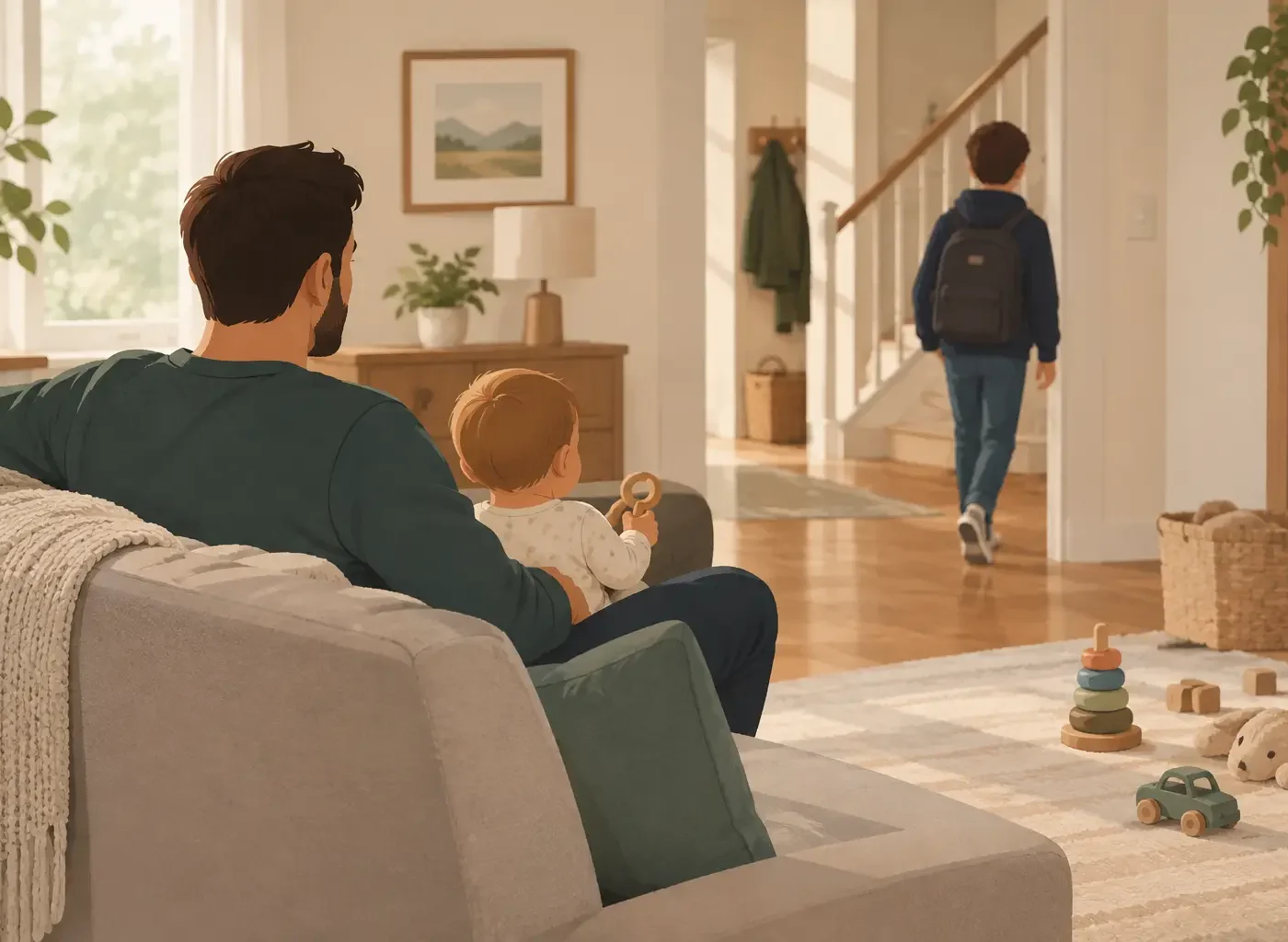
The first time your older child says, “The baby gets everything,” it can land hard, especially when you have spent the day moving between a diaper change, a school pickup, a work message, and dinner. A big age gap between siblings: what to expect is not a warning that something has gone wrong. It is a different family rhythm, with real gifts and a few pressure points that are easier to handle when you see them coming.
Table of Contents
Start With Two Separate Relationships
The most useful place to begin is not by trying to create a picture-perfect sibling bond. Start by protecting your relationship with each child. Your younger child needs your care because they are small. Your older child still needs to feel noticed for more than being “the big kid” who can wait, understand, or help.
Your older child may be more capable, but they still deserve to be cared for like a child.
Give your older child a small, dependable pocket of your attention that is not tied to helping with the younger child. It might be ten minutes in the car after an activity, making a snack together, or sitting beside them while they tell you about a game. The activity matters less than the message: you are still someone I make room for.
If your days are full, make the handoff between adults more intentional. One parent can take the little one for a bath or a walk while the other checks in with the older child. This does not need to happen every night. A predictable opening once or twice a week can do more than occasional grand plans that never quite happen.
It also helps to speak carefully around your older child. “I need you to be the big one” can sound like a compliment, but repeated often, it can turn into a job they never applied for. Try, “I know waiting is hard. I am helping your sibling first, and then I am with you.” That is honest without asking them to hide their disappointment.
A Big Age Gap Between Siblings Means Different Needs
Fairness will probably look less equal than it did when your children were closer in age. A preschooler may need help getting dressed while a 10-year-old wants privacy, later bedtime, and a parent at their game. Treating both children exactly the same can create more frustration, not less.
Fair does not mean identical, it means each child can trust that their needs matter.
Say the difference out loud in simple language. “Your brother needs help with his shoes. You get to choose your own shoes because you have practiced.” Or, “Your sister gets a shorter turn because she is little. You get a later turn because you are older.” Clear explanations help children see that family rules can change with development without becoming arbitrary.
The hard part is that older children often notice the cost of a younger sibling very clearly. They may miss spontaneous outings, quieter weekends, or having both parents available at once. You do not have to argue them out of that feeling. A calm, “I can see this changed things for you,” often lowers the temperature more than a long explanation.
Try not to answer every complaint by pointing out what the older child gets to do. Privileges are real, but they do not erase a loss. Your child can appreciate a later bedtime and still wish the house were less noisy. Both can be true.
Let Help Be an Invitation, Not a Role
A large age gap can make it tempting to lean on the older child. They can fetch a diaper, entertain the little one for five minutes, or hold a door when your hands are full. Small contributions can help a child feel included, particularly when they choose them.
Helping can build connection, but responsibility belongs to the adults.
Ask rather than assign when you can. “I am getting dinner started. Would you rather keep an eye on the blocks for five minutes or have your own time upstairs?” gives your older child a real choice. If they say no, accept it without making them feel selfish.
Be especially careful when your younger child is demanding attention and your older child is nearby. It is easy to say, “Can you just watch them?” several times a day until it becomes expected. An occasional favor is different from making a child the backup caregiver. Your older child needs room for homework, friendships, hobbies, boredom, and doing nothing useful at all.
One thing that worked for us was giving our older child a way to join in that had nothing to do with caregiving. They could pick a silly song for cleanup or choose a picture book for the little one. It made participation feel like belonging, not work.
Expect Connection to Look Different
Children with a big age difference may not play together for long stretches, and that is completely ordinary. A teen may adore a toddler and still have no interest in building blocks for an hour. A younger child may follow their older sibling everywhere, while the older one wants their room left alone.
A close relationship is built through repeated warmth, not matching interests.
Look for small shared moments instead of trying to manufacture constant togetherness. Your children might laugh over a family movie, make pancakes on a Saturday, toss a ball outside, or share a joke in the back seat. Those brief moments count.
Give the older child a clear way to ask for space, and help the younger child hear it. “She is reading now. You can wave goodnight, but her room is private.” This protects the older child without making the younger one feel rejected. Later, you can offer another chance to connect when both children are more available.
It may also help to stop comparing their relationship to siblings close in age. They may grow into something more like a mix of sibling, mentor, and trusted family friend. That can be deeply meaningful, even if it does not look like sharing clothes, friends, or the same favorite games.
Protect the Older Child’s Place in the Family
When a new little person joins a family, adults naturally talk about how much the older child has grown. Guests may say, “You are so grown up now,” or expect them to be patient whenever plans change. Your child may enjoy the praise, but they may also feel they have been pushed forward too quickly.
Growing up does not mean giving up the comfort, play, and attention they still need.
Let your older child be silly. Let them have a hard day without turning it into a lesson about setting a good example. If they are frustrated, you can hold the line on behavior while still recognizing the strain: “You cannot slam the door near your sibling. You can tell me you need a break.”
This is also a place where partners can support each other well. If one of you is occupied with the younger child, the other can notice the older child’s small bids for attention: a new drawing held up from across the room, a story started at the counter, a request to show you something. Those moments are easy to miss when the house is busy, and splitting the evening this way is one of the most practical things dads and moms can do together.
Handle Conflict Without Making Age the Whole Story
The older child has more power, more words, and usually more control. That means you may need to step in early when play gets too physical or the younger child keeps grabbing their things. But avoid making every conflict the older child’s fault simply because they are older.
Being older calls for guidance, not automatic blame.
Start with what happened in front of you. “Your tower was knocked over. You pushed him. I will help you move back, and I will help him learn not to grab your work.” Both children get a boundary and both children get support. It also helps to coach the older child ahead of time, as the Child Mind Institute suggests, to calmly come and get you rather than retaliating when a sibling grabs or hits.
Keep a few belongings clearly protected for the older child. A shelf, a drawer, a room rule, or a project that the younger child cannot touch can prevent many repeat arguments. You are not favoring one child. You are showing both that people are allowed to have things that stay theirs.
Over time, encourage repair in simple ways. The younger child can help pick up pieces. The older child can choose whether they want to rebuild together later. You do not need to force an apology performance or a hug. The goal is a home where hurt gets addressed and everyone has a path back.
Let the Relationship Change Over Time
The gap that feels enormous when one child is 11 and the other is 2 may feel much smaller when they are 18 and 9. Their relationship will keep changing as their abilities, interests, and independence shift. Some seasons will be warm and easy. Others will be mostly about sharing space with less friction.
You do not have to create a perfect sibling bond for your children to have a lasting one.
Keep making room for individual attention, clear boundaries, and ordinary moments together. A big age gap can bring less competition over the same toys and stages, along with more complicated logistics and very different needs on the same afternoon. Both sides are real.
For the bigger picture, see our complete guide to positive parenting by age.
Frequently Asked Questions About a Big Age Gap Between Siblings
What counts as a big age gap between siblings?
Most parents think of five years or more as a big gap, since the children are usually in very different developmental stages. One might be in school while the other is still in diapers. The exact number matters less than how different their daily needs, interests, and routines are.
Will siblings with a big age gap be close?
Many are, though the relationship often looks different from siblings close in age. It may feel more like a mentor and a younger fan in childhood, then grow into a closer friendship once both are older. Shared family moments and protecting each child’s space help that bond grow naturally.
How do I stop my older child from feeling replaced by the baby?
Protect regular one-on-one time with your older child that has nothing to do with the baby. Picture a ten-year-old and a parent getting pancakes every Saturday while the baby stays home. Also avoid making them the default helper, and let them have big feelings about the change without arguing.
Is it okay to ask an older sibling to help with a younger one?
Occasional, optional help is fine and can make an older child feel included. Problems start when helping becomes an expected job. Ask rather than assign, accept a no without guilt, and remember that childcare is the adults’ responsibility. Your older child still needs time to be a kid.
How do I handle fights between siblings with a big age gap?
Respond to what you saw rather than blaming the older child by default. Give both children a boundary, protect the older child’s belongings from a grabbing toddler, and coach the older one to come to you instead of retaliating. Being older means needing guidance, not automatically being at fault.
Final Thoughts
A big age gap between siblings brings its own rhythm: less competition, more logistics, and two children who need very different things from you on the same afternoon.
Your job is not to make your children feel equally pleased with every part of family life. It is to help each child feel secure that they belong, they are seen, and they do not have to earn their place by being endlessly easy.
If you are the parent with a little more room in the evening, the older child’s quiet bids for attention are a great place to put it. They notice who notices them.
How to Be a Better Dad is a practical guide to staying close to each of your kids, whatever their age, written by a mom of two who has juggled a school pickup and a diaper change in the same ten minutes.