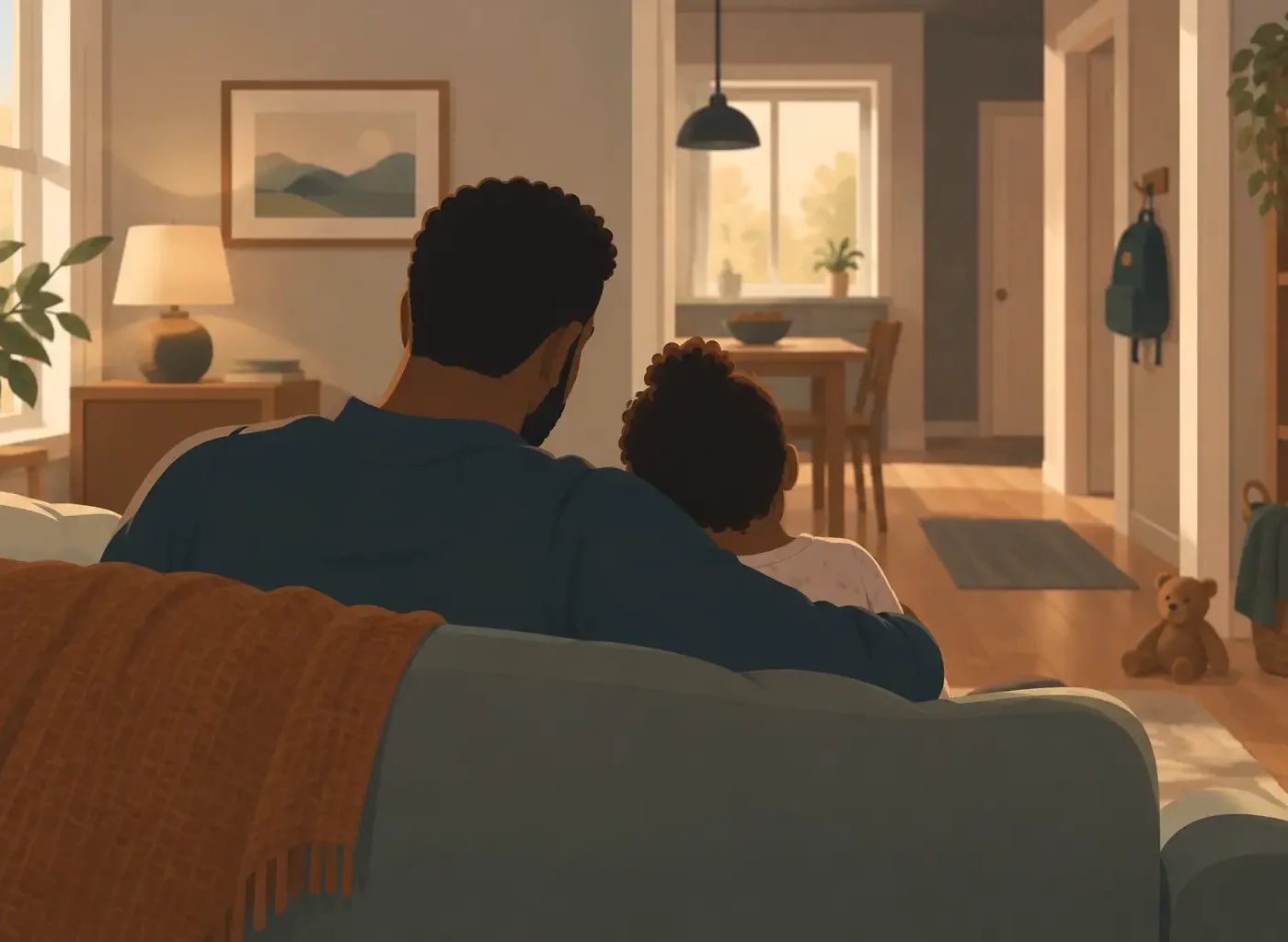
The hard moment may come without warning: your child is crying because you said no, your patience is gone, and suddenly you are trying to parent without a picture of what a good dad does next. Being a dad when you never had one yourself can bring a particular kind of pressure. You may care deeply and still feel as if everyone else got an instruction manual you missed.
You did not miss your chance to become a steady father because you did not have one to copy. You are allowed to build this as you go, in ordinary moments with your child, not through one perfect speech or a flawless childhood.
Table of Contents
Start With One Reliable Way You Show Up
Your child does not need a polished version of fatherhood. They need to learn that you are someone they can count on.
That starts smaller than most dads expect. Pick one part of the day or week that is realistically yours: taking a walk after dinner, handling the drive to practice, reading together on the couch, making Saturday pancakes, or sitting with them while they finish a project.
The activity matters less than the repetition. A child learns safety through the experience of, “Dad said he would be here, and he was.” If work shifts, travel, or shared custody make a fixed time impossible, be clear rather than vague. Say, “I can’t do Tuesday, but Thursday after dinner is ours.” Then follow through.
Do not make the moment a lesson every time. Sometimes your child will talk. Sometimes they will mostly show you a game, complain about something small, or want to sit nearby. Let it be enough. Connection often grows in the spaces where nobody is trying too hard. Harvard’s Center on the Developing Child describes these everyday exchanges as serve and return interactions: when a caring adult responds to a child’s signals, it helps build a strong foundation for their development.
If you have more than one child, a short one-on-one check-in can help each child feel seen. It does not have to be equal down to the minute. It does need to be sincere and predictable enough that nobody has to compete for your attention.
Build a Dad Style From Values, Not Memories
Not having a father to copy does not mean you have nothing to build from.
You may know exactly what you do not want to repeat: disappearing when things get hard, using fear to get cooperation, making love feel conditional, or treating feelings as weakness. That knowledge has value, but it cannot be the whole plan. “I won’t be like him” gives you a boundary. Your child also needs to feel what you will do instead.
Try choosing three words that describe the kind of father you want to be. Maybe they are steady, playful, honest. Maybe they are protective, patient, and accountable. Keep them simple enough to recall when your child is loud, your day has been long, and you are tempted to react on instinct.
Then turn those words into visible behavior. A steady dad says what will happen next and does not make threats he cannot keep. A playful dad notices when a pillow fight or a bad joke can soften a tense afternoon. An honest dad can say, “I got that wrong,” without making the child comfort him.
You do not have to force yourself into a version of fatherhood that feels fake. Some dads are naturally talkative and affectionate. Others connect by fixing bikes, kicking a ball around, cooking, drawing, or listening without many words. Warmth can sound different from house to house. The key is that your child can recognize it.
When You Feel Triggered by Your Child’s Behavior
A child refusing, shouting, or ignoring you can hit a much older nerve. You might feel dismissed, powerless, or suddenly determined to prove that you are in charge. That reaction does not mean you are turning into the parent you feared. It means a stressful moment touched something tender.
The goal is not to feel nothing. The goal is to choose your next move before the old pattern chooses it for you.
Give yourself a short pause when you can. Put both feet on the floor. Lower your voice instead of raising it. Use fewer words. You might say, “I’m getting frustrated. I’m going to take a minute, then we’ll sort this out.” If your child is young, stay close enough that they know you have not withdrawn from them.
Then deal with the actual issue in front of you. If they threw a toy, the toy gets put away for now. If they are arguing over a limit, keep the limit simple. You do not need a dramatic consequence or a long explanation to prove you are the adult. Calm, clear follow-through is often stronger.
There will be times you lose your temper. Most parents do, especially when they are tired or carrying a full day into the evening. Repair matters here. Later, say, “I yelled, and that was not okay. I was frustrated, but I should have handled it differently.” You can still hold the boundary. Apologizing for the way you handled a moment does not erase your authority.
For a dad who grew up without apologies from adults, this can feel unfamiliar. It is also one of the clearest ways to give your child something different.
Let Your Partner See the Dad You Are Becoming
Fatherhood can feel lonely when you are quietly comparing yourself to an absent father, a difficult father, or an idea of what dads are supposed to be. Your partner may not know that a simple family moment carries that much weight for you unless you tell them.
You do not have to carry the fear of getting this wrong by yourself.
Try naming the specific part that feels hard. “When he talks back, I worry I sound like my dad,” is easier for your partner to respond to than, “I’m a terrible father.” It gives both of you something real to work with.
This is not about asking your partner to manage your parenting. It is about being a team. Your partner might notice that you are more patient than you think, or help you agree on a response before a recurring hard moment happens. You can also ask for a practical handoff when you know you are close to your limit.
And notice what your partner carries, too. It may be the school forms, the changing clothes that no longer fit, the birthday gift that needs ordering, or the million tiny details that keep a week moving. Taking ownership of a concrete part of family life is not only helpful. It gives you more chances to know your children in the real texture of their days.
Find Models Without Trying to Copy a Whole Life
You may benefit from seeing good fatherhood up close, especially if you never had that example. Look for small, believable models: a friend who speaks respectfully to his kids, an uncle who makes time for teenagers, a coach who is firm without humiliating anyone, an older neighbor who listens carefully.
Take the useful piece. You do not need to copy how they discipline, joke, work, or run their home. Every family has different pressures, children, and personalities. Borrowing one good habit is enough.
It can also help to create a short personal rule for the moments that matter most. Maybe yours is, “My child will not have to earn my affection,” or, “I will come back after conflict,” or, “I will be honest without being harsh.” Put it somewhere private if that helps. This is not a promise to be perfect. It is a direction to return to.
Being a Dad When You Never Had One Is Built in Repairs
The absence you grew up with may always be part of your story. You do not have to minimize it, forgive it on demand, or pretend it did not shape you. But it does not get to write every next chapter in your home.
A good dad is not the dad who never gets it wrong. He is the dad who keeps coming back with care, clarity, and a willingness to try again.
Tonight, choose one small act your child can feel: sit beside them for ten minutes, ask about the thing they care about, make good on a promise, or apologize for a sharp tone. It may look ordinary from the outside. To a child learning who their dad is, those ordinary moments become the proof.
For the bigger picture, see our guide to parenting as a team.
Frequently Asked Questions About Being a Dad When You Never Had One
Can you be a good dad if you never had a father?
Yes. Plenty of steady, loving fathers grew up without one. What matters most is showing up reliably, staying calm enough to guide your child, and repairing when you get it wrong. Those are skills you can learn at any point, not traits you had to inherit.
How do I stop repeating what my own father did?
Awareness is the first step, but a replacement habit is what changes the pattern. Pick the moment where the old reaction shows up most, then decide ahead of time what you will do instead. A pause, a lower voice, and fewer words already break much of the cycle.
What if I feel like I have no idea what I am doing as a dad?
Picture a father who reads one book with his son every night, even when the day went badly. He does not feel like an expert, yet his child knows exactly where to find him. Feeling unsure is normal. Consistency teaches more than confidence ever could.
At what age does a father’s presence matter most?
Every age, in different ways. Toddlers need warmth and routine, school-age kids need encouragement and fair limits, and teenagers need a dad who stays interested even when they pull back. If you are starting late, it is still worth starting. Children notice a father who keeps trying.
Should I tell my kids I did not have a dad growing up?
Only if it feels right and fits their age. A simple, calm version is enough for younger kids, without heavy details. Older children may appreciate knowing why fatherhood matters so much to you. Keep the focus on what you are building with them, not on old pain.
Final Thoughts
Being a dad when you never had one yourself means building something you were never handed. That is harder, and it also means every steady choice you make is entirely yours.
You will not get every moment right. You will lose your patience, miss a cue, or say something you wish you had not. What your child will remember is that you kept coming back, kept showing up, and kept trying to understand them.
The pattern can end with you. Not through one big promise, but through a thousand small evenings where your child learns what a father feels like.
If you want a clearer picture of what that looks like day to day, How to Be a Better Dad lays out the practical habits that build trust with your kids, written by a mom of two who has watched a good father get made, one ordinary day at a time.