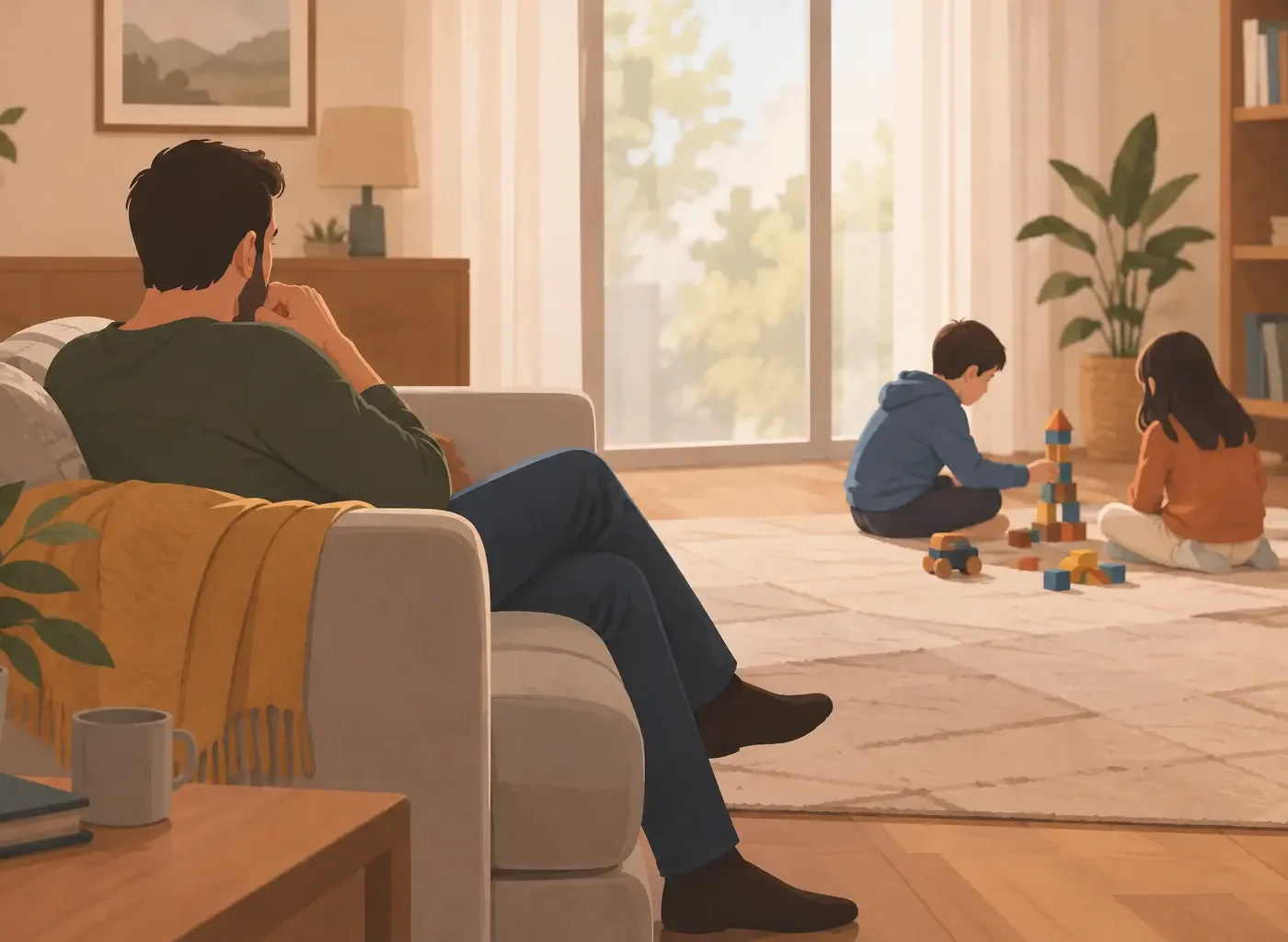
There is a particular kind of guilt that can show up when your child brings you a plastic dinosaur, a tea set, or a pile of blocks, and you feel yourself hoping they will be happy to play alone. When you do not enjoy playing with your kids, it can feel like you are missing a piece of parenthood everyone else seems to love.
You are not missing the love. You may simply not enjoy narrating a doll’s breakfast, repeating the same race-car crash 18 times, or being told exactly what your character is allowed to say. That is a preference, not proof that you are detached from your child.
Table of Contents
When You Do Not Enjoy Playing With Your Kids, Start Smaller
Your child needs moments of real attention, not a parent who performs enthusiasm for hours.
Start by lowering the job description. You do not have to become the full-time player, storyteller, referee, and audience. A short stretch of focused connection often lands better than 45 distracted minutes spent checking the clock.
Try giving the play a clear beginning and end. You might sit on the floor and say, “I can build with you for ten minutes, then I need to make dinner.” Set a timer if that helps. When it goes off, follow through warmly instead of stretching yourself past the point where you become irritated.
The hard part is that your child may want more. They may complain, bargain, or tell you that you never play. You can hold the limit without arguing about whether their disappointment is fair. “You wanted me to keep playing. I know. I’m finished for now, and I’ll be nearby while you keep building.”
Join the part you can tolerate
You do not need to accept every invitation in the form it arrives. If pretend play drains you, choose a role with less pressure. Be the person who sets up the train tracks, finds the missing puzzle piece, holds the fort blanket, or watches the dance show at the end.
Some parents enjoy being near play more than being inside it. You can fold laundry at the table while your child colors beside you, water plants while they make a mud pie, or sit outside while they ride a scooter. Your attention will move in and out, but your child still gets the comfort of having you close. Zero to Three, the early childhood organization, notes that independent play with a parent nearby is an important type of play in its own right, and that parents should not feel guilty about it.
One thing that worked for us was treating certain games as “kid-led, parent nearby.” My child could tell me the plot while I chopped vegetables, but I did not have to become a speaking character in every scene. It made play feel less like a demand and more like shared space.
Choose Connection You Can Actually Sustain
Closeness is built through repetition, not through one perfect kind of play.
A child who hears you laugh with them during a made-up song, helps you wash the car, or gets five calm minutes to tell you about their idea is still being known by you. Play is one route to connection. It is not the only route.
Think about the moments you already find easier. Maybe you like reading aloud, kicking a ball around, cooking pancakes on Saturday, drawing side by side, listening to music in the car, or taking a walk after dinner. Those moments count, especially when your child can expect them to happen again.
It helps to choose something you do not resent before it starts. If you hate crafts, forcing yourself into a glitter project every weekend will probably leave you tense and short-tempered. If you love fixing things, let your child hand you tools while you repair a loose cabinet handle. If you enjoy stories, make room for a chapter book or a made-up tale at lights-out.
Your child may still ask for the activity you do not enjoy. You can say yes sometimes, in a smaller dose, while also making space for the connection that feels natural to you. The goal is not to train your child to accommodate every adult preference. It is to create a family life where being together does not regularly leave you depleted.
Let your child be the expert
Children often want less adult creativity than we assume. They may want an audience, a helper, or someone to notice what they made. Try simple comments rather than taking over: “You worked hard on that ramp.” “Tell me what is happening here.” “You made the dog tiny and the house huge.”
This can be especially useful when your child wants pretend play but you cannot think of what to say. You do not need a clever voice or a complicated storyline. Let your child lead, and respond to the details they offer. A few minutes of genuine interest beats a long session of forced silliness.
Notice What Makes Play Feel So Hard
Disliking play is often a signal about the conditions around it, not a lack of care for your child.
Sometimes the activity itself is the problem. Other times, play is the final request after a day of meetings, commuting, noise, chores, school forms, and decisions. When your child asks you to sit down, your body may hear, “Give away the last bit of yourself.”
That does not mean you should never stretch. Children do benefit from seeing you make room for them. But the answer may be a more realistic time of day, a shorter window, or a different kind of interaction.
If you and your partner are both home, talk about which kinds of play each of you handles more easily. One person may be happy to wrestle on the rug while the other would rather help with a Lego project. This is not scorekeeping. It is using each person’s strengths so your child gets more relaxed adults and fewer resentful ones.
A parent carrying the details of the day may also need a few minutes to change gears before joining a child on the floor. Your partner can help by noticing the transition, rather than assuming the person who walked through the door is immediately available for questions, snacks, and play. Small acts of protection can make connection more possible later.
Avoid Turning Play Into a Test of Love
Your child can be disappointed in your limit and still feel deeply loved by you.
The guilt usually gets louder when you compare yourself to the parent who appears delighted by every game. But you do not see their full day, their private limits, or the ways they may struggle with something that comes easily to you.
Try not to make big promises when you are already worn thin. “We will play all afternoon tomorrow” can sound generous in the moment, then become another obligation you dread. A specific offer is kinder: “After lunch tomorrow, we can play cards for twenty minutes.” Your child knows what to expect, and you have a better chance of showing up with a steady mood.
It also helps to avoid using play as the only repair after a difficult moment. You can reconnect with a glass of water, a hand on their shoulder, a shared joke, a short book, or sitting nearby while they settle into an activity. Repair is about returning to each other. It does not require an elaborate game.
Give Yourself a More Honest Standard
A good parent is not the one who loves every part of childhood, but the one who keeps finding workable ways to show care.
There will be days when you get down on the floor and surprise yourself by enjoying it. There will be other days when you offer a cuddle, set out the blocks, and say, “I’m going to sit here while you play.” Both can be loving responses.
If your child is old enough, invite them to help shape the time you share. Ask them to pick between two things you can genuinely do, such as a board game or a bike ride. Giving a choice works best when both options are real, not when one is offered with a sigh.
If you want the full picture, from discipline to the mental load, read our guide to parenting as a team.
Frequently Asked Questions About Not Enjoying Playing With Your Kids
Is it normal not to enjoy playing with your kids?
Very normal, and far more common than parents admit. Many loving parents find pretend play repetitive or draining. Not enjoying a specific type of play says nothing about how much you love your child. It simply means you may connect better through other activities, like reading, cooking, sports, or walks.
How much should parents play with their kids each day?
There is no set number. Short stretches of full attention, even ten to fifteen minutes a day, often matter more than long, distracted sessions. Consistency is what counts. A daily routine your child can rely on, like a bedtime story or a quick game after dinner, builds closeness over time.
What can I do instead of pretend play?
Choose activities you genuinely enjoy and invite your child in. Board games, building sets, cooking, gardening, drawing side by side, kicking a ball, or reading aloud all build connection. Picture a dad who hates tea parties but loves fixing bikes, with his daughter handing him the tools every Saturday.
Is it okay to let my child play alone?
Yes. Independent play is healthy and helps children build creativity, focus, and confidence. Staying nearby while they play on their own still gives them a sense of security. You do not need to be in every game for your child to feel close to you.
How do I say no to playing without hurting my child’s feelings?
Be warm and specific. “I can’t play right now, but I can after dinner for twenty minutes” gives your child something to look forward to. Then keep the promise. Your child may still be disappointed, and that is okay. A clear limit followed through is kinder than a reluctant yes.
Final Thoughts
When you do not enjoy playing with your kids, you are not failing them. You are simply a parent who needs to find connection in a shape that fits who you actually are.
You do not have to manufacture a personality that enjoys every toy, every game, or every invitation. Let your child see that love can look like attention, honesty, warmth, and a parent who comes back tomorrow ready to try again.
If you are the dad who would rather fix something than play pretend, that is a gift too. Bring your kid into the garage. That is play to them.
How to Be a Better Dad is a practical guide to building real closeness with your kids in ways that fit who you are, written by a mom of two who has narrated more doll breakfasts than she would like to admit.