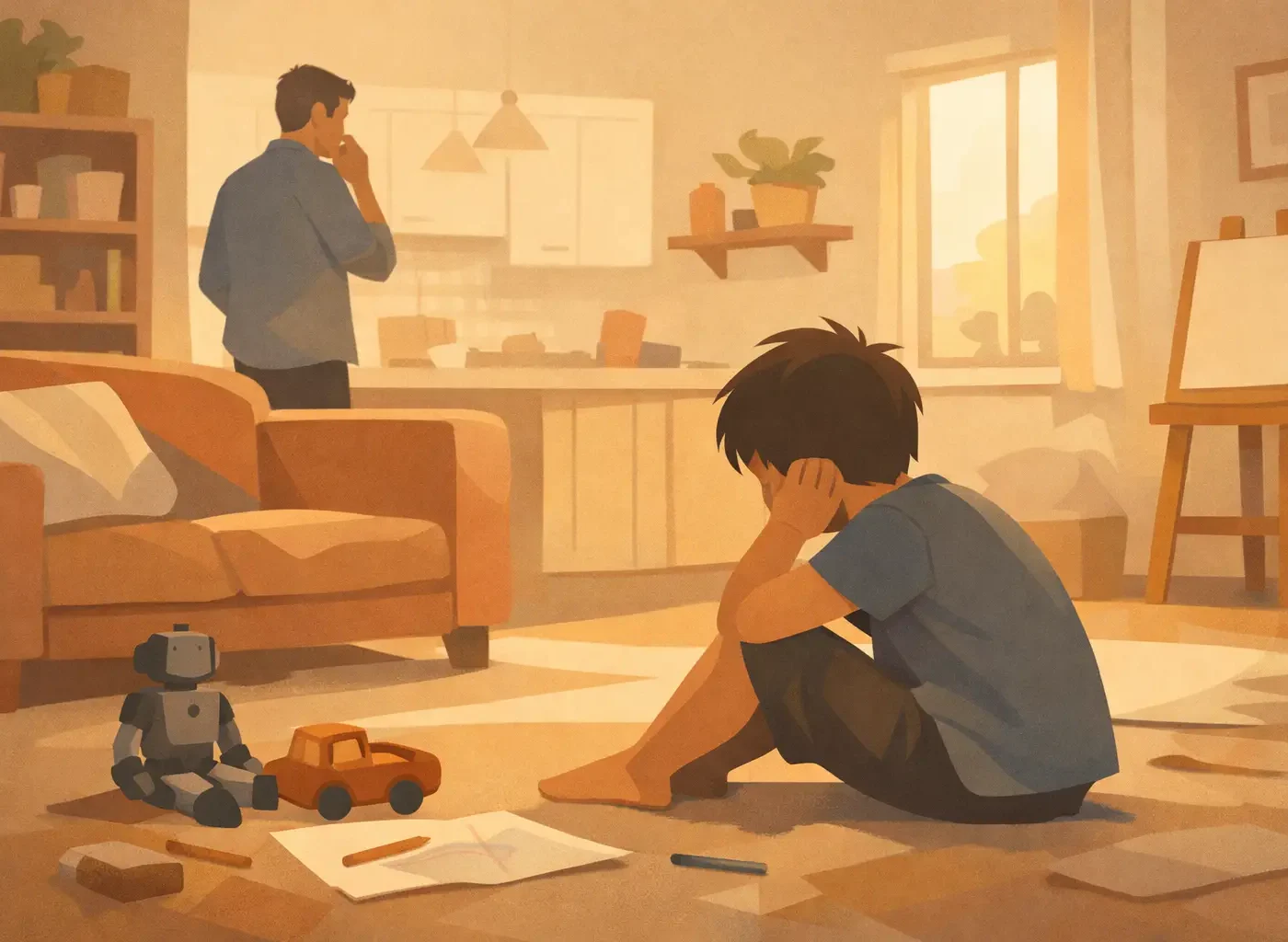
It is 4:47 p.m. You are trying to finish dinner, answer a work message, or sit down for three minutes, and your child appears beside you with the familiar complaint: “I’m bored.” If you have wondered what to do when your child says I’m bored, you are not alone. It can sound like a demand for entertainment when you are already carrying a full evening.
The goal is not to make boredom disappear. It is to respond calmly, offer a small amount of support when it is needed, and leave room for your child to figure out what comes next.
Start with a calm, brief response
Your child’s boredom is a feeling to acknowledge, not an emergency for you to solve.
Try starting with, “I hear you. It is hard when you cannot think of what to do.” Then stop. You do not need to immediately supply five activities, hand over your phone, or turn yourself into a cruise director.
For some children, that small bit of understanding is enough. They wander off, complain for another minute, and eventually begin building, drawing, reading, moving their bodies, or staring out the window. None of that is wasted time.
If your child asks you to choose something, keep your help narrow. You might say, “You can pick something from your art supplies, play outside for a bit, or help me with one part of dinner. Which sounds least boring?” The phrase “least boring” can feel more honest than pretending every option is thrilling.
This works best when your tone stays matter-of-fact. A sharp “Go find something to do” often turns a manageable complaint into a power struggle. A long explanation about how lucky they are to have toys usually does not help either. You can be kind without taking on the job of fixing the feeling.
Give a little structure, then step back
A small choice is often more useful than an open-ended command to entertain yourself.
“Go play” can feel enormous to a child who is tired, in between activities, or used to adults organizing the next thing. Instead, offer a starting point, not a full plan.
For a younger child, you might put out paper and tape, bring a basket of blocks to the floor, or ask them to wash vegetables beside you. For an older child, suggest a bike ride, a chapter of a book, reorganizing a shelf, making a comic, or beginning a project they have already mentioned. Then return to what you were doing.
The stepping back part matters. If you remain nearby asking, “Is that fun? What are you making? Do you need help?” your child may keep handing the responsibility back to you. Give them a few minutes of space before checking in.
One thing that worked for us was calling this a “first five minutes” problem. My child did not have to love an activity forever. They only had to try it for five minutes. Often, the hard part was beginning. If they still disliked it after that, they could choose again.
There will be days when independent play is not realistic. A child who has spent hours in a busy classroom, traveled, or had a disappointing afternoon may need connection before they can settle into anything alone. Ten minutes of cards, kicking a ball outside, or sitting together while they tell you about their day can change the whole tone. Connection is not the same thing as constant entertainment.
Build an “I’m bored” plan before the next complaint
Children get more independent when the next step is visible enough to start.
A simple family boredom list can help, especially during school breaks, weekends, or the long stretch before dinner. Make it together at a neutral time, not while everyone is irritated. Keep it somewhere your child can see it.
The list does not need to be clever. Ordinary choices are usually the ones children actually use: make a fort, draw a map of the house, listen to music, sort a collection, practice a skill, make up a game, water plants, write a note to someone, or help with a real household task.
It helps to include options that use different kinds of energy. Some children need to run, climb, or kick a ball before they can focus. Others want a quiet, hands-busy task. A child who says they are bored may really mean, “I do not know what kind of activity fits me right now.”
Keep supplies reasonably reachable if you can. You do not need a craft room or a cabinet full of new things. A few open-ended materials, books, basic games, cardboard, pencils, tape, and access to outdoor space when available can go a long way. The best option is often the one your child can begin without finding you first.
For children who reject every suggestion, use a gentle limit: “You do not have to choose one of my ideas. You do need to find something safe and respectful to do.” Then let the complaint be theirs to carry for a while. This is harder than it sounds when you are tired, but it prevents the pattern where rejecting ideas becomes a way to keep your attention.
Know when boredom is really a bid for you
Sometimes “I’m bored” means “I want to be near you,” and that deserves a clear answer too.
Your child may ask for an activity at the exact moment you need to make dinner, take a call, or help a sibling. You do not have to pretend you are available. Clear honesty is kinder than saying “in a minute” over and over.
Try, “I cannot play right now. I can sit with you for ten minutes after dinner,” or, “You can keep me company while I fold these clothes, but I am not starting a game.” If you offer time later, follow through when you can. Your child learns that they do not need to chase your attention all evening to get it.
This is also a useful place for partners to work as a team. If one parent walks in from work and the other has been managing the late-afternoon stretch, a simple handoff can make a real difference. “I have the kids for twenty minutes. Go finish what you need to finish” is practical care, not a grand gesture.
On especially demanding days, choose the easier version. Put on music and let everyone help with dinner. Sit on the porch while your child plays nearby. Invite them to do a shared task rather than insisting on a perfect independent activity. The point is not to prove that your child can occupy themselves under every condition.
Let boredom do some of its quiet work
Boredom gives your child practice noticing what they want, instead of waiting for someone else to decide.
Adults often feel pressure to make childhood memorable every hour of the day. That pressure can be especially strong during vacations, rainy weekends, or summer break. But a child does not need a packed schedule to have a good day. They need care, reasonable safety, and enough room to use their own ideas.
They may complain before they get there. They may lie on the floor dramatically. They may insist that every toy is boring. You can allow that without arguing. “You are having a hard time finding something today” is a steady response. Then let time pass.
Over time, you may notice your child becoming better at starting small projects, returning to old interests, or simply tolerating a quiet stretch. That growth rarely looks impressive in the moment. It often begins with a child grumbling in the hallway while you keep making dinner.
You are allowed to protect your own attention, even when your child is bored. A calm response, one small option, and the confidence to step back is enough for today.