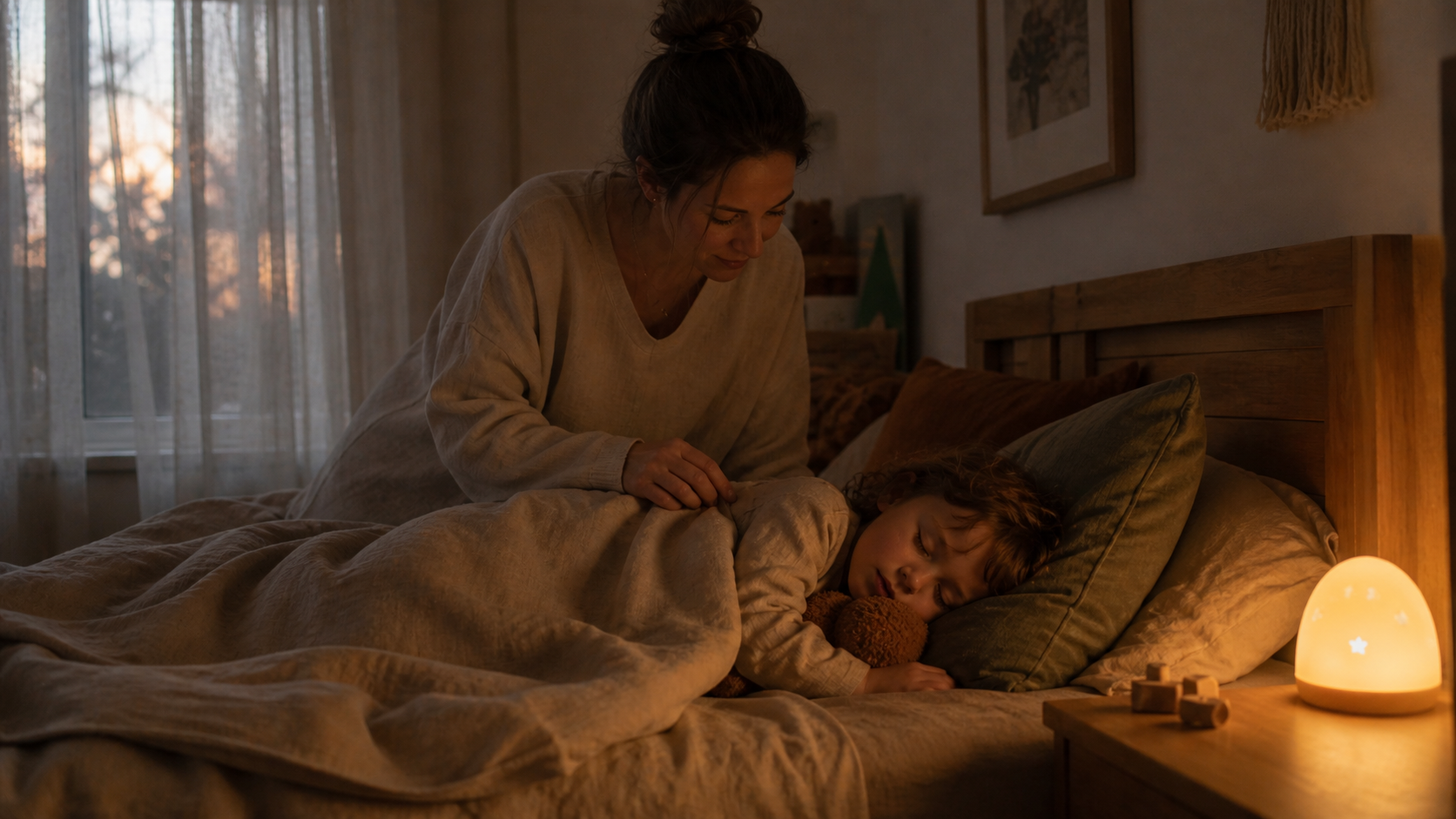
You’ve done the bath, the books, the song. You’ve tiptoed out of the room. And then, somewhere between midnight and 3am, a small voice calls out for you again. If your child can’t yet sleep through the night independently, you already know how bone-tired that cycle feels. The good news is you’re not doing anything wrong, and this doesn’t have to be permanent.
Most of us have been there. We start with whatever gets everyone the most sleep, and then one day we realize the habit we built isn’t working anymore. That doesn’t mean we made a mistake. It just means things need to shift a little. There’s no shame in that.
This article walks through what tends to help kids learn to fall asleep and stay asleep on their own, without harsh methods, without abandoning them to cry it out alone for hours, and without needing to overhaul your whole life overnight.
Table of Contents
Why Some Kids Struggle to Sleep Through the Night
Before anything else, it helps to understand what’s actually going on. Most night wakings aren’t about defiance or manipulation. Kids naturally move through lighter sleep cycles every 90 minutes or so. When they surface between cycles, they reach for whatever helped them fall asleep in the first place.
If that was a breast, a bottle, a back rub, or a parent lying next to them, their brain says: I need that again. It’s not a flaw. It’s just how sleep works. The goal isn’t to eliminate comfort, it’s to help your child build a bridge back to sleep that doesn’t require you to be physically present every single time.
Night wakings in toddlers are extremely common and usually peak between 18 months and 3 years, though plenty of school-age kids still struggle too. If you’re worried something medical might be going on, like sleep apnea, reflux, or sensory issues, it’s always worth mentioning it to your pediatrician.
What Independent Sleep Skills Actually Look Like
Here’s something that reframes things for a lot of parents: the goal of sleep through the night independently isn’t to make your child never need you. It’s to help them feel safe and confident enough to resettle without you needing to physically intervene every time.
Independent sleep skills develop gradually. They look like a child who can fall asleep in their own space at the start of the night, with a familiar and predictable routine, and who can get themselves back to sleep when they surface in the middle of the night without a major intervention.
This doesn’t happen all at once. And it looks different at different ages. A 10-month-old is in a very different place than a 4-year-old or a 9-year-old. What works at one stage won’t always work at another. That’s normal, not failure.
The first and most powerful thing you can do is build a consistent bedtime routine for kids. Not an elaborate two-hour production, but something predictable, something that signals to their nervous system: sleep is coming, and I’m safe. A bath, a couple of books, a song, a quick chat about the day. Same order, same time. That repetition does a lot of the heavy lifting.
Building a Bedtime Routine That Helps Kids Feel Safe
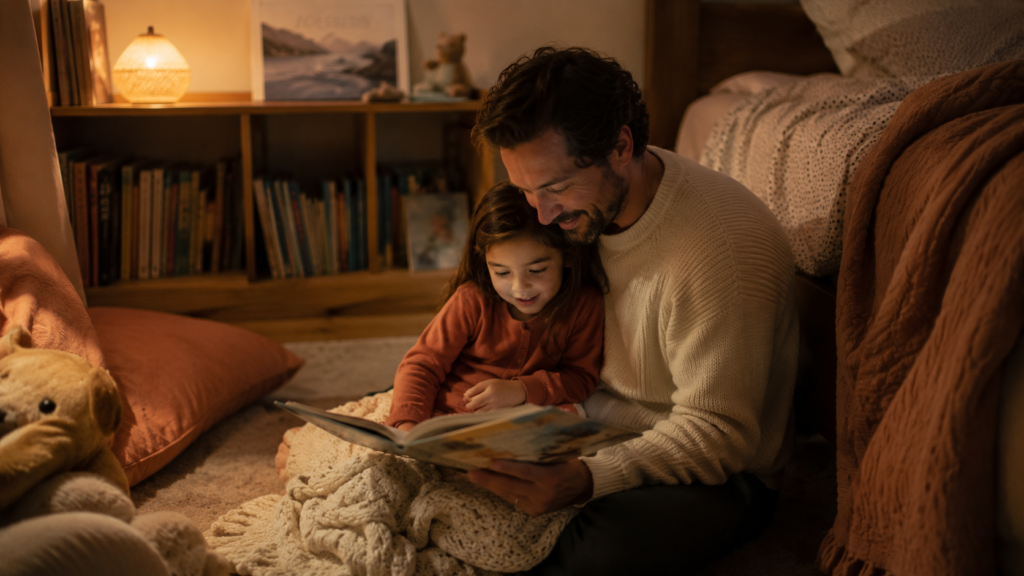
One of the most effective things you can do when a child won’t sleep alone is to make the time leading up to sleep feel predictable. A consistent bedtime routine for kids acts like a signal to the nervous system: this is safe, this is familiar, sleep is coming.
It doesn’t need to be elaborate. A simple sequence of bath, pajamas, one or two books, a short quiet chat, and a goodnight ritual is enough. What matters most is that it happens in the same order, at roughly the same time, most nights.
Predictability is calming at a neurological level. When kids know what comes next, they don’t have to stay alert. That alertness is often what keeps them awake and calling for you.
A few things that tend to help within the routine itself: dim the lights in the hour before bed, reduce screens, and keep your own voice and energy low and calm. Kids co-regulate with us, meaning they borrow our nervous system state. If we’re rushing and tense, they feel it.
If your evenings frequently end in meltdowns before you’ve even reached the bedroom, this guide to helping your child calm down without shame has some practical tools that work well in that pre-bed window.
The Role of the Sleep Environment
The sleep environment matters more than most of us realize. Kids are sensitive to light, sound, and temperature in ways adults often underestimate.
Darkness is one of the most underused tools in the sleep toolkit. Blackout curtains make a real difference for early morning wakers and kids who struggle to fall asleep in summer when it’s still light outside. A room that’s slightly cool, around 65 to 68°F, also tends to support better sleep.
White noise can be a game-changer for some kids, especially if there’s household noise, a sibling nearby, or street sounds filtering in. It’s not a crutch. It’s just a practical tool. If it helps everyone sleep, it’s worth using.
If your child uses a nightlight, low and warm is better than bright and cool. Blue-toned light interferes with melatonin production, even at night. Opt for something amber or red-toned if possible.
For a child who wakes frequently and seems anxious about being alone, a comfort object, a special stuffed animal or a small pillow from your bed, can help bridge that gap. It gives them something familiar to resettle with that doesn’t require you in the room.
Moving Away from Sleep Props Gently
If your child currently needs you present to fall asleep, moving away from that is the part that feels hardest. This is where gentle sleep training approaches can help, not because they’re about leaving your child to cry, but because they give you a gradual, paced way to shift the dynamic.
One approach that tends to work well is the gradual withdrawal method. You start by sitting next to your child’s bed until they fall asleep. Every few nights, you move a little further away, toward the door, then just outside the door, then a short check-in only. It takes a couple of weeks, but it’s a manageable pace for both of you.
The key is responding consistently, not perfectly. If you have a rough night and end up lying down with them, the world won’t end. One night doesn’t undo the work you’ve done. What matters is that you return to the plan the next night with patience and without guilt.
For night wakings toddlers find hard to shake, a technique some families use is the “camping out” approach. Instead of rushing in at the first call, you wait a short interval, maybe two minutes at first, before responding. You go in calmly, offer brief reassurance without picking them up, keep the interaction low-key, and leave again. Over time you increase the interval. This is different from full extinction cry-it-out. You’re still showing up. You’re just doing it on a slightly delayed, lower-key basis.
You know your child best. Some kids need more physical reassurance during this transition. Some kids respond better to fewer interactions. Neither approach is wrong if it’s moving things in a positive direction.
Age-Specific Things Worth Knowing
Sleep challenges genuinely look different depending on your child’s age, and what helps shifts too.
For babies under 12 months, night feeding is still often genuinely needed, especially in the early months. Sleep consolidation typically comes with developmental readiness, not with a particular training method. If you’re exhausted and want to work on overnight stretches, talking it through with your pediatrician first is a good idea.
Toddlers aged 1 to 3 are in the thick of separation anxiety and big developmental leaps. Night wakings in toddlers this age are often tied to what’s happening developmentally, a new sibling, starting daycare, a big emotional shift. Staying consistent with your bedtime routine for kids through these periods makes a real difference, even when it’s not perfect.
For kids aged 3 to 6, fear becomes a bigger factor. Fear of the dark, fear of monsters, fear of being alone. These fears are real to them. Dismissing them tends to backfire. Acknowledging the fear, giving them a sense of agency, a “monster spray” bottle, a special flashlight, a stuffed animal that “keeps them safe” can help more than logic will.
For school-age kids still struggling to sleep through the night independently, it’s often worth looking at screen time, anxiety, or inconsistent sleep timing. A consistent wake time anchors the whole sleep system more powerfully than almost anything else. If anxiety seems to be at the root of it, a conversation with their school counselor or your pediatrician is a worthwhile next step.
Daytime Connection Pays Off at Night
This one surprises a lot of parents. When a child won’t sleep alone, it’s easy to focus entirely on the bedtime moment. But what happens during the day matters too.
Children who feel well-connected to their parents during the day tend to separate more easily at night. It sounds almost too simple, but it’s one of the most consistent things I’ve heard from other parents and experienced myself. When my kids had days where we’d been present and playful together, bedtime was noticeably smoother.
Connection during the day reduces the need to cling at night. Not always, and not immediately. But over time, it shifts the baseline.
This doesn’t mean you need to be constantly available or entertain them all day. Even ten minutes of fully present, phone-down, child-led play can top up a child’s connection tank in a way that lasts. For working parents especially, that deliberate reconnection after the school pickup or workday makes a real difference to bedtime ease. There’s a lot more on that in this piece on how working parents stay connected with their kids.
What to Do When Your Child Comes to Your Room at Night
Even once bedtime is going better, many kids still wake in the night and come to find you. This is its own stage to work through, and it needs a slightly different approach.
The most important thing is to have a clear, calm, and consistent response. Whatever you decide to do, do it the same way every time. Inconsistency is genuinely harder for kids than a firm but kind boundary, because inconsistency keeps them trying.
One thing that tends to help is a “stay in your room” reward system for younger kids, not as a punishment or bribe, but as a positive motivator. A simple sticker chart where your child earns a star for every night they stay in their bed until a set time can work well. Keep the bar low at first so they experience success early.
For older kids, you can have a straightforward conversation in the daytime about what the nighttime plan is. What happens if they wake up scared? What are they allowed to do? Do they have a plan to help themselves feel better? Giving kids a role in problem-solving tends to increase their buy-in.
Some families also find a “hall pass” approach useful: one free trip to the parent’s room per night, no questions asked. Once it’s used, it’s used. It gives the child some control while still containing the behavior.
When You’re Running on Empty
Talking about sleep training and routines is a lot easier when you’ve had some sleep yourself. If you’re deep in the fog of chronic sleep deprivation, practical advice can feel almost insulting. So let’s acknowledge that part first.
You’re doing this on hard mode. Sleep deprivation is genuinely brutal, and it affects your mood, your patience, your relationship with your kids, and your sense of yourself as a parent. That’s not weakness. That’s physiology.
A few things that can make the transition period a little more survivable: take any sleep shift you can get, even 20 minutes during nap time counts. Ask for help from a partner, family member, or friend for even one night a week so you can get a longer stretch. Be honest about what you can manage. A gentle sleep training approach that you can actually stick to is better than a stricter method you abandon after two nights.
And please remember that sleep challenges are one of the most common struggles parents talk about. You are not alone in this, and your child learning to sleep through the night independently is genuinely possible, even if right now it’s hard to see how.
Helping Kids Feel Brave at Bedtime
A big part of helping a child won’t sleep alone situation to shift is building your child’s sense of their own bravery. Not by dismissing their fears, but by acknowledging them and then helping your child find resources inside themselves.
Try language like: “I know it feels a bit scary in the dark. And I also know you’re safe. What’s one thing that might help you feel better?” That shift from you solving it to them solving it, with your support, is huge over time.
Some kids do well with a transitional object: a special stuffed animal that becomes the “sleep buddy,” something that holds the feeling of safety when you’re not there. Others respond to a soft nightlight or a white noise machine. Some older children like having a simple breathing exercise they can use if they wake up and feel anxious.
This connects to a broader goal of helping kids build emotional confidence. The aim isn’t to remove the feeling of fear. It’s to help them learn they can feel it and still be okay. That lesson carries into every part of life.
If you’re also finding your own patience running low after weeks of night wake-ups, I want you to know that’s completely normal. This article on staying patient when you’re burned out is one I come back to myself on the hard weeks.
Final Thoughts
Sleep is one of those things that can make every other part of parenting feel harder or easier depending on how much of it everyone’s getting. If your family is struggling with this right now, the goal isn’t perfection. It’s small, sustainable progress.
Helping your child sleep through the night independently is less about finding the one right method and more about building consistency, adjusting the environment, and giving your child small opportunities to practice settling on their own. It takes time, but most families do get there.
Be patient with your child. Be patient with yourself. And if things don’t shift after a few weeks of consistent effort, it’s always okay to reach out to a pediatric sleep consultant or your pediatrician for more personalized support.
Why won’t my child sleep alone even after years of trying?
Many children have a genuinely higher need for closeness and connection, and that need doesn’t disappear just because time passes. What tends to help is shifting the focus from pushing independence to gradually building your child’s sense of safety at night, which takes consistent small steps rather than a single solution.
How do I get my toddler to sleep alone without crying it out?
A predictable bedtime routine for toddlers is one of the most effective gentle tools available, because it signals to the nervous system that sleep is safe and familiar. Many parents find that slowly increasing the distance between themselves and their child at bedtime, rather than leaving all at once, leads to much calmer nights over time.
What age should a child be able to sleep alone?
There is a wide range of normal, and toddler bedtime anxiety tends to peak around ages three to four before gradually easing for most kids. What tends to matter more than age is whether your child feels secure enough to stay in their room, which is something you can actively support through routine and reassurance.
Why does my child keep coming to my room in the middle of the night?
Children who won’t sleep alone often wake between sleep cycles and seek out a parent because being alone in the dark still feels genuinely unsafe to them, not because they are testing limits. Many parents find that addressing the underlying bedtime anxiety, rather than just the nighttime visits, is what creates lasting change.
How do I help my anxious child sleep in their own bed?
Helping an anxious child sleep alone works best when you focus on building their confidence gradually rather than expecting it to happen all at once. What tends to help most is combining a consistent bedtime routine with small, reassuring steps that let your child experience being okay on their own before moving further away each night.
WANT MORE LIKE THIS?
If this was helpful, you’ll love The Family Life Lab Weekly. It’s a no-fluff newsletter for real parents, covering sleep, routines, gentle parenting, and keeping your household running without burning yourself out. No judgment, no perfect-parent content. Just honest, practical stuff that actually helps.
And if you enjoy practical parenting ideas like these, feel free to follow me on X, where I regularly share simple tips on raising confident kids, creating a peaceful home, and supporting your children’s emotional growth.